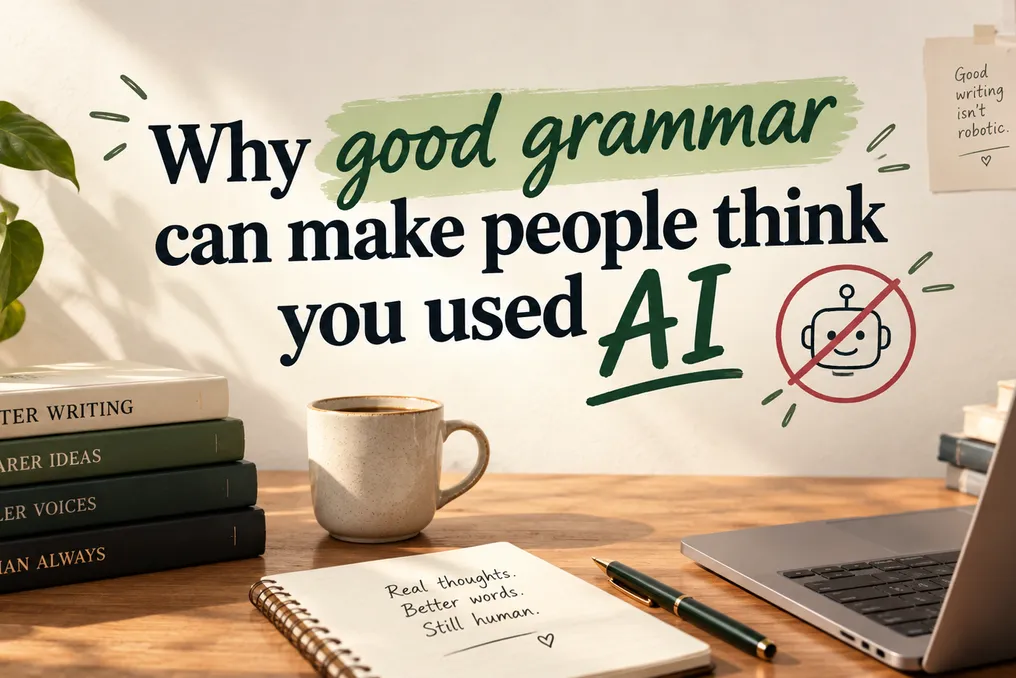
Not long ago, impeccable grammar was considered a sign of education, professionalism, and attention to detail. People were encouraged to proofread their work, expand their vocabulary, and communicate clearly.
However, today some authors are facing an unexpected problem: their polished writing is being mistakenly perceived as content generated by artificial intelligence.
As tools like ChatGPT, Gemini, and Claude become more widespread, readers are increasingly encountering texts characterized by grammatical correctness, structure, and ease of comprehension. This has caused a surprising shift in perception: sometimes overly polished text leads people to doubt the involvement of artificial intelligence.
Modern AI tools are capable of creating clean, well-structured text with consistent grammar and smooth narrative flow. Because people encounter so much of this text, they begin to associate these qualities with AI output.
At the same time, everyday human communication is often less perfect. People make typos, omit punctuation, use abbreviations, or leave thoughts unfinished, especially in messages and social media posts. This sets an expectation that certain imperfections should be present in human writing.
Consequently, highly polished text can sometimes raise suspicion, even if it was written by a human. Good grammar might simply reflect careful editing, drafting, and practice.
The growing use of AI detection tools has also contributed to this trend. Schools, workplaces, and publishers are increasingly interested in identifying AI-generated content. As discussions about AI detection become more frequent, people have become more cautious when evaluating written work.
The problem is that AI detectors are not always accurate. Human-written content can sometimes be flagged as AI-generated, while AI-created text can occasionally go undetected. This has forced some authors to question works they created entirely on their own.
For decades, literature teachers encouraged students to develop habits such as:
Paradoxically, these are the same characteristics that many AI tools are programmed to reproduce. Since AI systems are trained on vast collections of human-written texts, they often replicate traits traditionally associated with effective writing. This overlap makes it difficult for readers to distinguish between skillful human writing and AI-generated text.
As AI-generated content becomes more prevalent, some readers are starting to look beyond grammar when determining if something feels human.
Personal experience, original observations, emotional nuance, and unique perspectives are often seen as stronger indicators of authenticity than sentence structure itself. A grammatically perfect article can still feel generic, whereas a piece with a distinctive voice can feel undeniably human. This shift has changed how many people approach writing evaluation in the age of AI.
The idea that good grammar could give the impression of AI usage would have seemed unusual just a few years ago. However, as artificial intelligence becomes a more significant part of daily communication, perceptions of writing are transforming. Strong grammar remains a valuable skill, but it is no longer the only aspect readers focus on. Authenticity, originality, and personal viewpoint are increasingly helping writing stand out from AI-generated content, making the human voice the most important differentiator.