In the context of a busy schedule, the problem of finding time for regular exercise often arises. However, as one reaches the age of fifty and older, the body begins to react to a lack of movement. Physiotherapist Theresa Liu-Ambrose, Director of the Laboratory of Aging Health, Mobility, and Cognitive Functions at the University of British Columbia, notes that subtle changes occur in the body's systems responsible for mobility with age, including a decrease in muscle mass and strength, as well as deterioration in balance and proprioception—the body's ability to sense its position in space.
Movements that once seemed automatic can become difficult over time, and a lack of mobility—the ability of joints to move through a comfortable range—can hinder the maintenance of independence. Nevertheless, this does not mean that poor mobility is inevitable with age, according to Annalisa Na, Director of the Laboratory of Functional Aging and Mobility Research at Drexel University. The best way to maintain mobility is to regularly train it with exercises that mimic daily activities.
Liu-Ambrose and Na advise incorporating five exercises into the daily routine to improve mobility, maintain balance, and enhance proprioception. Before starting, it is recommended to have a friend nearby, especially if there are already balance issues. If there are doubts about the correct execution, one should consult a healthcare provider for a referral to a physiotherapist.
Exercises for strengthening leg muscles
Sit-to-stand type exercises help strengthen the quadriceps, hamstrings, and gluteal muscles. According to Liu-Ambrose, many older adults have difficulty getting up from a chair without using armrests. Including this exercise in the daily routine helps preserve this functional ability. It strengthens the quadriceps, hamstrings, and gluteal muscles, and also trains the mobility of several joints, including the hips, knees, and ankles.
How to perform:
Standing with feet flat facing a sturdy chair, lean forward at the hip joints to begin a squat-like movement. Lower yourself until your buttocks touch the seat. Then, push up straight by evenly pressing through your heels. This is one repetition; 10 repetitions are recommended. It is important to perform the movement slowly and control the descent: 'Imagine an egg on the chair,' advises Liu-Ambrose. 'You want to sit down, but you don't want to crush it.' Annalisa Na suggests making the exercise easier by choosing a higher chair or more difficult by choosing a lower one.
Dynamic chest stretching against a wall
Chest muscles help us push objects (such as a heavy door or furniture) and rotate our arms while washing the opposite arm in the shower. Liu-Ambrose notes that prolonged periods in a bent posture while looking at a phone, laptop, or tablet can cause the chest muscles to become 'quite tight.' This dynamic stretch helps relax tense chest muscles and promotes improved posture, which is critically important with age, as a hunched posture can make standing less stable and increase the risk of falls.
How to perform:
Stand facing a wall with your back against it, leaning your buttocks, back, and shoulders against the wall. Take a step forward with your feet a few inches and slightly bend your knees. Extending your arms in a gate shape, try to touch the backs of your forearms to the wall. Then raise your arms straight up, and after that, lower them back into the 'gate' position. This is one repetition; aim for 10. If the chest muscles are too tight for your arms to reach the wall, keep them a few inches in front of the wall.
Calf raises
The primary function of the calf muscles is to propel the body forward, helping to accelerate and decelerate. As we age, these muscles can weaken, leading to reduced stride power when walking or running, says Liu-Ambrose. Weakness in this area can also cause a shorter, shuffling gait, which makes maintaining balance difficult when losing support. Annalisa Na emphasizes that this 'removes a layer of protection that prevents you from falling.' Calf raises are one of the best exercises for healthy aging, effectively strengthening these muscles.
How to perform:
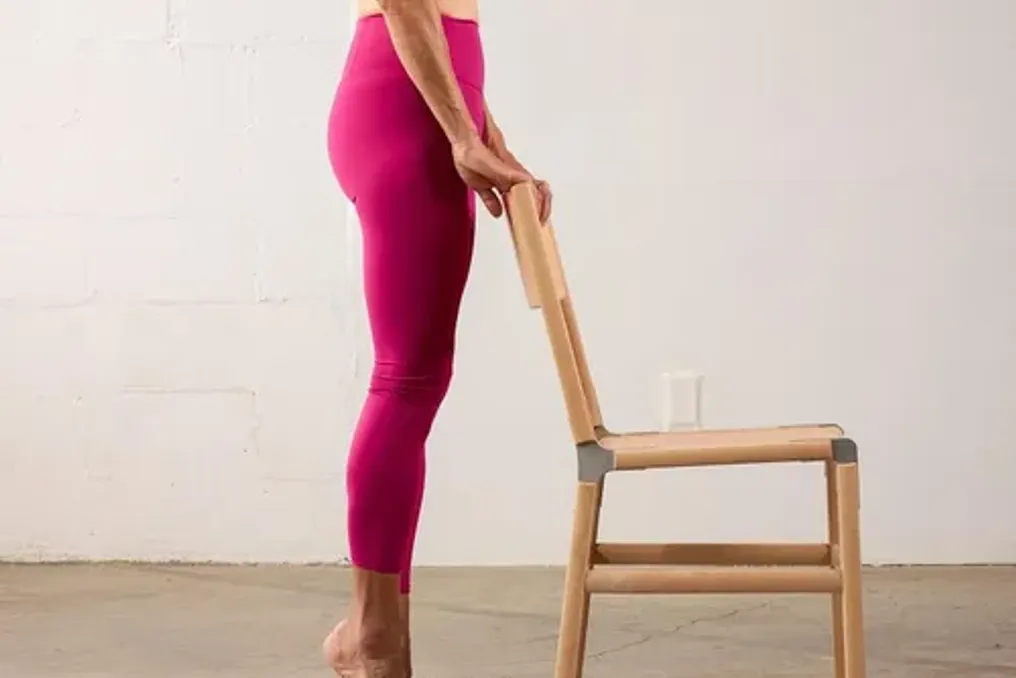
Stand a foot-width apart in front of a chair, counter, table, or wall and gently place your fingers on the surface for balance. Then, press down with the balls of your feet, raising your heels as high off the floor as possible before slowly lowering them back down. This is one repetition; aim for 10. If this seems easy, you can add a strength training element by raising your heels as quickly as possible and then slowly lowering them. For an additional balance challenge, you can perform single-leg calf raises. By narrowing the base of support, this stimulates the ankle muscles to make quick, small adjustments to maintain stability.
Tandem stance/walking
When young people lose their balance, the muscles around the ankle react automatically. However, with age, this happens less frequently due to decreased proprioception, as well as changes in ankle strength and stiffness. While calf raises help strengthen the muscles around the ankle joint, simple tandem stance or walking, where the feet are lined up heel-to-toe, also improves proprioception. Narrowing the base of support prompts the ankle muscles to make quick, minor movements for stabilization.
How to perform:
Stand so that one foot is directly in front of the other, the heel of the front foot touching the toes of the back foot. Try to hold this position while performing a task, such as washing dishes or brushing teeth. If this position causes excessive instability, do it in front of a counter, table, or another surface you can carefully hold onto. If this stance seems easy, try tandem walking, which will further refine balance. It is necessary to walk very consciously, maintaining the heel-to-toe sequence, and not to rush.
Standing hip abduction
Hip abductors—a small group of muscles located on the outer side of each thigh that allows the leg to move away from the midline of the body—are often weak in many people. Since these muscles play a huge role in stabilizing the body during single-leg actions (walking, running, or climbing stairs), their weakness can disrupt balance. The 'standing hip abduction' exercise helps strengthen these small but powerful muscles at home.
How to perform:
Stand hip-width apart next to a sturdy chair or counter, lightly holding onto it with one hand for balance. Keeping your torso upright, lift one leg out to the side as far as is comfortable, feeling the muscles of the outer thigh and glutes working, and then slowly lower it. This is one repetition; aim for 10, then repeat on the other side. Liu-Ambrose emphasizes: 'The main thing is that your toes always point forward, not sideways.' This targets the correct muscles.
By adding a few simple movements to your day, you can prepare for successful mobility in old age. Liu-Ambrose compares this to retirement planning: 'The advice has always been to start early and invest a little over many years so that you can retire quite comfortably.' She adds that daily care for the body leads to accumulated benefits, allowing functions to be maintained for a long time.
3.