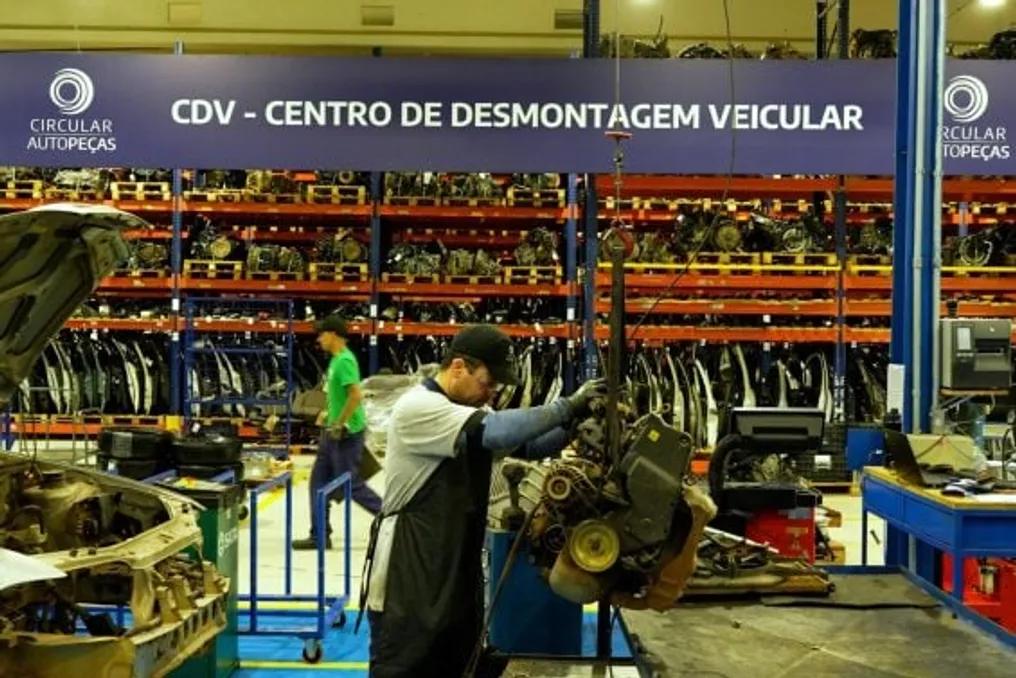
The Vehicle Dismantling Center (CDV), operated by Circular AutoPeças under the management of Stellantis in Osasco (SP), reached its first anniversary of operation, having dismantled a total of 1,150 vehicles. This volume corresponds to approximately 14% of the unit's total capacity, which was planned to process up to 8,000 automobiles annually.
Unlike traditional scrapyards, which compact the entire car as scrap, the CDV dismantles vehicles component by component at the end of their useful life. Each part is cataloged with an invoice and subsequently resold if it still meets usability conditions. This structure is pioneering in this type, maintained directly by a manufacturer in South America.
The activity follows the guidelines of Law 12.977/2014, known as the Dismantling Law. This legislation requires companies in the sector to register with the state's Detran, issue an entry invoice for each vehicle, and cancel the vehicle's registration. The law was created to combat illegal dismantling operations that supplied stolen parts to the market.
Of the 1,150 dismantled cars, over 20,000 parts were recovered for sale, with more than 11,000 of them already sold. Additionally, during the same period, about 862 tons of materials and nearly 14,000 liters of automotive fluids were disposed of properly, including over 4,600 liters of oil and approximately 1,830 liters of coolant.
According to Stellantis, reusing components, as opposed to manufacturing new parts, results in a reduction of up to 80% in raw material consumption and decreases CO2 emissions by up to 50%. For the end consumer, the benefit is financial, as used parts with documented proof generally cost less than new ones, especially for older models whose original parts have been discontinued.
The CDV is part of the circular economy strategy implemented by Stellantis in South America since 2023, structured around the four pillars known as 4Rs: remanufacturing, repair, reuse, and recycling. Through the Circular AutoPeças brand, the after-sales catalog already offers over 500 items, covering remanufactured, repaired, and reused parts.
Another important initiative takes place in Betim (MG), where the Vehicle Reconditioning Center has reconditioned over 500 cars in just over three years. Furthermore, there is the Motul NGEN Circular AutoPeças lubricant line, developed in partnership with Motul and Lwart, which uses used oil collected during the operation itself.
The company's next plans involve increasing the availability of reused parts and expanding sales channels. However, component reuse is not unanimous in the sector. During a hearing in the Chamber of Deputies, Sindipeças, the representative of auto parts manufacturers, spoke out against the reuse of parts from obsolete vehicles, citing risks to both safety and the environment. On the other hand, recycling entities, such as Abcar, defend this practice as a viable environmental and economic option.