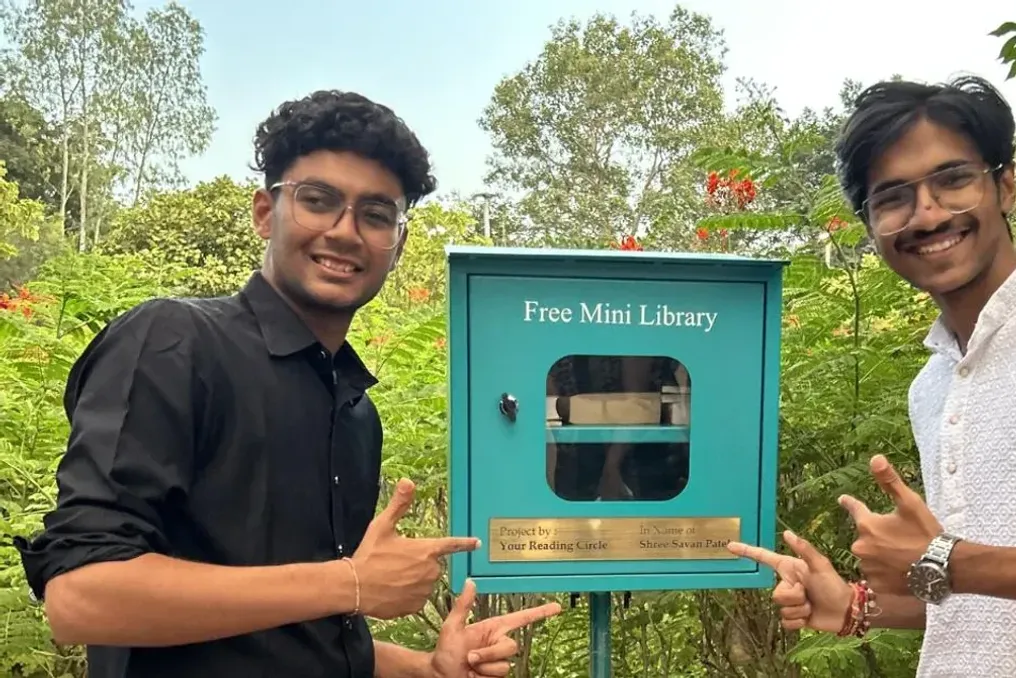
In Parimal Garden park in Ahmedabad, people gather every evening for various reasons: some take long walks after work, children play cricket with bats, and elderly residents relax under old trees. Amidst this hustle and bustle stands a small wooden cabinet filled with books that attracts the attention of city dwellers.
Children take comics, elderly men carefully leaf through novels, and students spend about twenty minutes reading, leaving with a paper book tucked under their arm. These shelves are not supervised; there are no membership cards, fines, or formal procedures—the library operates purely on trust.
The idea originated with friends from Ahmedabad, Hit Doshi and Om Thakkar, when they were still in college. Through their reading community, 'Your Reading Circle,' the pair began setting up free mini-libraries in public parks to make books more accessible.
What started with one library in Parimal Garden in June 2024 has now expanded to 13 libraries in Ahmedabad and Vadodara, with three more planned to open soon. In March 2026, they registered an NGO called 'Virakt Foundation' for the further development of this initiative.
For Hit, the journey began with a simple observation. He noted: 'We realized that many people love to read, but there are very few places where readers could meet and share this interest.' The duo founded 'Your Reading Circle' in Ahmedabad in September 2023, uniting book lovers who lacked spaces to discuss outside of social media or academic settings. Initially, the founders had no grand plans—they simply wanted to create a culture of reading around themselves.
Later, they saw a video on social media about Perumkulam in Kerala, where libraries are located every few hundred meters. Hit told The Better India: 'This idea stayed with us for a long time. We constantly wondered why, if something similar could be created in one village in India, we couldn't try to do it in Ahmedabad?'
A Small Bookshelf and Weeks of Approvals
In April 2024, the friends began discussing how to organize a small public library in the city park. They compiled a basic list of necessary items: permits, funding, construction, and the books themselves. However, they did not expect how complicated the permitting process would be.
Hit explained: 'The biggest problem was figuring out where to even go, because no one had done anything like this before, so we had to visit many departments to find out who could give us permission.' The team spent weeks moving from one office to another. Some officials directed them elsewhere, while others were unsure which department had the authority to approve a library in a public garden.
'It sounds like a very minor thing when you talk about placing a library in a park,' he added. 'But in practice, it requires enormous patience.'
Ultimately, after several follow-ups and discussions, the team was granted permission to install the first mini-library in Parimal Garden, one of Ahmedabad's busiest public spots. The first library officially opened to the public on June 23, 2024.
Initially, the founders viewed it as an experiment, not a large project. A co-founder noted: 'We just wanted to set up one library and see how people reacted to it.'
The reaction came almost immediately. Children started gathering around the shelves after playing. Elderly residents stopped to browse books during evening walks. Some visitors took books and returned them a few days later, bringing a different book from home. The system worked on a simple principle: anyone could take a book if they contributed one in return.
'The public mini-library runs entirely on trust,' he explains. 'People take a book, people leave a book. That's how we started, and that's how it works.'
The founders were prepared for the books to disappear or the shelves to remain empty after a few weeks. Instead, they witnessed completely strangers voluntarily maintaining the libraries. 'There were people we didn't even know who started tidying the shelves or arranging the books correctly,' he adds. 'Some of them told us they regularly visited the library just to maintain it.'
These moments convinced the team that the idea could exist outside of their direct involvement.
Why Parks Became the Chosen Location
As the libraries began attracting online attention, many asked why the founders chose parks and gardens instead of railway stations or bus stops. For Hit, the answer was always related to the atmosphere of these places.
'A park is a place where people naturally slow down, spend time with family, sit in silence, and relax, so we felt that reading would fit naturally into this environment,' he says.
The founders also noticed that many visitors spent long periods scrolling through feeds on their phones while sitting outside. 'We wanted to create another option,' he explains. 'If someone spends even ten minutes reading instead of sitting on their phone, that itself matters.'
Today, the team has installed 11 libraries in Ahmedabad and two in Vadodara. Two more are being prepared in Vadodara, and one in Ahmedabad.
One particularly memorable moment occurred shortly after the opening of the library in Kamati Bagh in Vadodara. For two days, almost all the books disappeared from the shelves. 'We were honestly disappointed because the shelves were empty after two days, and we thought people had taken the books, and probably the library wouldn't work here,' he admits.
A week later, a local social media page highlighted the library. Residents began discussing it online and promised to donate books. Soon, one of the team's volunteers visited the location and sent them a photo. The shelves were full again. 'We didn't add any books ourselves,' he says. 'The residents of Vadodara refilled the library.'
What Is Required to Open a Public Library in Your City
Over the past year, Hit and Om have received messages from people across India asking how they can create similar public libraries in their cities. Having gone through this process themselves, the founders are now openly sharing the steps they believe are most important.
'1. Start with permits first. According to Hit, the first step is to approach the municipal corporation and the city's gardening department directly. He advises: 'Don't start by building the structure because permits take the longest, so the first thing people should focus on is getting approval from the authorities.'
He recommends preparing a simple proposal that clearly outlines the idea. The document should include the size of the library, its location, whether it will be open or locked, how it will be maintained, and who will manage it. 'They mainly need to understand if you can responsibly maintain the library,' he adds. He also believes that approaching senior officials directly can significantly speed up the process. 'If the message reaches the highest authorities, the process becomes smoother.'
'2. Start with people who already love books. Long before installing the first library, the duo had already created a reading community through 'Your Reading Circle.' This network helped them find books and early supporters. 'There are already readers in every city; you just need to bring them together and create spaces where they can interact with books and each other.'
The first library was partially funded by the team, and partially by a retired director and professor named Indira Nityanandam, who became one of the earliest supporters of the initiative. 'She constantly told us to focus on the permits, and everything else would sort itself out,' he recalls. He notes that their experience showed that people are often willing to support the idea as soon as they understand what the team is trying to do.
'3. Invite public figures to build trust. The founders also realized that involving respected public figures during openings helps libraries gain visibility and community trust. 'Even a small library can have a big impact,' says the co-founder. 'If people see that respected personalities support it, they take the initiative seriously.'
The team collaborated with radio hosts, local content creators, and community leaders to raise awareness about the libraries and encourage participation.
'4. Don't wait until everything is perfect. One lesson the co-founder particularly emphasizes is the importance of starting. 'We got the idea in April 2024 and started working on it shortly after,' he says. 'If your intention is sincere, and you act consistently, things slowly start to happen.'
This approach now shapes how they advise others who want to replicate the model.
'Our Readers Support Us'
Although the initiative continues to grow, the most significant aspects for the founders remain the personal stories associated with the libraries. One such story came from a supporter named Part Jala, who decided to sponsor a library in memory of his grandmother. Hit explains: 'His grandmother couldn't read, but she loved listening to him talk about books, so after her passing, he decided to open a library in her honor so that many others could experience the joy of reading.'
For the founders, Part's gesture demonstrated how a library can transfer personal memory into a public space. Another instance occurred when elderly residents started calling the team directly to thank them for reviving their habit of reading. 'There were uncles in their seventies and eighties who told us they had started reading again after many years,' he continues. 'Some even brought books from their personal collections and donated them.'
The founders also noticed that women in some parks regularly gather around the libraries to read together and informally discuss books. These interactions showed them that the libraries were becoming places where people could read and talk about books together.
Now they want this idea to spread beyond city parks.
Mini-libraries remain central to their work, but the duo is now extending this idea to rural India. The foundation has already opened its first village library in Berunda near Modasa in Gujarat. The gram panchayat building houses about 200 books, along with a tracking system allowing residents to borrow books for 14 days.
The co-founder notes: 'For a person who has never left their village, books can be a way to see the world.'
The team is currently transforming the ground floor of the gram panchayat building in the village of Sudamda in Surendranagar district into a full-fledged public library where residents can sit and read. Unlike the mini-libraries in parks, this space will function as a real reading center with seating areas, shelves, and a more extensive collection of books.
Ultimately, the founders hope to build similar libraries in villages across Gujarat before expanding to other parts of India, including border areas and underserved communities.
For Hit, the attempt to realize the idea they once saw in a social media video also changed their perception of what is possible. 'This initiative changed us psychologically because it made us believe that if your intention is pure, and you continue to act consistently, almost anything is possible.'
Currently, the idea continues to rely on the same thing that allowed the first cabinet in Parimal Garden to work: strangers taking care of a shared bookshelf.