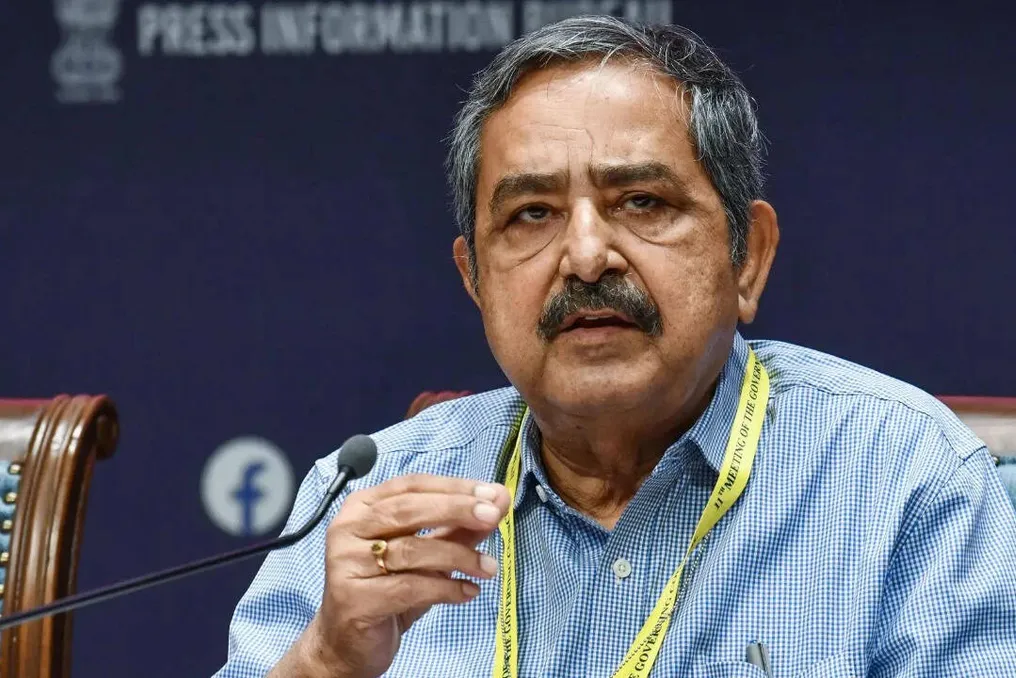
NITI Aayog Vice-Chairman Ashok Kumar Lahiri defended the Central Government's decision to introduce a Merchant Discount Rate (MDR) for high-value UPI transactions on Wednesday. He emphasized that enterprises must find ways to ensure their self-sufficiency instead of relying on government subsidies.
Referencing the ancient Indian teacher and philosopher Chanakya, Lahiri noted that the ruler should collect taxes from citizens much like a bee collects honey from a flower—'gently, gradually, and without causing pain or damaging the petals.'
Lahiri told reporters at the event that his remarks reflected his personal opinion, not the official stance of NITI Aayog. These comments came a day after the government announced the introduction of a 0.4 percent MDR for UPI payments exceeding 2000 rupees made to sellers starting October 15. Transactions between individuals and small payments to sellers will remain outside this rate.
He attempted to illustrate the scale of the proposed levy, stating that the impact on individual operations would be limited. Lahiri provided an example: 'Look at the numbers, this is for 100 rupees. You pay 40 paise for a transaction worth 100 rupees. Even on large transactions... Will this kill you? No, but you need to run your business based on self-reliance.'
Furthermore, he compared the proposed charge to other banking services, noting that users would get used to it. For instance, a small fee is charged for receiving cheque books from banks, which is part of doing business.
This move has drawn opposition from traders, shop owners, and political parties. Critics have labeled the proposed levy as the 'Modi Tax.' Congress leader and Lok Sabha opposition leader Rahul Gandhi accused Prime Minister Narendra Modi of being subservient to US pressure regarding this change on Wednesday.
In a video message posted on X, Gandhi stated: 'Modi ji has a completely different concept. He is neither left nor right; he decided to lie down straight and bow before Donald Trump.' He added: 'He has imposed a tax on every Indian by taxing UPI and handed over a huge sum of money to the United States. Modi ji, please stop bowing before the United States. Have some backbone, stand up, and return the UPI tax.'
Congress claimed that the government reacted to the US demand to end the zero MDR regime. The party also mocked Modi, saying he had 'redefined NOTA—Narendra's Continuing Tranquility before Trump.' The Ministry of Finance previously rejected accusations of external influence, stating that India's decisions on UPI policy are made independently. In an X post, the ministry stated: 'Some assertions suggest that the change is related to foreign influence. This is false. India's decisions on UPI policy are made independently, with the clear objective of building a self-reliant, inclusive, and accessible digital payment ecosystem.'
Government sources told news agency PTI that the MDR decision was taken in the greater interest of the UPI ecosystem and to strengthen its security and protection, and it cannot be reversed. One senior official told PTI: 'The question of reversal does not arise once a decision is made.'
The proposed 0.4 percent MDR will be paid by sellers and is capped at 300 rupees for transactions of 75,000 rupees or more. The government has ruled out reconsideration, as a senior official told PTI: 'There is no question of review.'