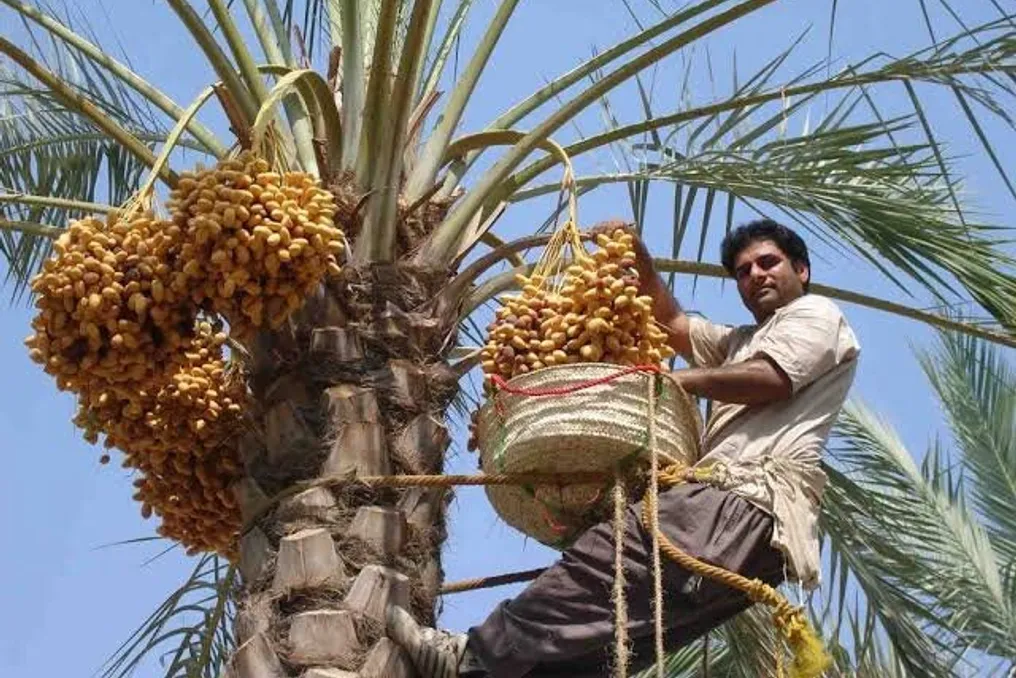
According to a statement, the head of the Center for Mechanization and Agricultural Industries Development of the Ministry of Agriculture announced that over 1.9 million tons of dates were produced in the country. He noted that Iran holds one of the top four positions globally in the production of this product.
Date production in Iran exceeded 1.9 million tons
During the National Date Day, as reported by Karim Zolfahari in an Iranian report on Wednesday, it was emphasized that the future of Iran's date industry depends on transitioning from simple raw material sales to developing the entire production chain. He added that processing and related industries can serve as a link between producers and domestic and international markets.
The head of the Center for Mechanization and Agricultural Industries Development of the Ministry of Agriculture defined dates as a strategic export commodity of the agricultural sector. He stressed that to strengthen Iran's position in target markets, it is necessary to improve quality, ensure proper packaging, standardization, and create products that meet the tastes and needs of these markets.
Zolfahari emphasized that dates, besides their high nutritional value, possess significant potential for earning foreign currency, creating jobs, and developing the food industry. He noted that shifting towards processing and producing diverse products can significantly increase the economic value of this product.
Addressing the opportunities for processing enterprises in the country, Jahid, the Head of the Center for Mechanization and Agricultural Industries Development of the Ministry of Agriculture, stated that the Ministry of Agriculture under Jahid has currently issued operating licenses to 654 processing and related units, with a nominal capacity exceeding 820 thousand tons.
He provided examples of products that can be derived from dates, such as date paste and syrup, liquid sugar, chocolate, and composite goods, compote, lavashak, vinegar, and alcohol, demonstrating that dates are not just raw material but the basis for a wide range of industries.
Zolfahari highlighted several priority areas, including the development and completion of export infrastructure, support for startups and knowledge-based companies, the creation of specialized cities and export terminals in production centers, as well as the restoration and modernization of worn-out processing facilities.
He concluded that dates can transform from a traditional agricultural product into the foundation for the development of the food, pharmaceutical, and new product sectors. Investments in processing, technology, and market promotion, while increasing the income of palm farmers, contribute to creating sustainable employment and strengthening Iran's position in global date trade.
Iran is one of the world leaders in date production, and stable export growth underscores the importance of this product in the country's non-resource economy. Iran is famous for its diversity of date varieties, with the main production concentrated in the provinces of Kerman, Sistan and Baluchestan, Hormozgan, Khuzestan, Bushehr, and Fars.
Domestically, about 70 percent of the harvest is consumed by Iranians themselves, with demand significantly increasing during the holy month of Ramadan. The remaining 30 percent, or approximately 350 thousand tons, is exported annually, generating about 400 million dollars in revenue.
Key international markets for Iranian dates include India, Iraq, Pakistan, Turkey, Russia, as well as East Asian and European Union countries. To increase the sector's value and reduce post-harvest losses, which have historically been estimated at 30 percent, attention is growing on processing dates into value-added products such as syrup, paste, and chocolate, both for domestic and foreign markets.