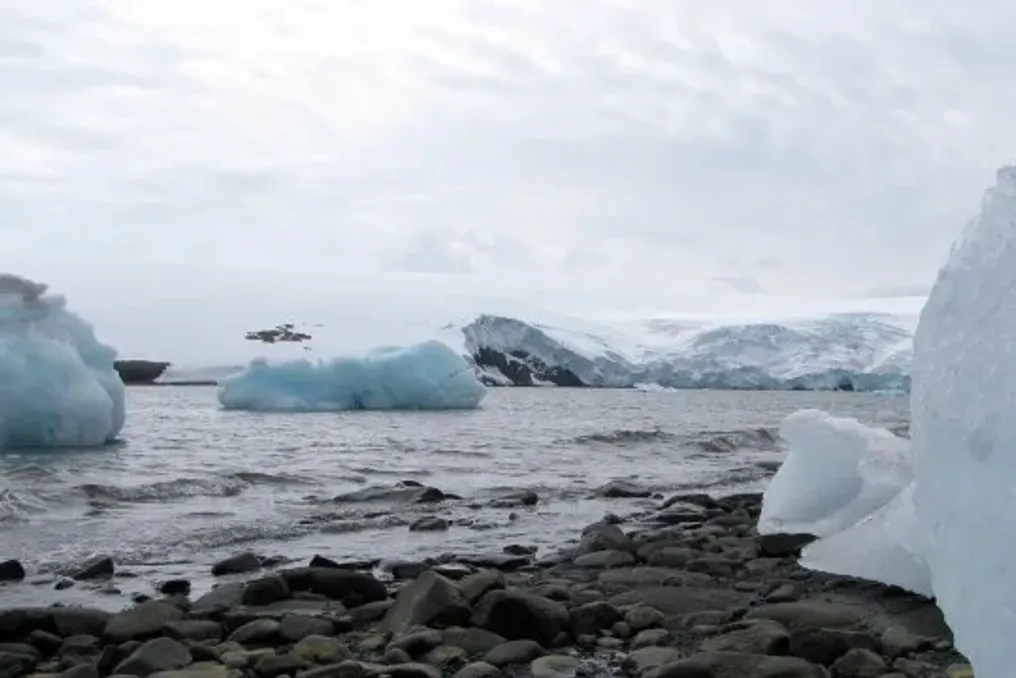
Global warming is accelerating the melting of the planet's two largest ice masses, with most of this melt not caused by rising air temperatures, but rather by the increase in water temperature reaching the ice layers as glaciers advance into the oceans.
Eric Rignot, an ice specialist from the University of California and co-author of the study, warned that the rapid melting of polar ice sheets and the consequent rise in global sea levels will intensify the vulnerability of coastal areas.
All the melted ice is equivalent to approximately three quadrillion liters of water, which has contributed to a rise in the average sea level of about 3.1 centimeters since 1979, adding to other climatic factors that raise the oceans, as detailed in the report.
Ines Otosaka, an ice specialist from the University of Northumbria in the UK and lead author of the study, emphasized that although 3.1 centimeters may seem small, every centimeter of rise can result in annual flooding for between two and three million people.
Otosaka also reported that the Jakobshavn glacier, located in Greenland, is currently retreating at a rate of 50 meters per day.
Previously, an international collaboration of polar scientists, led by the European Space Agency, had monitored the melting of ice sheets since the 1990s using European satellite data.
With the inclusion of NASA satellites, researchers were able to map the ice volumes in Antarctica since 1979 and in Greenland since 1972. The study revealed that in the 1970s, 1980s, and up to the mid-1990s, the ice sheets showed relative stability, but the melting began to intensify drastically during the 2010s, according to Ines Otosaka.
Andrew Shepherd, also from the University of Northumbria and co-author, stressed that this development is worrying because it indicates that climate changes have a decades-long lag relative to global warming, suggesting they will persist longer even if the planet's warming is halted.
The scientists observed that the most notable changes were driven by 'dynamic processes,' phenomena more sudden and active than the gradual melting caused by the air. David Holland, an ice specialist from New York University, expressed his concern about this aspect, as most of the ice loss has a dynamic nature, which would be expected in a collapse scenario due to ice sheet instability.
To conduct this study, the international team employed 45 independent surveys and 27 different satellites.