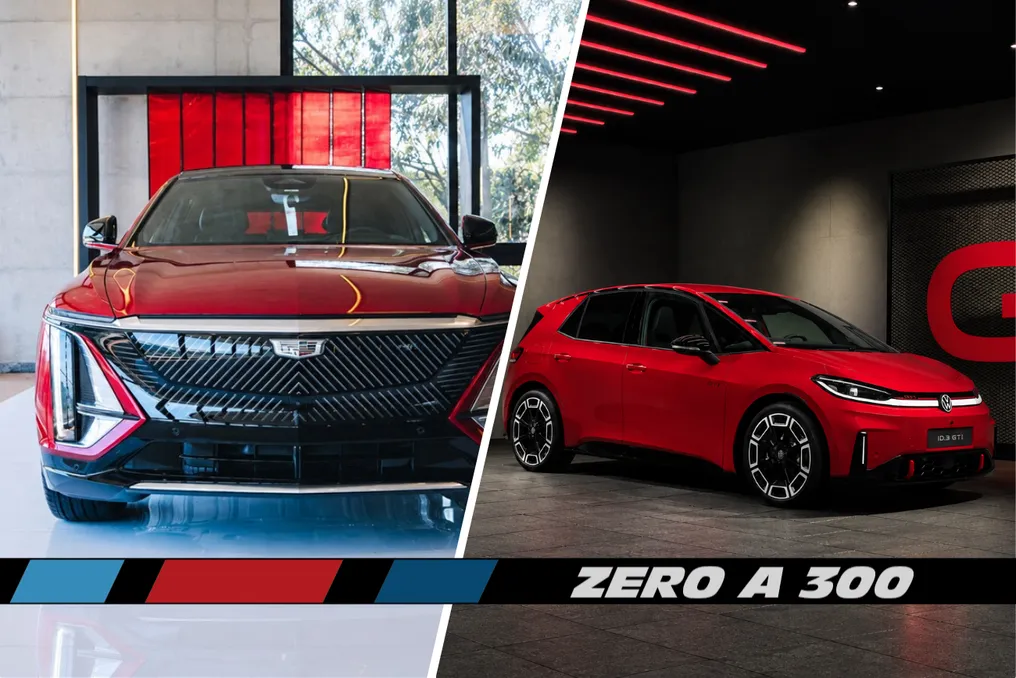
Cadillac began its commercial operations in Brazil on Wednesday, the 16th, introducing two high-value electric SUVs: the Lyriq, priced at R$ 820,000, and the Vistiq, priced at R$ 990,000.
These models will initially be available through reservations or pre-sales in the cities of São Paulo, Curitiba, and Brasília, with deliveries expected to begin in November. The Lyriq arrives in the Signature Luxury configuration, equipped with two electric motors, all-wheel drive, and 500 hp. Its 95.7 kWh battery guarantees an autonomy of 405 km according to Inmetro and supports fast charging up to 132 kW. Its interior features 22-inch wheels, seats with heating, ventilation, and massage functions, a panoramic roof, a head-up display, and an AKG sound system with 19 speakers.
The Vistiq, a three-row, six-seater SUV, has two motors, all-wheel drive, and delivers 604 hp. It accelerates from 0 to 100 km/h in 4.1 seconds and offers 395 km of autonomy according to Inmetro. Additionally, this model includes air suspension, rear wheel steering, five-zone climate control, infrared night vision, and an AKG system with 23 speakers.
Initially, service will be provided in three locations, operated by Eurobike in São Paulo, Metrosul in Curitiba, and Tecar in Brasília. A third vehicle in the line, the Optiq, is expected to launch in the first half of 2027 and will be positioned below the Lyriq. The initial prices are considered high, and Cadillac is expected to maintain a focus on low volume, leveraging its luxury reputation from GM, despite increasing competition from Chinese brands.
Volkswagen revealed the most powerful model in its GTI lineup, which is the electric ID.3 GTI. This represents the second battery vehicle to bear the legendary designation, succeeding the ID. Polo GTI, launched in May with 226 hp and front-wheel drive.
The ID.3 GTI elevates performance, boasting 326 hp and 55.6 kgfm of torque. This power surpasses the Golf GTI Edition 50 by 1 hp, which was launched at the end of 2025 and has 325 hp and 42.8 kgfm in the 2.0 turbo TSI engine. The design incorporates characteristic GTI elements, such as emblems, a red stripe on the front, and exclusive wheels, in addition to a straight-base steering wheel with a red mark and bucket-style seats with partial Alcantara upholstery.
Technically, the ID.3 GTI is essentially identical to the ID.3 GTX that circulated before the April redesign, using the previous generation's MEB platform, with a 79 kWh battery in the floor. Its performance is the same as the GTX: 0 to 100 km/h in 5.6 seconds and maximum speed electronically limited to 200 km/h. However, the strong point of the ID.3 GTI is the autonomy, capable of traveling up to 601 km under ideal conditions, and the battery charges from 10% to 80% in just 29 minutes.
Rolls-Royce presented the Phantom Hummingbird, an ultra-luxury sedan built under the brand's 'Architecture of Luxury Series II'. This vehicle is powered by a 6.75-liter biturbo V12, generating 570 hp and 91.8 kgfm of torque, allowing it to reach 100 km/h in 5.4 seconds, making it the version with the longest wheelbase.
The differentiator of this specimen lies in the interior finish with abalone mother-of-pearl, a material obtained from mollusks, which displays striking patterns of intense colors and dark lines that vary depending on light incidence. Unlike common mother-of-pearl, abalone mother-of-pearl is more fragile, and Rolls-Royce artisans dedicated nine months to developing the correct cutting and positioning technique, a process that consumed 45 hours of work.
The car was commissioned by a client from Dubai through the Private Office division, as a tribute to his wife. The tribute included hummingbird-shaped patterns on the folding rear tables and a floral pattern on the vertical panel between the rear seats, called 'Rear Waterfall'. Each bird was composed of 53 pieces of abalone, and the floral decoration used 84 pieces. Furthermore, the silhouette of a hummingbird was hand-painted on the body. Rolls-Royce justifies the choice of the hummingbird due to the iridescent effect of its feathers, which recalls the color changes in the abalone finish.
Although the value of the exclusive specimen has not been disclosed, it is mentioned that a model in the Dubai region starts at 2 million Dirhams, which is equivalent to just over R$ 2.8 million.
CAOA Changan launched the CS55 this Wednesday (16), aiming to compete with models such as the Jeep Compass and Toyota Corolla Cross. The vehicle is available in three configurations, with prices ranging from R$ 145,000 to R$ 190,000 for the top version, which incorporates a 286 hp plug-in hybrid system.
This mechanical package combines a 1.5 turbo flex engine with an electric motor and a specific hybrid transmission, resulting in 286 hp and 47 kgfm. The total declared autonomy reaches 1,200 km with the tank and battery full, although CAOA Changan has not yet provided details on battery capacity, charging time, or purely electric range.
The other versions, Prime and Infinity, use the 1.5 turbo flex engine producing 180 hp and 29.2 kgfm, coupled with a seven-speed dual-clutch gearbox. The Prime version costs R$ 144,990, and the Infinity, R$ 154,990. Both are manufactured in Anápolis, and the presented values are promotional, without a defined end date for the campaign.
With a length of 4.55 meters, a wheelbase of 2.66 meters, and a trunk capacity of 525 liters, the CS55 fits into the mid-size SUV segment. It also offers features common in the Chinese market, such as large screens, panoramic roof, electric seats with heating and ventilation, 540-degree cameras, adaptive cruise control, and lane keeping and centering assistants. The highlight is the positioning of the CS55 PHEV, which places 286 hp in the price range of conventional Compass and Corolla Cross versions, also competing with the CAOA Chery Tiggo 7.
There is now a miniature replica of the Porsche 550, licensed and developed in collaboration with Porsche itself, intended for enthusiasts who cannot yet drive the original model. This luxury toy is named 550J and is produced by Hedley Studios, a company specializing in scale replicas of classic cars from brands such as Aston Martin, Ferrari, Bugatti, and Bentley.
The 550J replicates the Porsche 550A, presented in 1956, which replaced the Volkswagen chassis with its own tubular structure and used a four-cylinder, 1.5-liter air-cooled boxer engine with power between 110 and 135 hp. In the toy version, the body is made of carbon fiber, resulting in a weight of 330 kg. An 11 hp electric motor on the rear axle is sufficient to reach up to 40 km/h. There is also an RS option, equipped with a 22 hp engine and a maximum speed of 80 km/h, which includes Bilstein shock absorbers and drilled disc brakes.
This luxury item has a high cost: the most basic version costs US$ 95,000, which corresponds to almost R$ 490,000 at the current exchange rate.