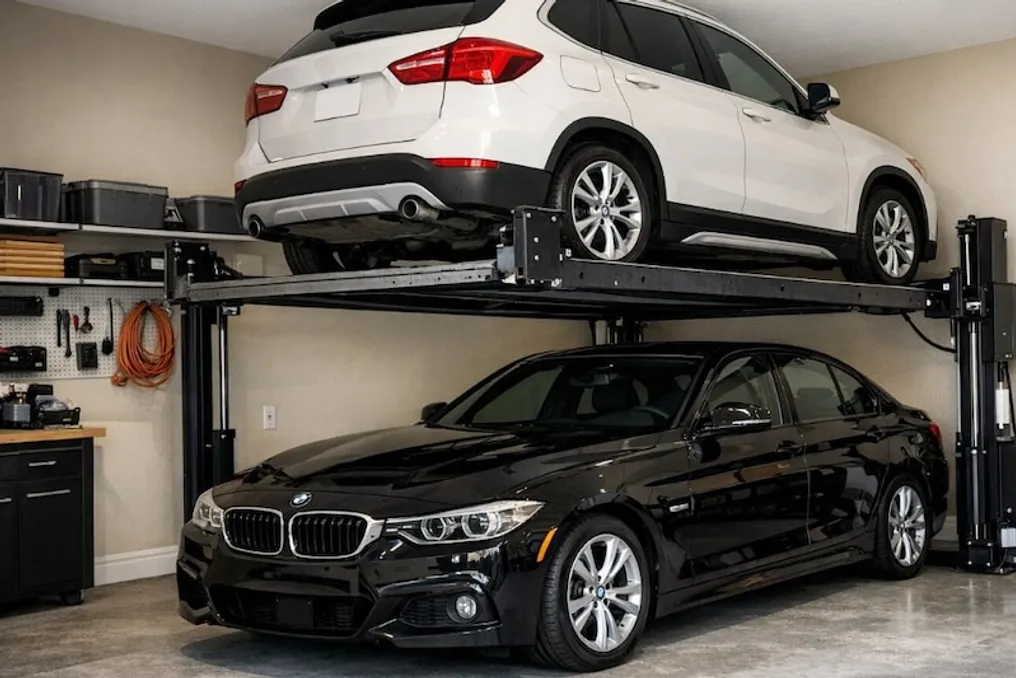
In modern cities where residential buildings are often constructed on limited spaces, it becomes a challenging task to allocate additional space for creating a spacious parking area or garage for a car. The solution to this problem is the hydraulic car lift system. With this machine, a car can be placed directly in the garage without moving forward or backward. Furthermore, if there is only room for one car but the owner has two, the lift allows for the creation of an additional parking zone.
The hydraulic parking lift system also provides the ability to move the car between different floors. The main advantage of these systems lies in their ability to operate efficiently in houses with small spaces. These systems are custom-made for a specific building to ensure quick access inside and outside, as well as safe operation with minimal noise and vibration. Compact, stepless drive mechanisms and a hydraulic system are used for the car lift.
Cost of installing a car lift in a private house
In India, the total cost of installing a car lift in a private house can range from 2 to 10 million rupees or even exceed this amount. The final price depends on the chosen type of lift and the size of the garage. Installing a premium lift suitable for small spaces will cost 3–6 million rupees. Meanwhile, installing an underground car lift to move a car from the basement to the first floor requires costs ranging from 10 to 16 million rupees.
A post-parker lift is installed to accommodate two cars stacked on top of each other in a limited space, costing between 2 and 4 million rupees. Additional expenses for installation work should also be considered, which typically amount to 50,000 to 100,000 rupees. Annual maintenance for such systems costs about 10,000–15,000 rupees.
How is a hydraulic car lift installed in a garage?
If planning to stack two cars on top of each other, the ceiling height in the garage must be at least 11–12 feet. Since the entire weight of the lift and the car rests on the floor, a sturdy concrete base of at least 4–6 inches is essential so that the lift bolts can be securely fastened to the floor. An engineer conducts precise measurements of the garage space and marks the locations for the support columns. Heavy steel columns are raised vertically, after which deep holes are drilled into the concrete floor using a heavy rotary perforator, and the base of the lift is rigidly secured with anchor bolts.
Next, levers or platforms are attached to the supports. Then, the hydraulic cylinder, fluid lines, and power unit (which includes an electric motor and a hydraulic oil tank) are fixed. After this, the power unit is connected to the electrical network to control the lift. Domestic lifts operate on both single-phase and three-phase networks. For safety, an automatic lock and limit switches are also connected to the system. Special hydraulic oil is poured into the hydraulic tank. Before loading the car, the lift is checked empty to ensure there are no oil leaks. The process concludes with a final test, during which the car is lifted to check the function of the safety locks and load capacity.