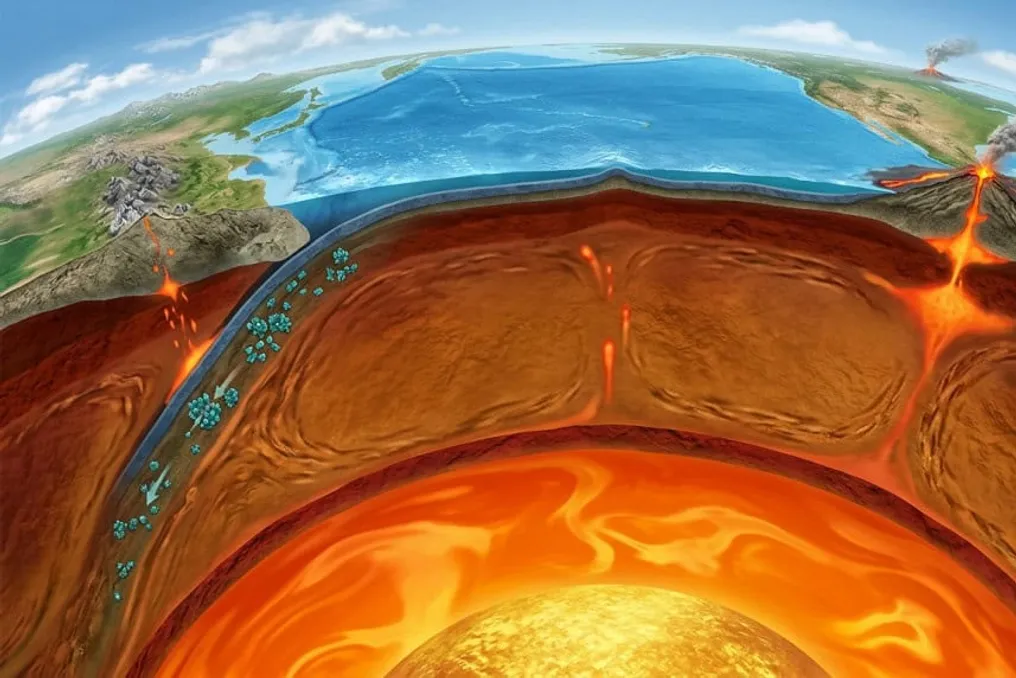
Scientists have discovered minerals capable of retaining water at a depth of approximately 2,900 kilometers, in an area near the boundary between the mantle and the planet's outer core.
Tests conducted under extreme pressures and temperatures demonstrated two iron compounds capable of storing hydrogen, even when the samples contained little water. This finding may offer an explanation for how the planet managed to preserve water within its interior.
To simulate the conditions found in the deepest parts of the mantle, researchers used diamond anvil cells. These devices compress small samples between two diamond tips and heat them using lasers. The experiment resulted in the identification of two forms of iron oxyhydroxides, specifically Fe5O12Hx and Fe7O12Hx, which possess the capacity to retain water.
These structures formed even when water constituted less than 0.1% of the initial material. Due to their higher density compared to surrounding rocks, these minerals could have sunk towards the core during the Earth's formation and cooling process.
The water contained in these minerals facilitates the extremely slow movement of mantle rocks. This mechanism is involved in the operation of tectonic plates and the cycle that promotes the recycling of materials within the globe.
If these minerals are transported to shallower layers by mantle movement, the decrease in pressure could cause them to disintegrate and release the water. Some of this water has the potential to return to the surface through ascending hot material columns or via volcanism.
The discovery also offers a possible explanation for the origin of a mineral configuration called the 'H phase', observed in previous investigations. Scientists suggest that small amounts of hydrogen, which may come from traces of moisture, aided in the formation of this structure.
More information
Mineral physicist and crystallographer Leonid Dubrovinsky, affiliated with the University of Bayreuth, stated that "even very small amounts of hydrogen are sufficient to stabilize these highly hydrated iron compounds."
The tests indicate that the new minerals can exist under deep mantle conditions, but they do not confirm their natural presence inside the Earth. Currently, researchers only know that such structures can retain hydrogen, but they still need to define the amount of water they can store and how this storage evolves over time.
Current central questions include: for geoscientist Alfred Wilson of the University of Leeds, the new minerals "represent an advance in understanding the mystery of how Earth obtained and retained its water." The research suggests that the hydrological cycle may reach regions near the core, although it remains impossible to determine the volume of this possible reservoir or its relevance to the planetary water cycle.