I had the chance to experience Fire Emblem: Fortune's Weave before its official release and present my first impressions. The franchise maintains its essence of traditional turn-based tactical RPG, but incorporates contemporary elements, attractive graphics, and a time travel mechanism that renews the series' narrative.
Developed by Intelligent Systems and published by Nintendo, the game will be exclusive to the Nintendo Switch 2 starting September 17, 2026. The setting takes place in the Dagdan Empire, a kingdom that thrives under divine rule. In the capital, Dagsion, competitors from various regions gather for the Heroic Games, where the winner receives a wish. Among these participants are four Heroes whose destinies are intrinsically linked to the world's future: Cai, a young man from Ribeira who participates to rescue his detained father; Dietrich, a warrior who reaches the coast after escaping a colossal monster; Theodora, from the kingdom of Saramis, seeking to restore her goddess's honor; and Leda, who gives up a successful musical career to seek revenge for her father's death.
Five years after the Heroic Games, the Dagdan Empire is on the verge of collapse due to the return of the demon god Balor, and the four Heroes mysteriously disappear. At this point, the progenitor goddess Sothis assigns the player (whose character is fully customizable, from name to hairstyle) the mission to save the world. To achieve this, she uses the time travel powers of the goddess Fortuna, allowing a return to the era of the Heroic Games to alter the destiny of each of the four Heroes. Progress is saved separately for each character, allowing the four campaigns to be played simultaneously, traveling through time as desired.
In addition to the game announcement, Nintendo used the Fire Emblem: Fortune's Weave Direct event to reveal other news: Nintendo Music will start including soundtrack tracks, such as the main theme, on the same day; the Nintendo Today app will receive a new visual theme dedicated to the title the following day; and on September 15, an article titled 'Ask the Developer' was made available on the Nintendo website, containing behind-the-scenes production details (this text was in English).
It is important to contextualize the origin of this franchise, as it has over three decades of existence. Fire Emblem was initially released in 1990 on the Famicom with Shadow Dragon and the Blade of Light. Since then, the series has consolidated distinctive characteristics, such as the permadeath system, where a character fallen in combat is permanently removed from the team (although this mode is optional in more recent titles), and the 'support' system, which allows characters fighting together to develop bonds—ranging from friendship to romance—and receive combat bonuses for it. It is this combination of battle tactics with personal drama that manifests again in Fortune's Weave.
A clear influence from Three Houses is observed, notably in the Combat Arts (special attacks that consume weapon durability) and the class certification exams used to promote units, which are practically identical. The innovation lies in the Blaze Arts, unique abilities of each of the four Heroes that consume health points instead of weapon durability. For example, Cai can launch an area fire explosion, while Leda uses her vihuela to strengthen allies and summon creatures. The premise of time travel to rewrite individuals' destinies also deserves mention as it dialogues, albeit remotely, with the generational structure of Genealogy of the Holy War: in both cases, decisions made at one moment have repercussions (or can be modified) later in the story.
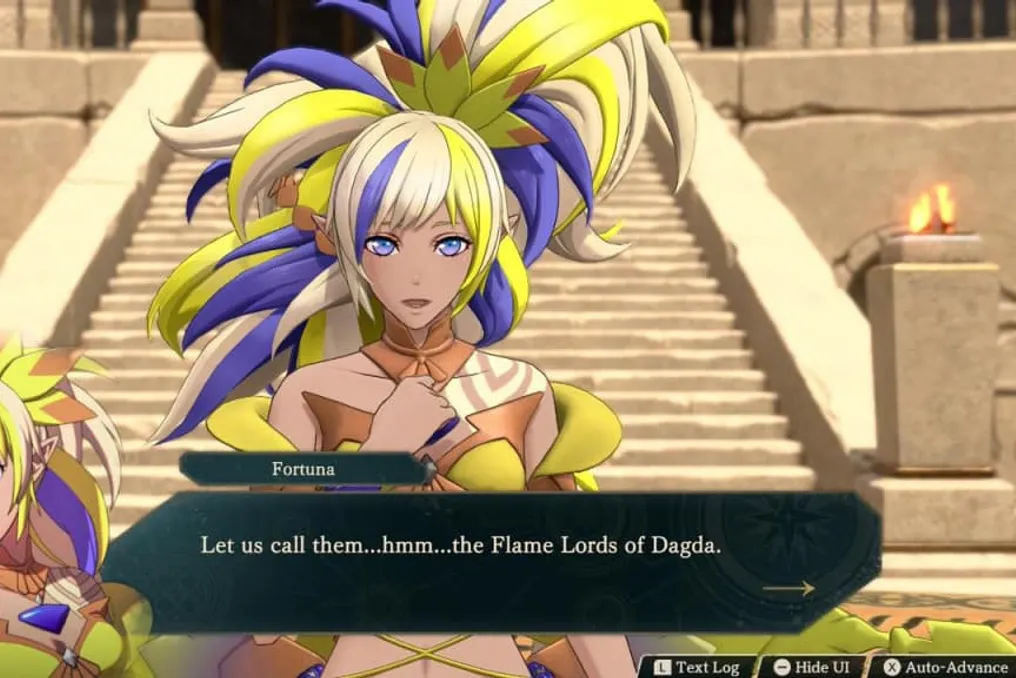
The narrative begins in a conflict scenario, with the city of Kulun being attacked, and the player-created character appears to defend it. The first chapter serves as a tutorial, being easy to understand because instruction accompanies practice, without being an isolated segment of the story. The process starts with character customization (including name, clothing models, style, and hair color), offering options ranging from more seductive visuals to more modest outfits, aiming to cater to diverse audiences. Next, the group meets their first companions, Hong Hua and Troy. After traversing a dungeon, the group encounters Lind, the campaign's first antagonist, responsible for the battles and monsters present in the setting. At the end of the confrontation, Lind tries to bring down the fortress entrance on the team, but everyone is saved by Fortuna, the Goddess of Destiny.
In order to form a robust army sufficient to face Balor's forces, and given the scarcity of soldiers, Fortuna proposes taking the group to the Obelisk Chamber, where there are four obelisks called 'Flame Lords of Dagda'. Each obelisk contains a story to be revealed, although the details are omitted to preserve the surprise for future players.
The game mixes the classic board-based turn method with direct combat, presented in a frontal view, without allowing free movement of characters on the screen. The format used is determined by the game itself according to the stage of the story; for example, in dungeons, direct combat is more frequent. An aspect considered strange (or whose functionality has not been discovered) in this type of battle is the limitation in target selection: it is possible to choose which character will act in the turn, but the target is mandatorily determined by the game, which was seen as a strategic drawback. Additionally, in each turn, only one character can be selected to attack, unlike games like Final Fantasy, where each character (on both sides) has their own action within the turn.
Aside from these observations, the mechanics do not present major mysteries: they include weapon swapping during combat, automatic spells for attack and counterattack, healing items, and equipment, configuring typical elements of a tactical RPG. There are moments when the game offers dialogue choices, influencing the character's tone and the sound of the responses. Not enough gameplay has occurred yet to verify if different choices generate new dialogues. The occurrence of only one response option available was considered unnecessary, although the intention to maintain interaction and engage the player is understood. Being forced to respond in the same way raises questions about the necessity of the interaction button. Perhaps, if there were two options and the undesired one was removed after use, it would add more dynamism to the conversation.
In this regard, the game demonstrates high quality. The story progression maintains a good pace, and the anime-style art captures attention. Emotions are conveyed clearly; up to the point played, no flaws falling into the uncanny valley have been found. There are also animations inserted during combat: even when executing a standard attack, the game can trigger a distinct strike animation, especially in finishing moves. This helps to dynamize longer battles, which otherwise could get stuck in the cyclical repetition of 'select enemy, attack, end of turn; enemy turn: defend, counterattack, end of turn' until the end.
The game does not have support for Brazilian Portuguese voice acting, which represents an access barrier for part of the local audience, but this is a common situation in the franchise. Despite this, the quality of the original voice acting is high: the voices manage to convey emotion, distancing themselves from robotic and lifeless recordings, which significantly aids immersion. Regarding the soundtrack, it was not perceived as epic; it is pleasant, but within expectations for a game of this genre.
Since the climax of the campaign has not yet been reached, this report summarizes the impressions obtained in the first half of the journey, without detailing aspects that could harm the experience of those who will still play. So far, Fortune's Weave fulfills the promise of a Fire Emblem: satisfying tactical battles, purposeful characters, very beautiful art direction, and a time travel mechanism that gives a new aspect to the formula the series has refined since Three Houses. The most bothersome point so far has been the inability to define the target in direct combat, which impacts those who prefer to plan every move with precision. Excluding this, it is a visually pleasing, well-structured title that rewards those who appreciate the fusion of strategy and personal drama, the trademark of the franchise. We intend to return with more complete reviews after the completion of the campaign.