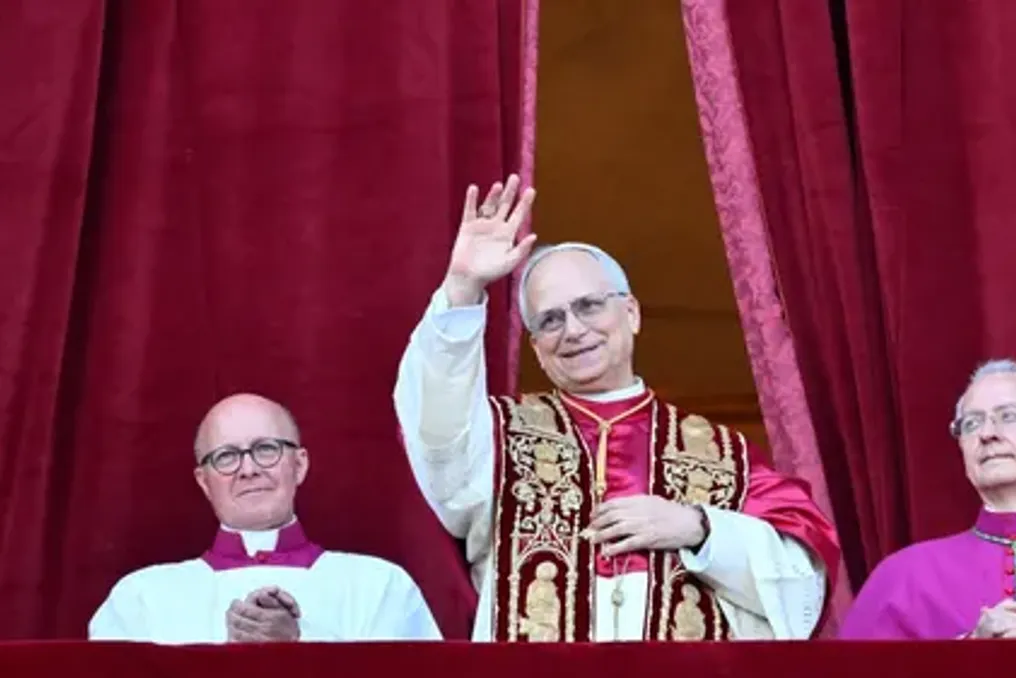
Pope Leo XIV issued a warning against delegating decisions to artificial intelligence algorithms that should remain the prerogative of human conscience. This statement was made amid growing concern over the risks associated with AI development.
During his weekly general address in the Vatican, the Pope stated that technological development, the spread of mass media and social networks, and the increasing use of artificial intelligence are opening up new possibilities, breaking down barriers and distances. However, he also warned that relationships are becoming less personal and more virtual, creating a risk of becoming accustomed to having decisions that belong exclusively to human conscience transferred to algorithms.
He emphasized that the contribution of the Christian community is to ensure that social connections possess real substance and personal depth. Concerns about AI have intensified in recent weeks following a series of security incidents and the emergence of the ability for AI models to improve themselves without human intervention. The discussion now also touches upon the sector's capacity for self-regulation.
In his first major document, the encyclical 'Magnifica Humanitas' (Great Humanity), published in May, the head of the Catholic Church called for 'disarming' AI to 'prevent its domination over humanity.' Furthermore, in recent months, the Holy See has intensified its initiatives to support international governance of AI based on human dignity, particularly in the fields of nuclear technology, culture, and artistic creation.
Concerns about smaller competitors
The largest global companies in the field of AI are working on establishing a standards body. This was reported by OpenAI on Tuesday as anxiety over AI dangers grows and pressure mounts to create a safer version of the technology. OpenAI stated that it is collaborating with Anthropic and Google on an idea proposed by Demis Hassabis of Google DeepMind to create a self-regulating body, similar to the Financial Industry Regulator that oversees US brokers and investment firms.
In July, Hassabis called on the United States to establish an organization that would test the most powerful AI systems before their public release. He noted that 'funding must be substantial and likely come mainly from the industry to attract world-class technical talent and provide the necessary computational resources for large-scale testing.'
OpenAI CEO Sam Altman supported cross-industry collaboration on Tuesday, acknowledging public concerns that competition between companies and countries might sideline safety issues. Speaking at a conference organized by Salesforce in San Francisco, Altman said: 'I think it's great that our industry is saying it wants to come together and wants to be able to coordinate and make sure we have enough time to do this safely.' He added that people get very scared when there is a hint that someone in the industry 'might do something wrong.'
Some tech figures fear that cooperation among AI giants could lead to the marginalization of smaller competitors. Co-founder and CEO of the Canadian AI company Cohere recently accused dominant American AI labs of forming a 'cartel' under the guise of ensuring safety. Aidan Gomez, co-founder and CEO of Cohere, wrote in a blog post on Sunday: 'AI needs guardrails. That is not a debate, and it never was. The debate is about who writes them, who has the right to participate, and whose interests the rules protect.'
Escalation of AI safety issues
Concerns about AI safety have sharpened in recent weeks, including warnings from workers who left major AI companies due to worries about industry risks. Last week, researcher Jacob Coxon left Anthropic and warned that AI labs are 'playing with our lives.' He previously worked at OpenAI.
On Monday, Bilal Chuttai, a former Google DeepMind researcher, echoed the concerns raised by Coxon and others. He wrote on social media: 'I sincerely believe that AI could potentially kill us all, and that we may be wasting time to avoid this outcome.'
On Saturday, Anthropic CEO Dario Amodei called for a slowdown in AI development, a view supported by OpenAI CEO Sam Altman, Elon Musk, and Hassabis. US Senator Bernie Sanders, concerned about catastrophic AI consequences, stated that tech leaders cannot be trusted to keep promises to slow down development or establish safety standards. Sanders said at an AI safety event in Washington: 'When the future of humanity is at stake, we need mandatory international safety rules, not voluntary industry standards.'
Altman warned that AI accidents, both small and large, may be inevitable. 'Accidents with any new technology are inevitable, and we must have an excellent culture of transparent reporting about them,' Altman stated. He continued: 'I think that rapid learning from them and adapting as they occur will benefit our industry, and perhaps we can avoid' larger, potentially catastrophic incidents.'
Trump rejects warnings
US President Donald Trump dismissed warnings about AI risks as 'showmanship' on Monday. Nvidia CEO Jensen Huang also objected, hinting at the belief that AI warnings were part of a coordinated campaign. Huang stated on Monday at a conference in Los Angeles: 'The combination of these words, and then predictions, is alarming and worrying, and that should not be done. It is irresponsible.' During a call from Trump while he was on stage, Huang thanked Trump for 'seeing through' the AI warnings. Nvidia is at the center of the AI revolution; its chips power the vast majority of systems, and Huang has become an unofficial advisor to Trump.