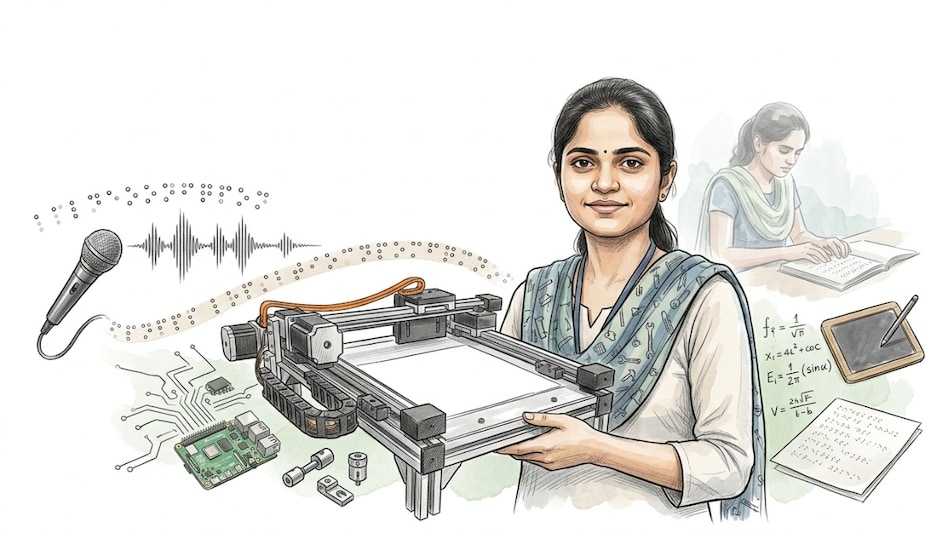
Undergraduate student Himaja created a voice Braille printer named 'Rudra'. This device is capable of printing text in Braille font directly onto paper using voice commands. Himaja's innovative development was recognized as the winner of the National 'James Dyson Award' for 2026.
Initially, while completing a university project, Himaja visited a school for the visually impaired. There, she observed a girl manually writing Braille using traditional slates and pins. Due to constant piercing of paper, the girl's fingers became stiff and damaged.
The process of writing Braille requires puncturing the letters from the back of the sheet so that they can be read correctly when the page is turned over. This method demands significant physical and mental effort from children.
Himaja first developed a manual printer with six buttons. However, when she met this girl again, the girl asked, 'Akka (sister), why do we have to exert so much force to press buttons? Can't we just write with our voices?' This single question fundamentally changed the direction of the entire project, leading to the creation of 'RUDHRA'.
The printer functions based on artificial intelligence and voice recognition (Alexa) technologies. When the student says something aloud, Alexa instantly converts this speech into text. Then, the 'Raspberry Pi' chip converts this text into Braille patterns. The machine uses solenoids and mathematical calculations to create perfectly accurate Braille dots on the paper. Now, visually impaired students no longer need to puncture pages themselves; the machine prints the entire page in Braille automatically.
The James Dyson Foundation selected Himaja as the National Winner. She is entitled to a cash prize of about 600 thousand rupees and will now represent India at the international stage, where Sir James Dyson will determine the final winner. Currently, the cost of this prototype is around 1.5 lakh rupees, but Himaja is working to refine it to bring the price down to the range of 50,000–60,000 rupees.
Himaja's vision is for the RUDHRA printer to be placed in every school and classroom, similar to a personal computer. This will allow visually impaired students to print their notes and books independently during exams, without relying on a 'scribe'. Himaja, who is a Kuchipudi dancer and guitarist, believes that these children need not just sympathy, but solutions that simplify their daily lives. Her idea demonstrates that when sensitivity is added to technology, inventions capable of changing the face of the country and the world are born.