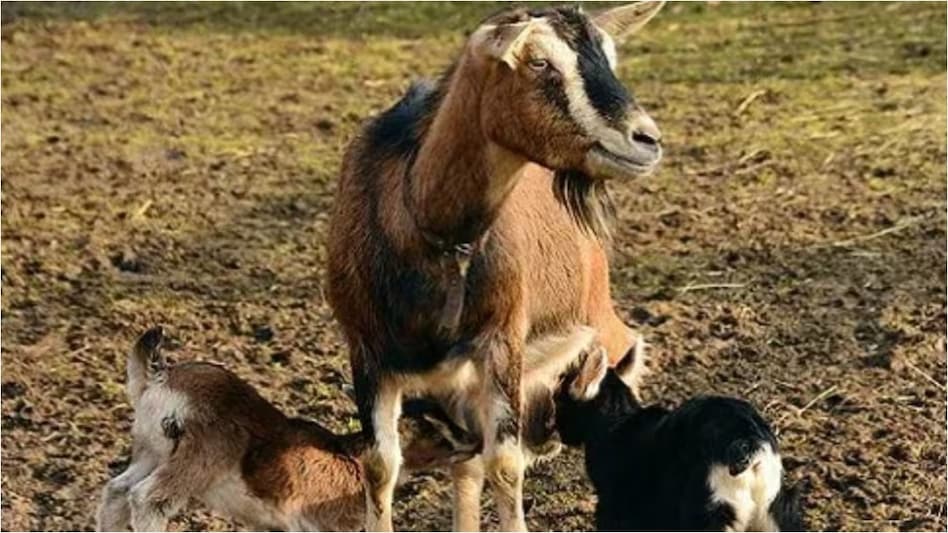
If you aim to increase your income by engaging in livestock farming alongside agriculture, goat breeding can be a suitable option. Government programs are in place in various regions of the country to support this sector. These initiatives provide financial assistance for launching small goat farms or offering subsidies for starting large-scale goat breeding businesses.
It is important to understand that there is no single national government program across the entire country; the conditions, subsidy amounts, selection criteria, and application procedures vary depending on the state. Furthermore, under the National Livestock Mission (NLM) of the central government, capital subsidies are provided for large projects related to sheep and goat breeding.
In Gujarat, programs exist related to establishing 10+1 type farms. These provide financial support for creating a farm consisting of 10 does and 1 ram. Although the terms and limits of assistance may vary depending on the beneficiary category, these plans support the development of goat farming in Gujarat. According to program details, the cost of such a farm is 90 thousand rupees, and the corresponding beneficiary can receive a subsidy of 50 percent of this cost, which is a maximum of 45 thousand rupees. This amount covers expenses for feed, water, housing, and goat maintenance. Rules and selection criteria depend on the recipient's category.
Livestock farmer Hatabhai Chavalia from Tamachal village in Jamnagar district also utilized a government program to start a farm of 10 does and one ram. He noted that thanks to government support and loans, he was able to start goat farming and is now trying to improve his financial situation.
Goat farming support programs are implemented not only in Gujarat but also in many other states across the country. Information on government plans concerning goat breeding is available on the official websites of the respective livestock departments in Madhya Pradesh, Uttarakhand, and Himachal Pradesh. However, the level of support and requirements for candidates differ, so farmers should apply according to the rules of their state's program.
There is an important distinction to consider: the central government's National Mission program for sheep and goat breeding differs from the standard 10+1 farm. This central program is intended for large commercial projects. According to official directives, entrepreneurs can establish a breeding farm for sheep and goats containing at least 500 does and 10 rams. For this project, a reverse subsidy of up to 50 percent of capital costs is provided, with a maximum subsidy limit of 50 lakh rupees. Thus, this central scheme should not be considered equivalent to state-level goat farming programs designed for small farmers.
In Gujarat, 10+1 farm programs are active, with support depending on the beneficiary category and the specific program rules. In Madhya Pradesh, a bank loan and grant scheme is available for 10+1 farms: 60 percent grant for Scheduled Caste and Scheduled Tribe representatives and 40 percent for the general category. Uttarakhand provides a mechanism where the government covers 90 percent of the costs for a 70 thousand rupee farm, which is 63 thousand rupees. Himachal Pradesh offers a 60 percent subsidy for various farms, including 11-goat farms. The central government, through the National Mission, provides a subsidy of up to 50 percent of capital costs for large breeding projects, with a maximum limit of 50 lakh rupees.
The aid provided under goat farming programs should not be considered direct income. The cost of goat farming includes not only the purchase of animals but also expenses for feed, shelter, water, medicine, insurance, and care. Furthermore, overall income is influenced by goat breed, morbidity, mortality rate, local market prices, and sales channels. Therefore, before utilizing benefits, it is crucial for the farmer to study the costs of goat farming and the market situation in their region.
The application process may differ in each state. In some cases, selection is done through the village council and the livestock department, while in others, applications are submitted via an online portal.
Goat farming as an option for supplementary income while engaged in agriculture can become a source of additional income for small and marginal farmers. State programs are designed to assist with initial investments, whereas the central government's National Mission program promotes the development of large commercial sheep and goat breeding projects.