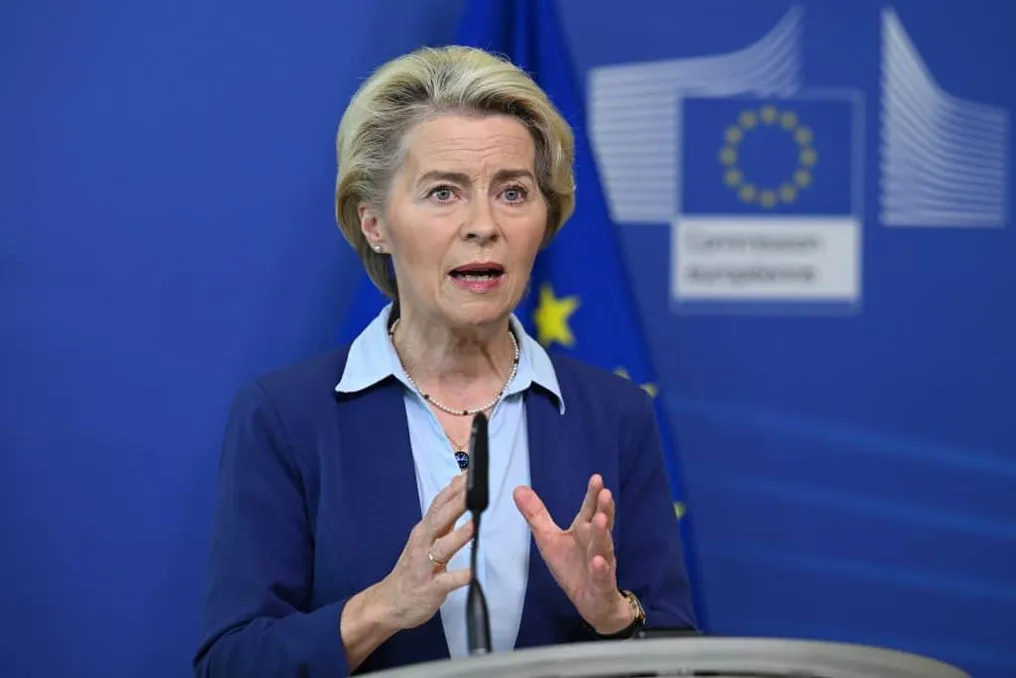
The European Union is about to implement stricter measures regarding social media. The President of the European Commission, Ursula von der Leyen, released a proposed law known as the EU Kids Act, which aims to restrict access to these platforms for children under 13 years old.
Additionally, for adolescents aged between 13 and 15, supervised profiles will be established with limitations on functionalities and control over usage time. For the age group of 15 to 18, the bloc requires the adoption of new 'security by design' standards.
In her speech on the State of the Union in the European Parliament, von der Leyen emphasized that each age group has distinct sensitivities, deserving a specific level of protection. The proposed ban covers not only social media but also video sharing platforms, online games, and artificial intelligence chatbots.
Currently, social media platforms in the bloc are not required to verify user ages, allowing minors to circumvent barriers by falsely stating an age. With the new legislation, companies will have the legal responsibility to verify the age of those accessing their services.
The president warned against addictive features and the channeling of children towards increasingly extreme content, citing the risk of girls' photos being used to generate sexualized images by AI. She stressed that the focus is not just on access, but on the timing and manner in which social media interacts with minors.
Von der Leyen argued that social media is stealing youth from young people, causing a 'great capture' of their attention and mind. She mentioned health problems associated with the digital environment, such as insomnia, anxiety, self-harm, and, in some cases, fatal tragedies, concluding that it is time for Europe to act.
The president also announced that she will convene major AI laboratories to discuss measures against technological risks. According to her, the AI Act is crucial for setting limits and positions Europe as a shaper of global efforts against these challenges. Furthermore, the European Union plans to intensify collaboration with partners such as Canada and the United Kingdom on AI safety.
In the scientific field, the National Institute for Space Research (Inpe) put into operation the Ocean, Earth, and Atmosphere Prediction Model (Monan), a weather forecasting computational model that runs on the Jaci supercomputer, located at the agency's data center in Cachoeira Paulista (SP).
Meanwhile, Mark Zuckerberg, CEO of Meta, commented on the speed of artificial intelligence development, criticizing the idea of a coordinated slowdown in the industry. In a post on Tuesday (15), he suggested that major AI labs should focus on safety rather than seeking continuous improvements in the technology itself.
In space exploration news, SpaceX scheduled September 22nd for the first attempt to place Starship into Earth orbit. This will be the 14th test flight of the mega-rocket and constitutes a vital phase in the vehicle's development.
On the other hand, Brazil conducted the launch of the VS-30 V16 rocket on Tuesday (15). This launch departed from the Barreira do Inferno Launch Center (CLBI) in Parnamirim (RN), carrying the Recoverable Microgravity Suborbital Platform (PSM-R) as part of Operation Potiguar 2. The main objective was to test the platform's parachute recovery system under real flight conditions.
Finally, OpenAI announced that a system composed of approximately 10 thousand artificial intelligence agents managed to solve the problem of existence and smoothness of the Navier-Stokes equations, one of the seven 'Millennium Prize Problems.'