For the past two decades, the Venice Film Festival has served as a glamorous counterpart to leading global film festivals, acting as a platform for award seasons and a more open showcase for Netflix productions that are often overlooked in Cannes. Political themes have always played a significant role at the festival, including last year's session, which featured the world premiere of 'The Voice of Hind Rajab,' as well as protests in support of Gaza and numerous speeches defending Palestine.
However, the 2026 program significantly heightened political intensity, becoming the most uncompromising in content in the festival's recent history. Among the films from the Middle East, there are an impressive 11 feature-length works and numerous short films, exceeding the total number of MENA films shown in Cannes, Locarno, and Toronto combined. The war between Russia and Ukraine continues to hold a prominent place at the festival, as does Iran, which is represented by two feature films in the official sections.
Nevertheless, the USA became the dominant force at the 83rd edition of the world's oldest film festival, even in films that do not directly concern America. In Venice in 2026, America was subjected to a moral examination regarding its imperial past, racist military, bankrupt media, and power-hungry oligarchs.
Ink
Dani Boyle's opening film, 'Ink,' although fundamentally a British story, touches upon the origins of the newspaper The Sun and its founder Rupert Murdoch. Through this lens, the director, known for 'Trainspotting,' reveals the essence of the right-wing American media landscape. The film begins in 1969 when a young Australian journalist, Murdoch, starts building his media business in Great Britain.
After acquiring the publication News of the World, Murdoch switches to the struggling daily newspaper The Sun, which was initially an anonymous publication with little influence. He hires Larry Lamb, a working-class journalist from Yorkshire, who possesses immense charm but questionable methods. Together, they begin the era of modern tabloids, where truth becomes a secondary commodity. Lamb asserts: 'What matters isn't why; it's what's next?'
'Ink' is not a biographical film about Murdoch, as some viewers assumed, but it offers an invaluable look into the mind of the man who would later become the world's most powerful media magnate. Like Trump, Jeff Bezos, or Mark Zuckerberg, Murdoch appears as a person without a clear ideology or principles, whose life and career are built on maximizing profit and selling everything. It is worth noting that Murdoch owned the left-leaning Village Voice from 1975 to 1985.
The conflict between him and Lamb over a highly controversial decision at the end of the film is driven not so much by ethical problems as by the fear of losing readers and jeopardizing the business. At one point, Murdoch tells Lamb: 'Let's do something big. Something dangerous. Something fun,' thereby laying the foundation for media ethics aimed at entertainment and seduction, rather than information. During the heyday of The Sun, it was the best-selling newspaper in the world. The type of sensationalism it popularized formed the basis for publications such as Fox News, The Daily Wire, Newsmax, and the entire spectrum of social media.
Prime Time
Greed, ethical bankruptcy, and the insatiable desire to be number one are central themes in Lance Oppenheim's competition piece 'Primetime.' This recent A24 film recounts the true story of Chris Hansen, a former host of the show 'To Catch a Predator,' one of the most popular reality shows of the noughties. Within this show, crew members organized men, posing as minors, and engaged them in candid sexual conversations. The men were lured to a house under the pretense of meeting children. When they arrived, Hansen, played by Robert Pattinson in the film, confronted them on camera, often asking the famous question: 'Why don't you sit over there?'
At one time, the NBC channel pitted 'To Catch a Predator' against the series 'Lost' in the same time slot, achieving an average rating of just over seven million viewers. Like the iconic media satire 'Network' (1976), 'Primetime' depicts a morally hollow American media landscape obsessed with the battle for ratings. In one key scene, Hansen speaks with Dan Plumb (Skyler Gisondo), a crew member torn between duty and desire, about how their views on good and evil differ greatly. Hansen never questions the moral justification of his actions; he is too blinded by fame and too focused on maintaining his position to acknowledge the fundamentally corrupt nature of his enterprise. Similar to 'Ink,' Oppenheim's American information ecosystem is built on cheap thrills and disposable entertainment. Hansen, the self-righteous modern crusader, administers justice as a purely capitalist gesture for financial and professional success. The picture Oppenheim paints of America after 9/11 is no different from the present: a society mired in schadenfreude, orgasming in the spectacle of punishment, and clinging to illusory moral certainty detached from the complexity of reality.
Wild Horse Nine
Even more condemnatory is Martin McDonagh's latest black comedy, 'Wild Horse Nine,' the director and playwright of 'In Bruges.' Like 'In Bruges,' McDonagh's film is a comedy about friendship, centered on two hitmen and set in an unusual location. Chris (John Malkovich) and Lee (Sam Rockwell) are CIA agents sent to Chile on the eve of the 1973 military coup. Chris, suffering from cancer, asks Lee to kill him on Easter Island. However, as his memory fades and regrets begin to surface, the elderly operative starts recording his memoirs, which irritates his handler MD (Steve Buscemi), who may be a drug addict.
'Wild Horse Nine' is a scathing critique of the CIA and 'the terrible things they have done around the world' over the last six decades, as McDonagh stated at a press conference. Although Chris may mourn the people he killed, he still believes in violence as a necessary principle of life and never fully condemns US foreign policy. In one of the film's most striking scenes, Chris mentions Patrice Lumumba, the former Prime Minister of the Democratic Republic of Congo, whom the US and Belgium killed in 1961. Chris recalls: 'Lumumba said that if you kill me, you kill democracy in Africa for the next 50 years,' referencing an interaction that haunted him but did not prevent him from distancing himself from the state agency by more than a decade.
Chris, Lee, and MD are not unlike Pete Hegseth, J.D. Vance, and Kristi Noem: they are foolish, egocentric, and far from the brilliant individuals one might expect in such key positions; their overconfident behavior reflects an equally idiotic, imperialistic foreign policy built solely on pure arrogance and egoism. In McDonagh's world, the US is not a 'force for good,' as President Joe Biden claimed. Their dedication to work surpasses any sense of universal morality. In almost all films touching upon various aspects of the American experience, individuality is expressed only in capitalist terms. Nevertheless, even the most rebellious of these protagonists never attempt to change the political system driven by capitalist intentions. They may have deep doubts about it; they may question their place in it; but they are content to receive financial returns from it, regardless of the moral cost.
Mr. Nelson, Did You Kill People?
The sole exception to this rule is the military drama 'Mr. Nelson, Did You Kill People?' by Shin'ya Tsukamoto. Rodney Hicks plays the titular Allen Nelson, a 23-year-old African American soldier who returns home with PTSD after serving in Vietnam. For many years, Nelson's therapist, Dr. Daniels (Jeffrey Rush), asks him a question he cannot comprehend: why did he kill these people in Vietnam? The long answer reveals a system of oppression in which African Americans and other disadvantaged groups are forced into state structures due to a lack of better options. Nelson was born to a harsh father in a hostile, poverty-stricken environment. Military service never gave him the social lift he desired; instead, he ended up re-experiencing the violence inflicted upon him, redirecting it onto another unfortunate crowd. His healing only begins when he unequivocally rejects the military, when he rejects the racist, expansionist, speculative structure that long lost its moral compass.
Musk
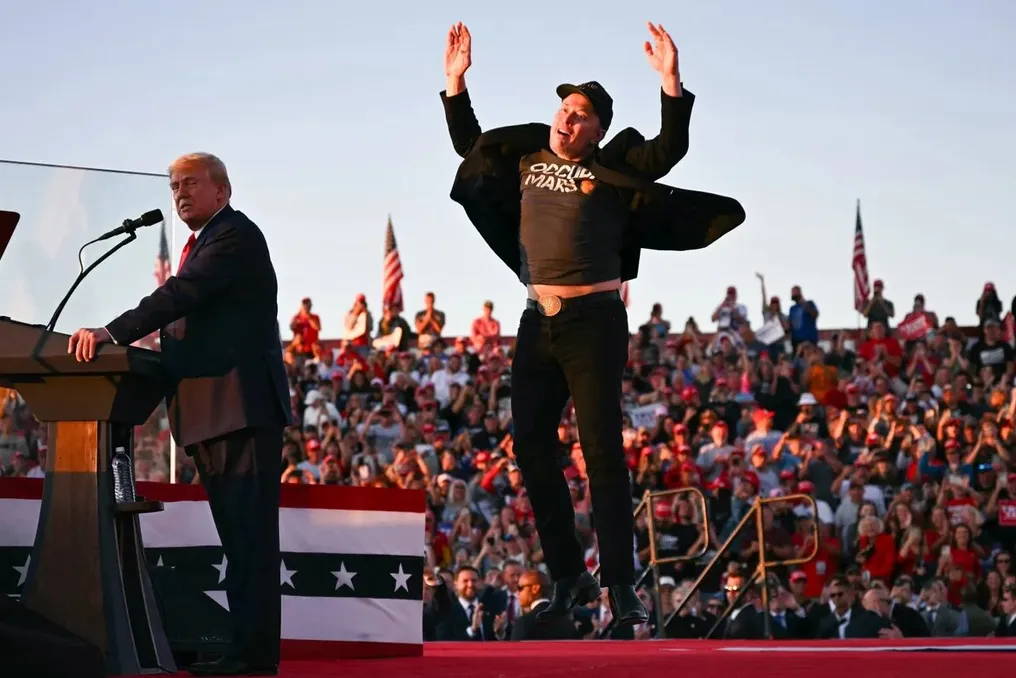
On the opposite pole is 'Musk,' Alex Gibney's long-awaited exposé on the world's richest man. Over four hours, the Oscar-winning director of 'Taxi to the Dark Side' and 'Going Clear: Scientology & the Prison of Belief' weaves a narrative of rise and corruption: a detailed character study that is both captivating and unsettling. Gibney traces 'Musk's' early years as a dreamy entrepreneur with high ambitions in space travel and discovering alternative universes—a South African computer botanist seeking refuge from constant bullying in video games and technology. In the US, he found fertile ground for ambitious businesses—Zip2, PayPal, Tesla—which served as a pretext for his grand project SpaceX, founded in 2002.
From the beginning, 'Musk' understood that ethically dubious methods were necessary for successful business in Silicon Valley. He betrays his business partners, exaggerates Tesla's capabilities, and fiercely suppresses his critics and opponents. Over time, the dreamy inventor quickly transforms into a charlatan, a cult leader, and ultimately, a powerless oligarch. He buys X and turns it into a platform rife with hateful speech and losses; he engages in a bitter legal battle with his ex-partner Grimes over child custody; he blames the 'progressive agenda' for his estrangement from his transgender daughter Vivian Wilson; he supports Donald Trump, takes control of the short-lived Doge department, which destroyed USAID and deprived millions of children and communities worldwide of education and medicine.
Gibney hints that 'Musk' may have interfered in the last US presidential election and that he might try to influence the upcoming midterm elections. His support for the far-right party AfD in Germany, Jair Bolsonaro in Brazil, and Javier Milei in Argentina is well documented. However, what 'Musk' truly believes and what his real ideological stance is remains a mystery. Gibney warns disturbingly that his accumulated wealth and power have turned him into a divine figure: invincible, limitless, and uncontrollable. And all of this became possible thanks to every previous US administration. As early as 2002, the US positioned itself as a primary client for 'Musk,' using SpaceX for cheaper and more reliable launch capacity for NASA and the Department of Defense. According to a Washington Post report, 'Musk' and his various companies received $38 billion in government contracts, loans, subsidies, and tax breaks over the last two decades. George W. Bush, Barack Obama, Trump, and even Biden contributed to the creation and proliferation of 'Musk' through various programs and policies that made his companies strategically valuable. For the author, this is the main conclusion drawn from the film—a fact that Gibney skillfully emphasizes in different parts of the documentary.
In this sense, 'Musk' is a true American monster: a manifestation of unrestrained corporate capitalism, interventionist policy, and a unilateral approach to power, ignoring the common good. 'Musk's' technological utopianism is now merely a faint trace of another person's life.