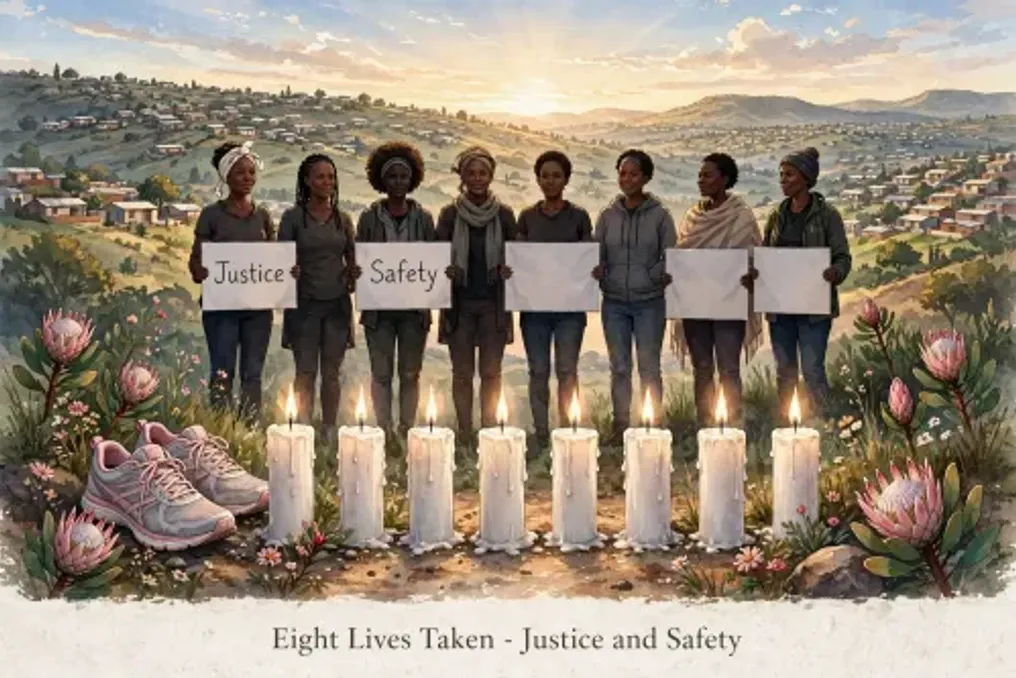
As South Africa confronts the harsh reality of violence against women, the tragic story of loss underscores the urgent need for action. Eight families seek justice as the country grapples with its relationship to patriarchal violence. It is time for change.
In eKurhuleni, women feel fear when moving through public spaces—they are afraid to walk, run, travel, or simply be in public. Across the country, mothers call their daughters more often, partners check if loved ones have arrived safely, and running groups are forced to change routes. Social media is flooded with grief, anger, fear, warnings, and speculation.
The focus must be on the women themselves, not the noise surrounding their deaths. The names of known victims should be called out, and every life honored, including those whose names remain unknown. For example, Elizabeth 'Tshontso' Moselakgomo, who went for a run and never returned home; she was a mother, a professional, a church member, a runner, and a person with her own dreams, responsibilities, and loved ones.
At the same time, objectivity is important. The police are investigating the eight deaths in eKurhuleni, but it has not yet been established whether one person committed all the crimes or if all cases are connected. Justice demands urgency, but it also requires facts, as rumors cannot replace evidence, and social media cannot replace a courtroom.
Anger is understandable, as it signals a violation of something sacred and reminds us that life should not be reduced to statistics. However, anger must find direction, transforming into protection, justice, and change. If it remains mere rage, accusation, and hatred, it drains energy without changing the conditions that breed violence.
Fear is also a real experience, and women should not be shamed for it. Nevertheless, fear must not become a permanent state. The country cannot demand that half its population disappear from the streets, give up sports, change clothes, shorten trips, and organize their lives around male violence.
Women deserve to be safe, but safety is not enough; they need freedom. Freedom to run at dawn, freedom to return from work after dark, freedom to say 'no,' freedom to leave relationships, freedom to report abuse and be heard, freedom to occupy streets, parks, taxis, workplaces, campuses, and homes without constantly calculating the probability of harm.
This is not just a problem for women; it is a national test of our character, our institutions, and our humanity. Patriarchy survives by placing the responsibility for managing male violence onto women. It asks questions: what she wore, why she walked alone, why she trusted him, why she stayed or left, or why she spoke. The focus of the question needs to shift to: why did he harm her? Who ignored the warning signs? Which institution failed? What should men do differently?
Fathers must teach boys that love is not possession. Brothers must challenge friends who humiliate women. Colleagues must stop laughing at harassment disguised as humor. Faith leaders must confront domestic and institutional violence, not protect reputations. Political leaders must stop turning women's suffering into speeches before returning to ordinary business.
Men cannot define virtue merely with the phrase 'I do not rape women'; the true test is whether they intervene in violence, challenge misogyny, support survivors, report danger, and change the conditions that foster violence.
The designated police unit is obliged to thoroughly investigate each case, responsibly inform the public, and keep families updated. Evidence must be protected, and leads must be followed. Perpetrators must be arrested, held accountable, and convicted through due legal process. Women reporting threats, stalking, assaults, or missing relatives must never be ignored at a police station.
Municipalities must conduct immediate safety audits jointly with women: patrolling routes they use, checking lighting, overgrown areas, abandoned buildings, transport hubs, cameras, and emergency service access. They are obligated to eliminate sources of danger and publish reports on the work done, responsible officials, and deadlines.
Every district must create a practical women's safety pact involving civil society organizations, police, municipal officials, schools, clinics, transporters, religious communities, runners, and businesses. This pact must identify problem areas, organize rapid communication, provide support to survivors, and track the resolution of stated problems. It must be an active mechanism, not just another meeting.
Running groups, escorts, and arrival verification systems can help right now, but these are only emergency measures that should not become the permanent price women pay for participating in public life.
Women's agency must be central. Expressing an opinion is power. Saying 'no' is power. Reporting an incident is power. Organizing is power. Supporting another woman is power. However, agency cannot be confused with responsibility for preventing violence against women. Responsibility lies with the perpetrator, and the duty to create safety lies with all of us.
We must also preserve our national dialogue: share verified information, not horrific images. We should not name suspects without proof, turn murdered women into content, or attack those who ask difficult questions. Social media can mobilize aid, but it can also multiply fear, hatred, and disinformation.
There are brave women in society who organize communities, comfort families, lead institutions, and refuse to be silent. There are men willing to change and challenge other men. There are neighbors who search together, investigators who follow evidence, activists who demand accountability, and families who constantly remind us of our humanity.
Collective healing does not mean forgetting. Forgiveness cannot be demanded from grieving families. Peace is not silence. Love is not leniency towards wrongdoing. Without truth there can be no healing, without safety there can be no peace, and without justice there can be no reconciliation.
Nevertheless, justice alone will not be enough to eradicate the beliefs that breed violence. Deeper changes are required in how we raise boys, understand power, resolve conflicts, and value life. Strength is not might; control is not love. Violence does not breed respect; it breeds trauma, and untreated trauma is passed down through generations.
Let sorrow deepen our humanity, let anger sharpen our courage, let courage organize action, and let action create safer streets, responsive institutions, responsible men, and free women. We honor these women when we refuse paralysis, hatred, and inaction. We honor them when every institution fulfills its duty, and every community protects life. Women should not inherit our fear; they should inherit our freedom.