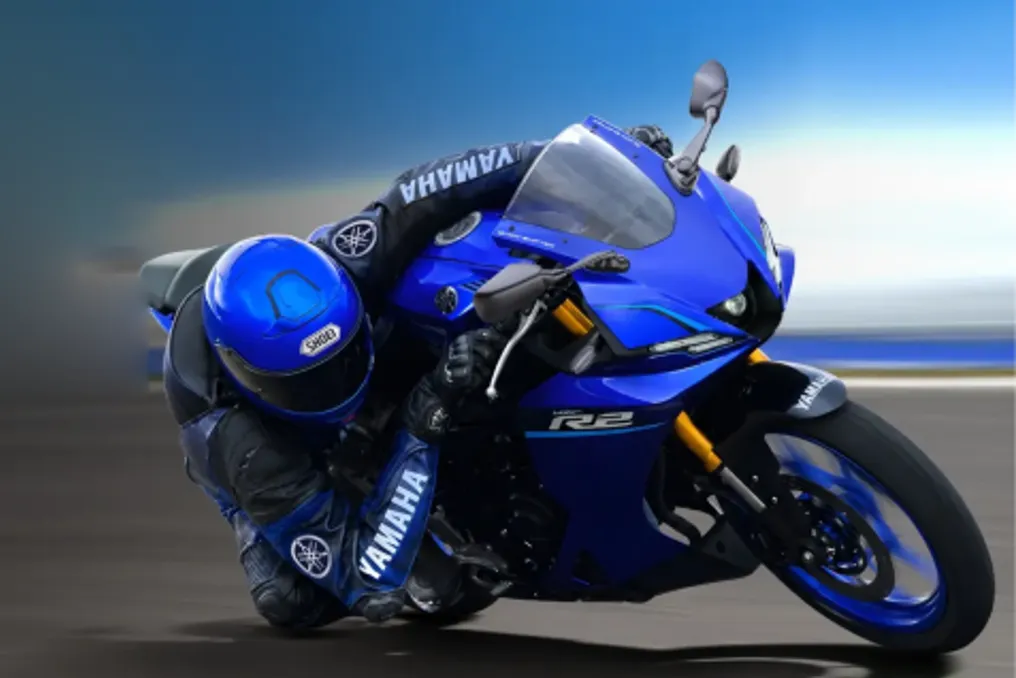
The Yamaha R2 was officially introduced to the Indian market in early September, taking on a significant role as a slightly higher-spec model in a country known for selling a high volume of low-displacement motorcycles. In the Brazilian context, this new motorcycle would represent a middle ground between the R15 and R3 models, making its arrival—which has not yet been announced by the manufacturer—an event that could be extremely successful or a significant strategic error.
More than two years ago, Yamaha introduced the R15 in Brazil, which has since established itself as the smallest sportbike available in the national territory. This decision was successful, attracting both sportbike enthusiasts looking for a simple and accessible model and those who are starting out on the track.
Previously, the brand's smallest sportbike was the R3, a model considered more aggressive for beginner riders. For industry experts, such as Seku Mello, the introduction of the R2 in Brazil could be seen as an opportunity to fill an existing gap between models, although it could also generate negative impacts on the market already established by these machines.
In the Asian scenario, the presence of the R2 makes sense, given that the 200 and 250cc segment is highly competitive and high-volume, especially in India, where it is common to find brands offering bikes in 150, 160, 200, and 250cc.
However, in the specific case of Yamaha, having the R15 already in the national market and launching an R2 shortly after presents a complex situation. According to Seku, this could end up eliminating the R15 in this sportbike niche, despite him acknowledging that it would be good to have another option for the Brazilian consumer, but he predicts that Yamaha might not take that risk in Brazil.
The most logical alternative would be to replace the R15 with the R2; however, given the market's loyalty to the small 150cc sportbike—which even has competitions organized by the brand itself—it is more likely that the manufacturer will wait a few years before launching the new 200cc bike, as the R15 is still relatively new in Brazil.
From a market perspective, positioning a 200cc sportbike between a 150cc and a 300cc model would be somewhat innovative. This initiative would help bridge the large power disparities between the existing motorcycle categories in Brazil, adding more choices to the market, which is a positive aspect. Additionally, Yamaha would be the first major brand to return with a 200cc model in Brazil after more than two decades.
Conversely, the issue of price arises. Considering that the R15 costs starting from R$ 23,690 and the R3, R$ 37,490, the R2 would be priced around R$ 30,000. Even though it is a technologically advanced sportbike, this price range exceeds the national average for engines under 300 cm³.
When questioned by AutoPapo, Yamaha Brazil opted not to comment on the news. This silence was predictable, as it respects the boundaries between the representations of each country. Those awaiting the arrival of the Yamaha R2 in Brazilian stores should be financially prepared to acquire a larger or smaller model, or alternatively, hope for an unexpected move from the Japanese company.
Announced by Yamaha on September 4th, the R2 will be delivered to Indian dealerships in mid-month as a 2027 model, manufactured locally by India Yamaha Motor. The brand positions it above the R15 and aligns it with the strategy for emerging markets, offering three versions that cater from daily use to track days.
A highlight is its 204 cm³ single-cylinder engine—marketed as 200—which operates with four strokes, dual camshafts, four valves, electronic injection, and liquid cooling. It generates 26.1 hp and 1.9 kgfm. Yamaha claims this power is the highest in the 126 to 200 cm³ range and mentions the adoption of semi-dry lubrication to reduce friction losses.
The vehicle features a six-speed gearbox and comes standard with assisted slipper clutch on all trims. The third-generation bidirectional quickshifter is standard only on the intermediate and top-of-the-line versions. Electronic features include electronic throttle (YCC-T), traction control, and different riding modes through the Yamaha Ride Control system—an unusual combination for this displacement and one that specifically creates a distinction from the R15.
Structurally, the chassis is made of diamond-type tubular steel, and the manufacturer specifies a weight of 149 kg. Its design maintains the identity of the R line, characterized by a compact and narrow fairing.