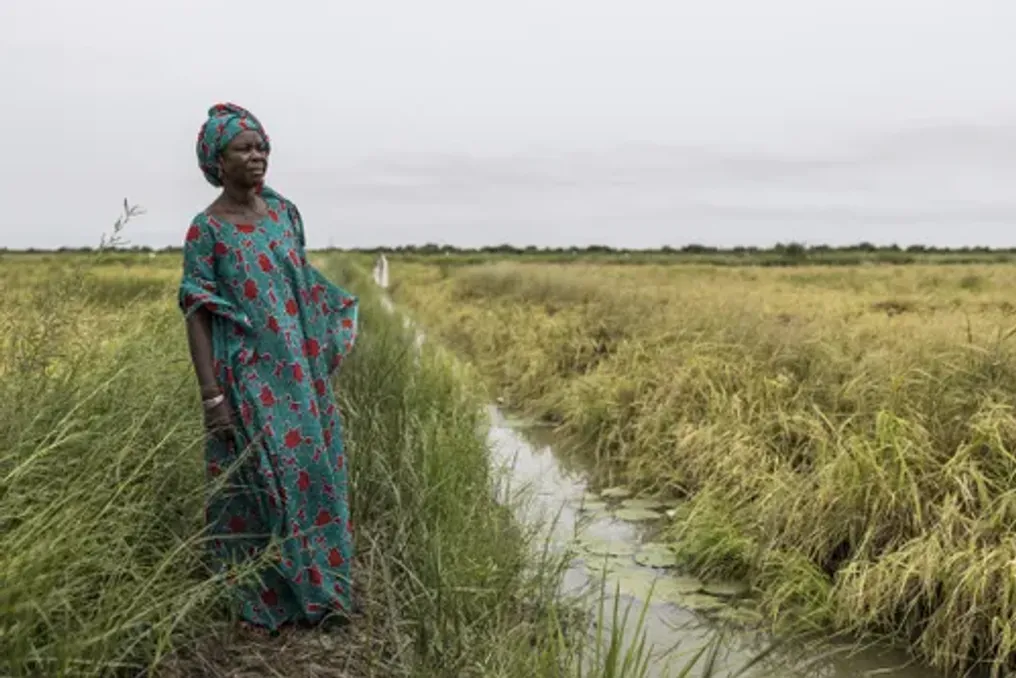
In Senegal, where rice and fish are integral food staples and a source of national pride, scientists are conducting research on the joint cultivation of these two crops in rice fields. Local residents find this approach logical because fish eats snails that cause schistosomiasis, a parasitic disease, and also fertilizes the rice with its excrement.
The study aims to combat one of the global parasitic diseases and increase rice yield by adding fish to the fields, which can then be caught and sold, representing a win for local farmers.
The pioneering study showed that fish destroys snails, which are carriers of schistosomiasis, while simultaneously fertilizing the rice. The village of Lampar, where part of the research is taking place, is located in the valley of the lower Senegal River Gorge, near the border with Mauritania.
Local residents, such as 80-year-old Moussa Ndiaye, who observes the harvest in a northern rice field, live near waterways where fish are traditionally caught. However, fish were not previously kept in rice ponds.
In the region, freshwater snails causing schistosomiasis are widespread. Ndiaye himself suffered from this disease three times, as did his sons who worked in the field. Schistosomiasis can manifest from skin itching to organ damage or death, and although it is treatable, it does not prevent reinfection or compensate for lost time and money.
The World Health Organization estimates that 254 million people need preventive treatment, with 94 percent of them living in Africa. The disease transmission has been recorded in 79 countries.
Scientists introduced Nile tilapia into the rice fields, which fertilizes the fields, and African catfish, which eats snails that cause schistosomiasis. More than 40 farmers from different villages participated in the pilot study and subsequent research.
Emily Selland from the University of Notre Dame, lead author of the paper on the pilot study published in Nature Sustainability, noted that the work covered not only the problem of diseases but also aspects of nutrition, economy, sustainability, and ecology. Her scientific data showed that adding fish increased rice yield by 25 percent, while the average net benefit for rice farming households was at least $380 USD per year. Furthermore, fewer snails were found in the fields with predatory fish.
Abdoulaye Diop, a 62-year-old resident of Lampar, told AFP that he noticed that the fields with fish looked consistently greener than those without. He also mentioned that he used the profits from selling fish to buy sheep and poultry.
On the day of the AFP visit, Ndiaye collected 20 bags of rice, each weighing 80 kilograms. A few days later, he caught over 350 large tilapias and three African catfishes, known locally in the Wolof language as ndiguel.
Mai Diop, who comes from generations of rice farmers, told AFP that she participated in the project to increase income. Like many Senegalese people, she eats rice at least once a day, and her favorite dish is thieboudienne—a national dish made of rice and fish.
At Gaston Berger Aquaculture Center at Saint Louis University, located about fifteen minutes southwest of Lampar, Nile tilapia swam in a large concrete pool. These fish will soon go into the AfricaRice research fields, which will conduct similar studies in a controlled environment. The goal is to refine the process and gather more data before scaling up.
Ali Ibrahim, regional representative of the Sahel AfricaRice station, told AFP that conducting experiments in rural areas involving farmers is directly linked to numerous uncontrolled parameters. Kayla Kauffman from Stanford University's Disease Ecology in a Changing World program, also involved in the work, added that AfricaRice results must be even more convincing because they will have fixed points where the initial number of snails will be known.
Although the work has not yet begun, the scientists are optimistic, and Ibrahim stated that their intention is to scale up this project in many African countries after obtaining the expected results.