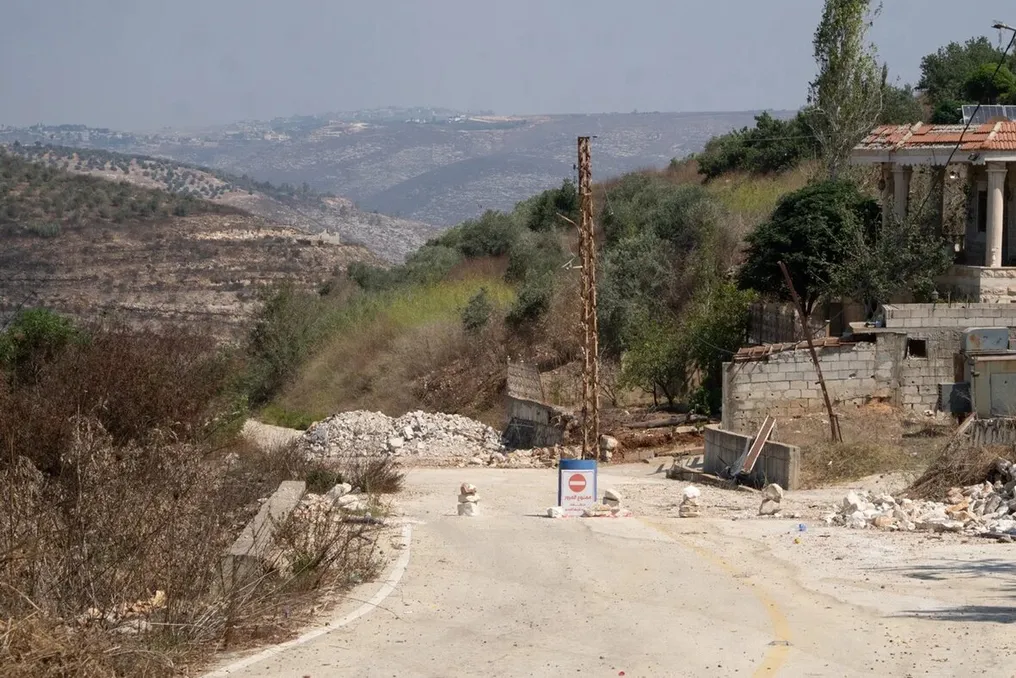
Mariam Ismail Ballout was waiting for a doctor's appointment at the entrance of a mobile medical clinic in Ghandouriyeh, located in southern Lebanon. Around this small mountain village, which was previously a strategic point that Israel attempted to occupy, most houses are either heavily damaged or completely destroyed as a result of shelling that occurred earlier this year.
The 66-year-old Ballout told Middle East Eye while waiting for medication: 'All our houses are destroyed, all our houses lie on the ground, demolished.' She added that her house burned down, leaving them without a washing machine, refrigerator, or gas.
Ghandouriyeh is near Frana, one of the areas designated as 'pilot zones' in the Nabatieh prefecture of Lebanon, and is located outside the 'Yellow Line' established by Israel. However, the situation here is far from stable.
The Wadi al-Khujair valley separates the village from direct sight of Israeli military presence on the opposite side. The only thing separating the outskirts of the settlement from the now inaccessible roads is a large plastic container surrounded by stones and marked with an Arabic sign warning of an 'enemy.'
Mayor Mohammed Ali Nader reported that about 228 families have returned to their homes in Ghandouriyeh despite the lack of water supply or electricity. Many had no choice but to live among the rubble of their homes and share buildings with neighbors because they cannot afford to rent accommodation elsewhere.
The mayor noted that there have been no direct shelling incidents in the village for 'months,' but residents live in a constant state of high alert, which, according to medical specialists, has a profound impact on their mental health.
Critical Assistance
Almas Al Andari, a consultant and clinical psychologist from Médecins Sans Frontières (MSF), told MEE from the mobile clinic that some people who previously had no mental health problems are now showing symptoms of such disorders.
MSF organizes daily mobile medical units in the southern regions of Lebanon, serving as vital support for villages that often lack access to medical care. Al Andari emphasized: 'We definitely see many people suffering from acute stress disorders. And we cannot formally diagnose these symptoms because the crisis is still ongoing.'
According to the organization, since the start of the war on March 2nd, consultants have conducted 1326 individual mental health sessions in southern Lebanon, with teams confirming that requests for psychological support in the region are 'chronically increasing.'
When Ballout arrived at the MSF clinic in Ghandouriyeh on August 28th, a constant drone hum hung over the village—a sound residents describe as almost daily. The grandmother of a 14-year-old girl told MEE: 'I am afraid of drones.'
On that day, only three people came to the clinic, which, according to medical staff, was an unusually low figure. Nevertheless, of those who came, two were new patients seeking mental health support. Al Andari explained that the number of visitors decreased because airstrikes had occurred the previous day, causing people to flee the area again.
The psychologist explained that many cases of mental health issues she recently supported are linked to this year's conflict, as well as the ongoing threat of instability, displacement, loss of homes, livelihoods, and loved ones.
Despite the ceasefire agreed upon with US mediation in June in Lebanon, Israel continues to shell areas, including Nabatieh and Tyre, outside the yellow line, leading to dozens of deaths. The Lebanese Army confirmed last week that it has 'intensified operations' in southern areas that are not currently under occupation, amid signs of escalating tension.
Al Andari repeated: 'We definitely see many people suffering from acute stress disorders. And we cannot formally diagnose these symptoms because the crisis is still ongoing.' She added: 'We find these symptoms where people react intensely to drones or airstrikes, such as tension, hypervigilance, fear, constant anxiety.'
Earlier this year, the Lebanese mental health non-profit Embrace, which runs the country's National Helpline, reported that the volume of calls was 55 percent higher during the 2026 war compared to the 2024 conflict.
However, there is little public data on the current mental health situation in southern Lebanon amidst a fragile 'truce.' But on the ground, the reality is harsh.
Public health specialist Farah Kerbadj told MEE: 'They sleep poorly; there are many sleep disturbances, which causes them severe stress and leads many to take medications related to sleep and mental health conditions.'
Medical workers, such as obstetrician Riem Farhat from MSF, note that patients are often 'very agitated.'
The situation is exacerbated by the stigma surrounding mental health and difficulties in tracking data among displaced families.
Always Ready to Flee
Outside the municipal building where the MSF clinic is located, the mayor of Ghandouriyeh told MEE that the village's most pressing need is access to water, without which people cannot grow enough food. However, many families also appear ready to flee at any moment—a symptom Al Andari compares to hypervigilance.
Resident Mohammed Ghanem stated: 'Honestly, we are fed up. We are fed up with wars; we have enough wars.'
Nader explained: 'People return here. But with any attack, they run, sitting in the valley at the river crossing until the situation calms down.'
Mohammed Ghanem, a local resident standing near the medical clinic, returned to the city with his family in June, happy that his house was still standing, but he still faced difficulties: 'We didn't sleep yesterday,' he said. He is also concerned about the psychological impact the situation is having on his two daughters. His youngest is almost two years old, and 'she has gotten used to the rumbling sound, and now when she hears the rumble, she gets scared.'
Medics suggest that the reason for the increase in patients seeking psychological help may be twofold: people are potentially becoming more aware of mental health support in Lebanon and overcoming previous stigma, but they are also becoming more desperate.
Consultant Georges Jeray from the southern suburbs of Beirut, where MSF ran another mobile clinic, explained that they see cases of mental health issues in waves, one of which is expected about six months after the war this month. He noted: 'Usually, this is the time the brain needs to truly grasp the situation to be able to think about what people are going through.' He continued: 'And the central nervous system calms down during these periods, so other parts of the brain become activated.'
As the session at the Ghandouriyeh clinic drew to a close, another unexpected sound interrupted the silence in the town and briefly drowned out the drones overhead. A pale pink ice cream vendor with a broken windshield slowly drove past the ruins of houses, representing a rare hint of normalcy in the form of a playful jingle. But as the ice cream vendor's sound slowly faded into the hills, it was replaced once again by the threatening buzzing of the drones.
}} , {