The first track from the film 'Ramayana,' directed by Nitish Tiwari, titled 'Jai Jai Ram,' has recently been released. This composition, written by A.R. Rahman, with lyrics by Kumar Vishwas and melodious vocals by Arijit Singh and Shreya Ghoshal, is gaining great popularity among viewers. The song features majestic scenes of the wedding of Shri Rama (Ranbir Kapoor) and Mata Sita (Sai Palvi), as well as the welcome of the residents of Ayodhya with a shower of flowers and emotional moments with King Dasharatha (Arun Govil).
However, the most touching scene in this song is the moment when Shri Rama embraces his younger brother Bharat. Through this song, the filmmakers presented the first opportunity to see actor Adinant Kotare, who plays the role of Bharat. Subsequently, the narrative explores the importance of the character Bharat in the Ramayana and the true essence of the role he portrays on screen.
According to the Ramayana and Ramcharitmanas, Bharat was not merely the younger brother of Shri Rama, but also the supreme embodiment of selfless love, dharma, and sacrifice. He was the son of King Dasharatha of the Suryavanshi dynasty and his beloved queen Kaikeyi. From childhood, Bharat felt deep affection and respect for his elder brother Shri Rama. Bharat married Mandavi, the daughter of Kushadhwaja, the brother of King Janaka.
According to the narration of the Ramayana, when Bharat returned to Ayodhya from his native home (Kaikei Desh) and learned that his mother Kaikeyi had secured two boons from King Dasharatha—to send Shri Rama into fourteen years of exile and to gain the royal throne for herself—he experienced extreme sorrow and shame. Bharat unequivocally opposed this wrongful act by his mother. He clearly stated that the throne of Ayodhya belonged exclusively to his elder brother Shri Rama, and he would not accept any dishonest happiness. He also sharply criticized his mother Kaikeyi's actions.
Following this, Bharat did not remain merely sad; he, along with all of Ayodhya, the mothers, and the teacher Vashishta, went to the forests of Chitrakoot to bring Shri Rama back. The meeting between Shri Rama and Bharat in Chitrakoot was so emotional that the eyes of all present became moist. Bharat fell at Shri Rama's feet and pleaded with him to return to Ayodhya. However, Shri Rama refused to return, upholding his father's promise.
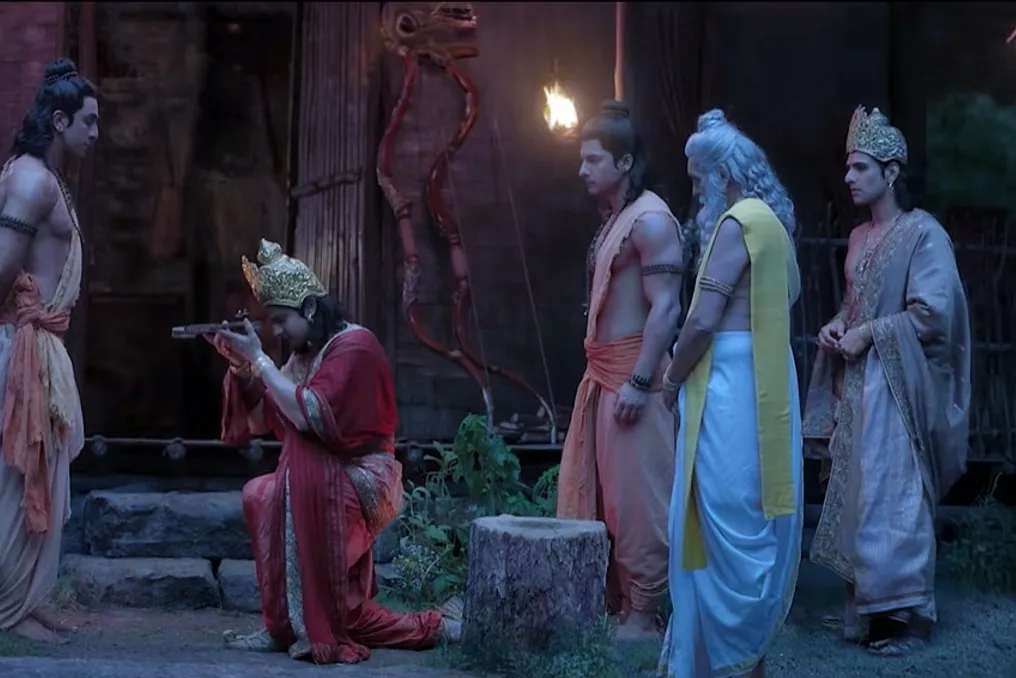
When Shri Rama refused to return, Bharat requested Shri Rama's 'Paduka' (sandals). He vowed never to sit on the royal throne of Ayodhya. Bharat placed Shri Rama's paduka on the throne and governed the state, considering himself only his 'representative' (servant).
Bharat was not just a title of renunciation; he proved it through his lifestyle. He gave up all the wealth and luxury of the palace. Leaving behind the grandeur and comforts of the palace, Bharat built a simple hut outside Ayodhya in Nandigram. There, he spent 14 years leading an ascetic life similar to his brother Shri Rama: keeping his hair long, wearing coarse cloth, eating wild roots, and sleeping on the ground. He believed that if his brother Shri Rama suffered in the forests, he had no right to enjoy the comfort of the palace.
Bharat's message to modern society is that relationships, values, and fraternal love are worth more than any material possessions or positions. He proved that true right is based on dharma and justice, not on violent appropriation.