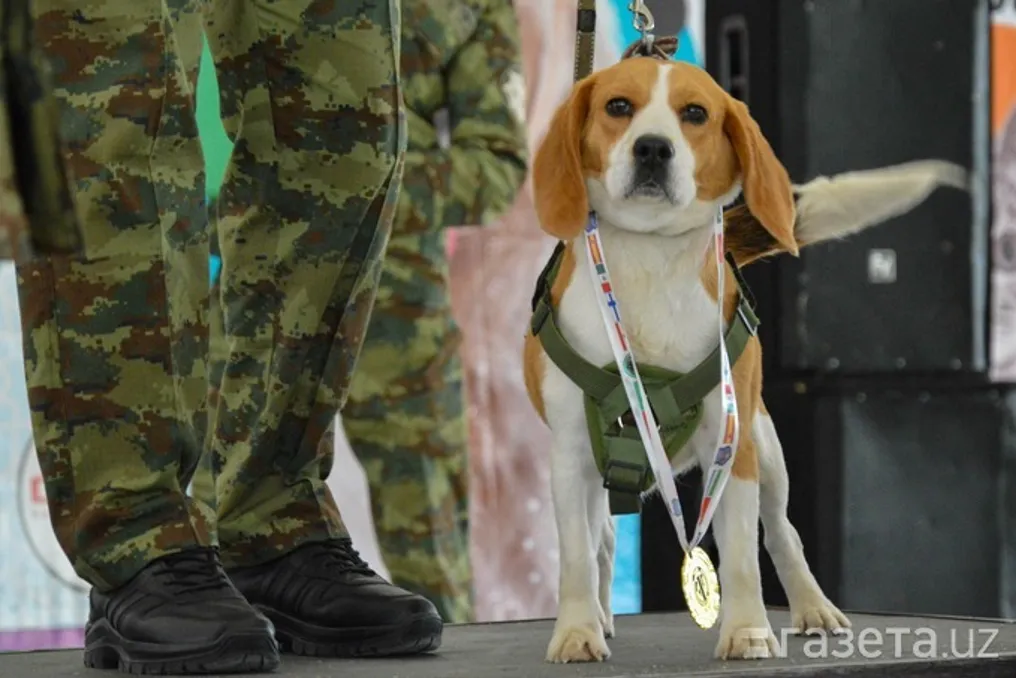
Although nitazenes, which are synthetic opioids, have not yet been detected in Uzbekistan, there is a significant risk of their appearance. These substances, hundreds of times more potent than heroin, are actively circulating on the global black market. This issue was brought to the attention of 'Gazeta' during the World Caninology Forum held in Tashkent last week.
Since the beginning of 2026, Uzbekistan's customs services have intercepted 532 cases of drug smuggling, seizing nearly 1.9 tons of substances from 30 different categories. This significantly exceeds the figures from 2025, when 420 cases were registered and 1.3 tons of drugs were seized. Despite the absence of nitazenes in the seized batches, the Customs Committee considers the probability of their appearance in the republic high due to the dynamics of the global illegal market.
Nitazenes are not a single compound but an entire group of synthetic opioids. Initially, the Swiss company Ciba developed them in the 1950s as potential painkillers, but they never received registration for medical use due to their high potency. On the illegal market, these substances began appearing regularly in the late 2010s.
The situation is exacerbated by China introducing the entire class of fentanyl-like substances under national control in 2019, and Afghanistan authorities banning opium poppy cultivation in 2022. In response, drug traffickers switched to nitazenes, and from 2019 to 2024, these substances have been recorded in 28 countries. The agency emphasized that the main centers for nitazene synthesis are located in China, as Uzbekistan is recognized as a zone of high risk.
The Customs Committee notes that the effect of nitazenes surpasses heroin by 50–250 times, and fentanyl by 10–50 times, and even minimal doses of these drugs can lead to death. For the initial analysis of suspicious cargo, Uzbekistan's customs authorities use portable laser analyzers TruNarc and rapid tests, but the primary task is detecting potentially dangerous contents among luggage, parcels, and goods, which is aided by service dogs.
A special session on training dogs to detect fentanyl, its analogues, and nitazenes was held at the World Customs Organization's World Caninology Forum in Tashkent. Canine specialists from the UK Border and Customs Service shared their experience in developing methods. Tracy Jackson, Head of Training and Technical Preparation, reported that her service encountered nitazenes about three years ago. In 2024, 195 deaths related to these substances were recorded in England and Wales, almost four times more than in the previous year, when there were 52 such deaths.
Nitazenes pose a complex challenge for canines because they include over 180 compounds, including analogues and precursors. Since the synthesis method can alter the odor profile, a dog trained on one type of nitazene may not recognize another. To solve this problem, the service tasked universities with researching common chemical components for the most prevalent nitazenes in the UK. Scientists were provided with 13 pharmaceutical compounds—nitazenes, fentanyl, and xylazine—along with samples seized at the border for instrumental analysis of both pharmaceutical and street batches.
According to Tracy Jackson, the odor characteristics of purely laboratory-produced and illegally manufactured samples proved to be similar. This indicates that producers in clandestine conditions have achieved a high level of skill, effectively mimicking pharmaceutical quality. As a result of the research, the laboratory identified four odor profile components common to all studied nitazenes, based on which a training substitute was created. This allows instructors to train dogs even when real samples seized at the border are scarce.
The question arose regarding the possibility of training a dog to recognize an entire category of odors and to find a variant of a substance it has never encountered. Lead trainer Liz Adams is testing this approach using cocaine as an example. Young dogs are divided into two groups. The control group undergoes traditional training, repeatedly familiarizing itself with one source of the target odor. Dogs in the second group are introduced to the target odor from the beginning in an environment with extraneous stimuli (such as disinfectant wipes, tape, tea bags) and are exposed to samples from five different batches and countries of origin, ranging from 1 to 100 grams.
After completing the course, both groups are asked to locate samples from batches they have not previously encountered. Preliminary data suggests that dogs in the second group learn the material slower, but subsequently demonstrate higher speed and accuracy in recognizing new sources of the target odor. This method is planned to be applied not only for detecting nitazenes; if its effectiveness is confirmed, dogs will be able to be trained to detect various groups of drugs, even if the training samples do not cover the full diversity of substances found at the border.