
Human labor is used to train artificial intelligence, raising concerns about the future of jobs
Read more
Aaj Tak
www.aajtak.in

Human labor is used to train artificial intelligence, raising concerns about the future of jobs

The application of artificial intelligence (AI) is no longer limited to offices, schools, or colleges; it has now reached ordinary stores, integrating into daily tasks. People themselves are training AI to simplify their work. A recent post has caused public concern regarding job preservation.

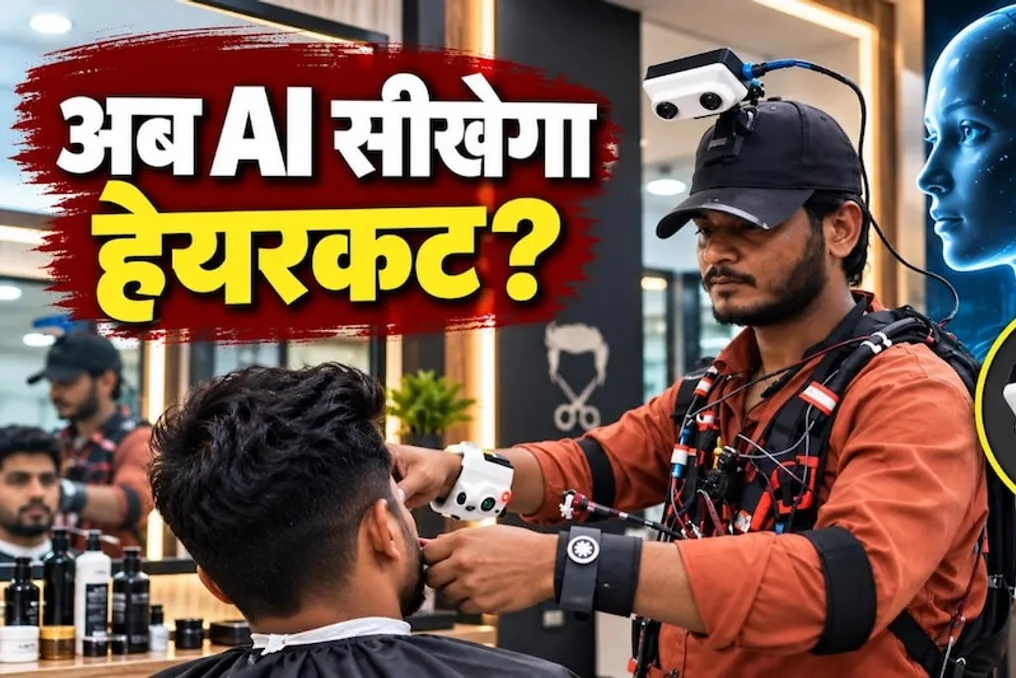
In one instance, a barber demonstrated hand and body movements while filming a client's shaving process. This video material was published by industrialist Harsh Goyanka. Following this, discussions began about how AI and robots in the future might be able to master tasks traditionally considered entirely dependent on human skills.

To improve AI performance, some people are paid to record their daily duties. According to reports, in India, some employees are recording their work using cameras. This helps AI systems understand how a person holds a weapon, how they move objects from one place to another, and how they use their body to perform tasks.

An example is Sunita Rathore, who records the recycling process using an iPhone mounted on her head. According to the report, she earns an additional about 150 rupees per hour. Her duties include removing labels from trash, sorting goods, and collecting bags.

This process is not limited to one type of activity. In factories, warehouses, fields, and other locations, people are also recording their work actions and receiving extra income for it. Such recordings can become training data for AI and robotics. This allows machines to understand human working methods in the real world.

However, this does not mean that machines will immediately replace employees, but it indicates that in the future, human labor and skills may become important data for training AI.

Now, not only production processes are being recorded to train AI. Reports indicate that ordinary household chores, such as cutting fruits and making flower garlands, are also being captured by cameras. Some people are offered up to 250 rupees per hour for recording such work. Videos shot with head-mounted cameras help the machine understand what the person is looking at while working.

The discussion was not limited to this; previously, videos of Indian factory workers wearing cameras on their heads went viral on social media. These videos sparked a debate about whether these employees' work was being recorded to train AI. However, the exact purpose of recording these videos remained unknown.

The barber's work makes this discussion more interesting. Automation is usually discussed in the context of factory or computer work. However, in tasks like cutting or shaving, hand movements, tactile sensations, and experience are extremely important. If these actions are recorded by cameras and sensors for AI training, then in the future, robots may be able to perform such complex physical tasks better.

Nevertheless, the barber's work is not proof of the imminent disappearance of the barber profession; it is merely an example of the growing use of human activity to train AI and robotics.

Currently, people recording their work for AI training receive supplementary income. At the same time, companies and AI developers gain data on real working methods. However, as AI and robots come to better understand human physical labor, this will affect employment opportunities in the future. This will depend on how far the technology advances and how companies choose to use it.
Similar stories

Discussion on the potential impact of artificial intelligence on the hairdressing profession after a viral video
Read more
www.aajtak.in

Discussion on the potential impact of artificial intelligence on the hairdressing profession after a viral video

Artificial intelligence (AI) is perceived differently by the world, but among office workers, there is a fear that their significance may disappear, and the duties they perform may transition to AI, leading to job loss.

This fear has some basis, as reports of layoffs in technology companies appear weekly. AI experts also state that only activities requiring human labor will remain in the future, namely skilled trades such as plumbers, bricklayers, and technicians. However, it remains an open question how accurate this assertion is.

Several videos have gone viral, demonstrating that AI is preparing to penetrate blue-collar professions. Recently, a video was known where hairdressers were being trained using cameras. In connection with this, another video published by RPG Enterprises chairman Harsh Goyanka is actively being discussed on social media.

This video shows a working hairdresser while an AI-controlled system tracks their manner of working and hand movements. Sharing the video, Harsh Goyanka wrote: 'AI training is happening in India! Is the hairdresser's job under threat?'

Nevertheless, one video cannot lead to the hasty conclusion that machines will soon completely replace hairdressers. However, it clearly shows that the influence of AI is spreading to tasks that long required human experience and manual skill.

Haircutting is not just a process of using scissors. A hairdresser must constantly make small decisions based on hair length, client preferences, face shape, and desired style. Hand movements, precision, and timing are also important.

Robotics or AI systems can record a person's working manner using cameras, sensors, and other technical means. This collected data is then used to train the machine on a specific procedure.

It is this aspect that makes this video interesting. The main question is not whether a machine can do a haircut, but whether AI can learn the process by observing human skills.

Discussions about automation initially mainly concerned factory and repetitive work. Then generative AI began to affect office tasks such as writing, coding, design, research, and customer support.

Now, thanks to progress in robotics and computer vision, discussions are growing regarding physical professions. Although it is still difficult for machines to perform precise manual tasks like humans, technology is moving in this direction.

Harsh Goyanka's video points precisely to this shift. This does not mean that a machine will replace every hairdresser. AI may primarily take over some parts of the job or assist the professional.

Currently, there is no basis to believe that this will happen. One demonstration or viral clip does not prove that AI-controlled machines are ready to replace people on a large scale.

Every client's needs are unique. A hairdresser must make on-the-spot decisions considering hair texture, head shape, preferences, and style. Furthermore, communication and trust between the client and the specialist are an integral part of this job.

Therefore, at present, it is more appropriate to view AI not as a direct replacement for a hairdresser, but as a technology that may automate or assist in performing certain parts of this job in the future.

The significance of this video goes beyond just cutting hair. It points to a major challenge of the future. If AI begins to better study human hand movements and working techniques, it could increase the number of professions previously considered entirely dependent on human skills.

Thus, in the future, the question will not only be 'what job will AI take?', but also 'what tasks will humans and AI perform together?'

While the viral video cannot be considered a direct signal of danger to the hairdressing profession, it certainly indicates that the world of automation is no longer limited to computer screens.

Popular