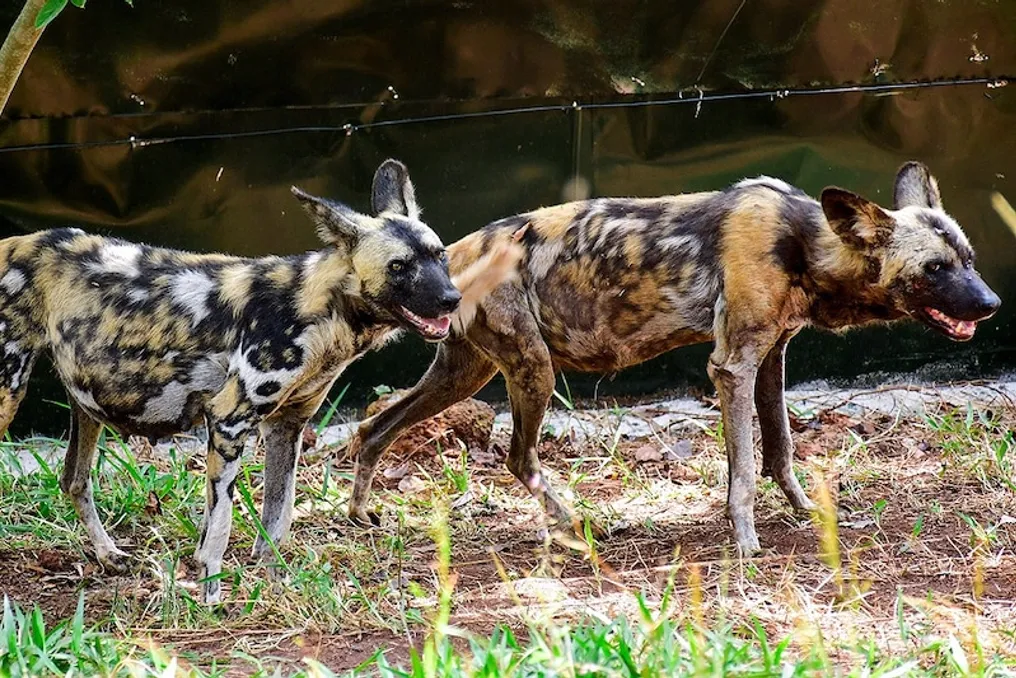
The desire to reproduce is not limited to humans; there is also a struggle for this in the wild that can be surprising. The population of wild dogs in Africa is under threat, with about 6,600 individuals remaining worldwide, divided into 39 different groups. A new study revealed a striking fact: these dogs travel thousands of kilometers across the continent in search of females to continue their lineage.
Specifically, three brother-dogs traveled 4,126 kilometers over eight months. This represents the longest recorded migratory route among all African mammals. This study was published in the journal Ecology. Researchers used GPS trackers to monitor packs of wild dogs in Zambia as they moved from Zambia into five neighboring countries or near them.
Four separate groups collectively covered a distance of 9,863 kilometers, which is more than twice the width of America. Lead researcher Scott Krell stated that he has been studying these dogs since 1991 and never expected to receive results in 2026 showing that most important populations in East and Southern Africa are still connected.
African wild dogs live in strictly regulated packs. Generally, only the strongest pair in the pack reproduces. Other members, especially young individuals aged two and three years, leave the pack in search of a mate and new territory. According to the study, younger members either wait for the opportunity to become leaders, use the help of relatives, or embark on an urgent search for breeding opportunities, which accounts for such long journeys.
This journey is not easy; many dogs die along the way, most often falling into traps set for bushmeat hunting. One female, coded as EWD-1355, traveled 2,300 kilometers from Zambia to Mozambique, where she died in a trap in June 2022. The Zambian Predator Program team tracked these dogs, observing how they repeatedly crossed rivers, large roads, ascended and descended hills in the Great Rift Valley, and passed by cities and lakes.
The population of Zambia increased by approximately 50% after 2010, leading to habitat fragmentation for wildlife. About 40% of the country's territory is declared protected areas, but there is a severe lack of funding. Despite this, wild dogs continue to cover large distances, passing through densely populated areas. Matt Baker, CEO of the Zambian Predator Program, noted that the dogs demonstrate that connectivity still functions, and additional efforts are now needed for its conservation and strengthening. This finding is crucial for nature conservation, as it was previously thought that different populations were isolated from each other, but it is now evident that these dogs can still reach each other.
The study shows that it is not enough just to preserve protected areas; corridors between them must also be protected. These corridors pass through rivers, roads, and cities. Growing human populations and constant expansion of agricultural land lead to the closure of these routes. The problem of hunter traps also remains serious. Snares set for bushmeat often drive wild dogs into traps. There is also a risk of disease, as during long journeys they may come into contact with other animals or domestic dogs. Scientists like Scott Krell have been monitoring these animals for a long time and believe this discovery offers hope.
It was previously assumed that the populations were isolated, but the dogs themselves show that they can remain connected. There is an urgent need to strengthen conservation programs in Zambia and neighboring countries. Lack of funding is a major obstacle. However, if they work together with local communities to remove traps and protect corridors, results can be improved. This study is not just about wild dogs; it demonstrates that large mammals are capable of covering great distances even in areas with human habitation. Conservation strategies must take this factor into account, as protecting migration routes will benefit not only wild dogs but also other animals.