
Hero Motors raises 300 crore rupees from anchor investors ahead of IPO
Read more
YourStory [india, en]
yourstory.com

Hero Motors raises 300 crore rupees from anchor investors ahead of IPO

Hero Motors has successfully raised an amount of 299.99 crore rupees from anchor investors ahead of its Initial Public Offering (IPO), which opens for public subscription today.

In a filing to the stock exchanges, Hero Motors announced that it allotted 57,14,284 equity shares at a price of 84 rupees per share to anchor investors. The automotive technology company set the price band for its IPO between 79 and 84 rupees per share.

Institutional participants in the anchor round included ICICI Prudential Life Insurance Company Limited, 3P India Equity Fund 1M, Edelweiss Life Insurance Company Limited, Societe Generale – ODI, and ASAS Global Fund Incorporated VCC Sub Fund.

Among the schemes oriented towards equities, the company distributed stakes among ICICI Prudential Smallcap Fund, Kotak Mahindra Trustee Co Ltd A/C Kotak MNC Fund, and JM Financial Mutual Fund – JM Flexi Cap Fund, among others.

Out of the total allotment of 35,71,428 equity shares to anchor investors, 29,16,441 shares were distributed among seven domestic mutual funds through 16 different schemes.

The IPO represents a combination of a fresh issue worth up to 600 crore rupees and a sale of equity capital worth up to 400 crore rupees from promoters O P Munjal Holdings and Hero Cycles Limited.

Of the proceeds from the fresh issue, 190 crore rupees will be used for partial or full repayment of certain outstanding loans of the company. Another 200 crore rupees will be allocated to capital expenditures, including the purchase of equipment to expand the company's production capacity in Gautam Buddha Nagar, Uttar Pradesh. Furthermore, the funds will be used for inorganic growth through unidentifiable acquisitions and other strategic initiatives, as well as for general corporate needs.

Hero Motors is engaged in the design, creation, manufacturing, and supply of engineering solutions for powertrain systems to Original Equipment Manufacturers (OEMs) in regions such as the USA, Europe, India, and ASEAN.
Similar stories

Positron AI raises $875 million to scale AI inference hardware
Read more
ventureburn.com

Positron AI raises $875 million to scale AI inference hardware

Positron AI has successfully raised $875 million in a Series C funding round, valuing the company at $5 billion. The company's core business involves developing hardware that makes the artificial intelligence inference process more energy-efficient and cost-effective.

The funding was secured in two stages: first, a Series C round of $375 million was closed, followed by a Series C-1 round of up to $500 million. The main round was led by NEA, Atreides Management, and Valor Equity Partners, with co-leads from Andra Capital and SemiAnalysis Capital participating. The second tranche was led by Jim Clark, founder of Silicon Graphics and Netscape, with participation from several institutional and strategic investors.

The capital raised will allow Positron to significantly expand its growing business in inference and add several experienced technology investors to its board of directors. Forest Basket from NEA and Gavin Baker from Atreides Management will join the board. Thomas Germoluk and Dylan Patel will also become directors.

As AI workloads increasingly shift towards inference, infrastructure is necessary for the continuous operation of models by every AI assistant, agent, and helper. Positron focuses on solving memory and power issues arising from this growth. The company's systems are designed with an emphasis on bandwidth and memory capacity, rather than raw computational power.

The company's next-generation systems utilize standard LPDDR5X memory, which reduces dependence on constrained high-performance memory supply chains. Positron claims its systems can achieve over 90% of available memory bandwidth.

Furthermore, the company focuses on high performance in tokens per dollar and tokens per watt metrics. Positron's architecture supports both air-cooled and liquid-cooled data centers, giving customers flexibility in deploying systems across various rack densities.

Positron already has clients using the first version of the Atlas system. Over 50 Atlas racks have been deployed in Oracle Cloud Infrastructure, where Parasail uses this power for its own inference services. Jump Trading and i3d.net are also production clients of Atlas.

The new funding will be directed towards developing the next generation of silicon chips. The Asimov chip is scheduled for fabrication using TSMC's N3P process by the end of 2026; TSMC describes N3P as an improved 3nm process. Production of Asimov is slated for the second half of 2027. Each Asimov chip will support between 288 GB and 2304 GB of memory, meeting the demands of increasingly complex AI inference workloads.

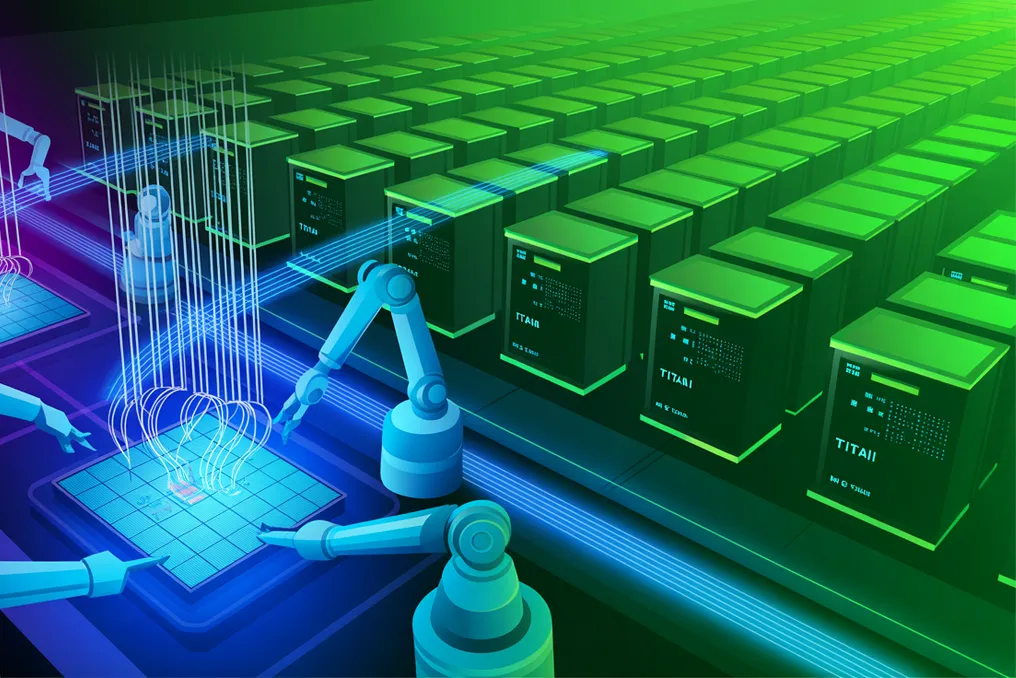
The Titan system will integrate four to eight Asimov chips into a single system and is designed to support models exceeding 16 trillion parameters. Titan will also target context windows exceeding 10 million tokens and can scale to thousands of nodes for larger deployments. Positron also plans to build a data center engineering facility with a capacity of over 2 MW and an emulation platform to support development, testing, and manufacturing readiness.

Positron intends to use the funds to secure LPDDR5X supply commitments, as well as to increase manufacturing capacity and system integration. Go-to-market operations will expand in parallel with production, helping the company meet the growing demand for inference infrastructure.

CEO Mitesh Agrawal noted that the Atlas deployments provided valuable customer insights that influenced the design of Asimov and Titan. The company is currently in a demanding execution phase, requiring it to complete silicon development while simultaneously scaling production and customer adoption.

Positron's strategy is focused on the economic efficiency of AI model operation. Its memory-centric architecture aims to reduce both energy consumption and infrastructure costs. The $5 billion valuation reflects investor confidence in the inference market.

Popular