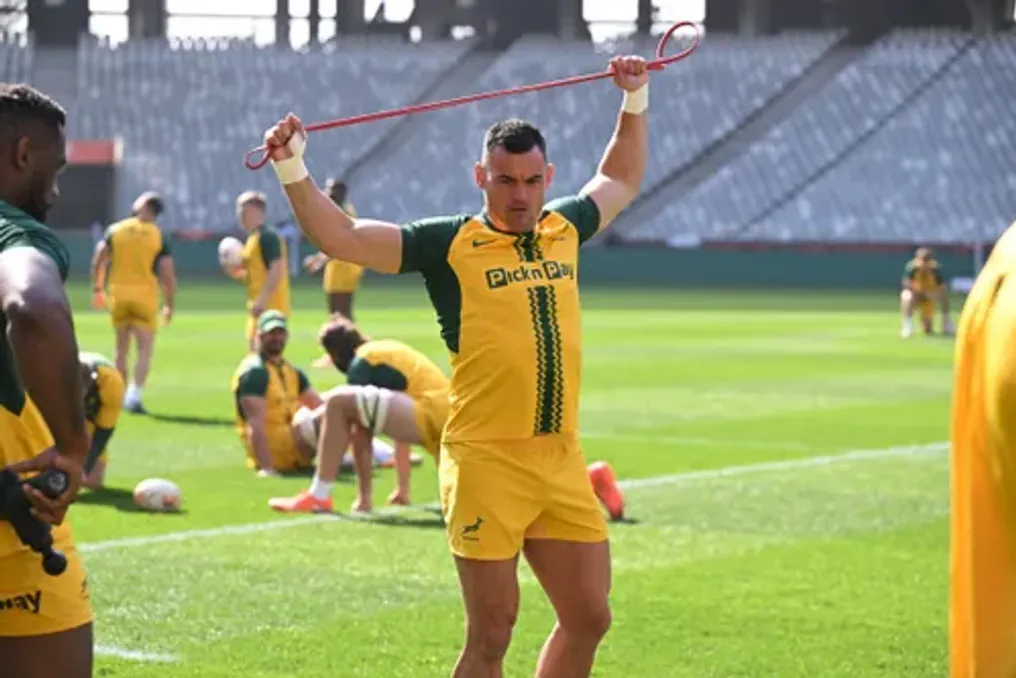
Morne van den Berg argues for increased starting matches for Springbok number 9
Read more
IOL
iol.co.za

Morne van den Berg argues for increased starting matches for Springbok number 9

Scrum-half Morne van den Berg presented compelling arguments during the clash of rugby's greatest rivals, insisting that he should be given more starting positions this season.

Over ten test matches in the green and gold colours, van den Berg has remained undefeated. His performances as number 9 for the Springboks against the All Blacks have established him as a strong candidate for a permanent starting halfback role in the next two matches.

When Grant Williams was sidelined due to injury, van den Berg seized the opportunity and delivered three impressive games. He came off the bench twice in Cape Town and Soweto, making a significant impact, before starting in a 43-28 victory in Baltimore, replacing veteran Kobus Reinach.

Across ten matches, five as a starter and five as a substitute, he maintains his winning streak for the national team. His first test match start was at Optus Stadium in Perth in 2024, where the Boks will meet the Wallabies again in a friendly match in a couple of weeks.

The twenty-eight-year-old player has also shown an ability to interact effectively with three Springboks flyhalves: Sacha Feinberg-Mngomezulu, Mani Leibbok, and Andre Pollard, although he recently did not play alongside the latter due to Pollard's injury.

Despite his box kick having significantly improved, his ability to control the pace of the game during this great rivalry made the biggest impression. This quick number 9 player also demonstrated high physical activity in tackles, which was likely a surprise to many All Blacks players.

But this is what van den Berg did. Judging by his performances, he should be given more opportunities to start in the future. The scrum-half has shown that he can take responsibility in moments of high pressure, and his combination of speed, physical strength, and game management makes the Springboks another strong option at number 9.

In the upcoming friendly against the Wallabies, and later during the Nations Cup in November, Springbok coach Rassie Erasmus may give Reinach a deserved rest and entrust van den Berg with running the halves.

Similar stories

Springboks demonstrate growing superiority over All Blacks in series of matches
Read more
iol.co.za

Springboks demonstrate growing superiority over All Blacks in series of matches

Springboks captain Siya Kolisi and his teammates achieved an impressive result against the All Blacks led by Russell Erasmus, further solidifying the team's dominance over their arch-rival.

The triumphant series for the Springboks, with a score of 3:1 against the All Blacks, revealed a significant gap between these two Southern Hemisphere giants. After the fourth test in the greatest rugby rivalry in Baltimore, where the world champions won 43:28 and secured their first trophy, it is becoming increasingly difficult to claim that these two teams are evenly matched.

The Boks are now operating at a different level, and even the mighty representatives of New Zealand are struggling to keep up. To win three consecutive matches against the All Blacks requires a special team, and this is exactly what the Boks did, concluding the series after a loss in the first match at Ellis Park in August. However, three dominant performances, backed by immense squad depth, allowed them to defeat their bitter rivals.

Squad depth is the defining advantage of the Springboks

What makes the defeat of the world's second-ranked team even more significant is that in the last 10 encounters, the Springboks have won eight times, while the All Blacks have managed only two victories—one in Auckland and one in Ellis Park.

Meanwhile, the Boks have dominated them, especially in the match where they crushed the team 35:7 in Twickenham, the 43:10 victory in Wellington, and the latest win in Baltimore. This indicates that the evolution of the Springboks machine has surpassed the development of the mighty black team, and they are currently dominating their competitors. It is almost unheard of for the New Zealanders to lose three consecutive matches to the same team, let alone eight out of the last ten meetings against them.

However, this is the current situation between the two sides. And the most worrying thing is that in none of the Greatest Rivalry matches were the Boks playing at their best level. Issues such as lineup changes due to injuries, uncharacteristic errors, inability to convert numerous attacks in the 22-meter zone into points, and a high number of penalties slowed down the Springboks at various times. Nevertheless, even making these mistakes, the world champions find a way to win.

This is what currently distinguishes the teams: the depth of the Boks' squad, the ability of all players to fulfill any role, and the quality of that depth. New Zealand has failed to catch up over four tests, and injuries have severely undermined them, with the loss of captain Ardie Savea in the third match likely being the most significant. South Africa has shown them how to cope and win despite various changes, and this kind of depth is currently unprecedented in world rugby. The task now is to continue moving in this direction. Erasmus has demonstrated that they can change tactics and still beat the best in the world.

A warning for the 2027 World Cup

Before the matches against the Wallabies and Italy, before they meet France and Ireland in the Nations Cup, opportunities open up for further squad experimentation from Erasmus and his management. If they manage to include players such as Paul de Villiers, Cameron Hanekom, Johan Grobbelaar, Jan-Hendrik Vessels, Morne van den Berg, Ntutuku Mchunu, Zack Porten, Ben-Jason Dixon, Ethan Hooker, and Edwill van der Merwe, it will put the Boks in an even stronger position ahead of the 2027 Rugby World Cup.

The Boks have already won the World Cup, defeated the All Blacks on home soil, dominated them in South Africa, and crushed them on neutral ground. More importantly, they did this with different combinations, different players, and under different circumstances. Perhaps this is the biggest wake-up call for the rest of the world: this Springboks team is not just beating the All Blacks—it is building sustainable dominance over them, making it a dangerous contender. Currently, the New Zealanders are chasing the world champions, and Erasmus and his management will want to maintain this state for many years to come.

Springboks ready for any conditions in the decisive series match against All Blacks in Baltimore
Read more
iol.co.za

Springboks ready for any conditions in the decisive series match against All Blacks in Baltimore

Springboks assistant coach Mzwandile Stik stated that the team is prepared for any weather conditions that may arise in the final match of the greatest rugby rivalry against the All Blacks, which will take place in Baltimore on Saturday.

The Springboks are preparing not only for the encounter with the determined All Blacks in Baltimore but also for the weather and playing conditions to become another test in the concluding match of this great confrontation. The series is tense, with the world champions holding a 2-1 advantage.

A victory at M&T Bank Stadium on Saturday evening (starting at 23:10 South African time) would allow them to win the series against their main rivals. However, since New Zealand aims to keep the series alive by achieving a 2-2 draw, the Boks expect a fierce battle against a significantly altered team, possibly under Durban-like conditions.

The Greatest Rugby Rivalry

Immediately upon arriving in Baltimore, the Boks felt the humidity, and assistant coach Mzwandile Stik compared these conditions to something similar to Kings Park stadium. Thanks to the presence of several Sharks stars in the squad, as well as other players accustomed to humid climates, the Boks believe they will not have to adapt much to the upcoming conditions.

Stik noted that they use various techniques during training, such as wetting the balls, so that players get used to such conditions. He added that some players played in Durban with the Sharks, so they are familiar with some of these conditions. Regardless of how the weather turns out on Saturday—whether it rains or not—the team will play in its own style.

He emphasized the intention to maintain their playing style and achieve goals in the match while adapting to various field conditions. Stik mentioned the change in field width: it is 65 meters compared to the usual 68 or 70 meters, which provides less space to cover. He suggested that the props would be pleased with the reduced field size, as they would not have to cover such a large distance.

The team visited the stadium on Friday for the captain's run. Stik said it was a wonderful place, and they look forward to this challenge. The Boks must be ready for whatever Baltimore offers, striving to conclude the four-match series on a high note.

After victories in Cape Town and Soweto following a loss in the first match in Ellis Park, they are just one win away from winning the series against their fiercest rivals. Stik added that they want to win not only for the South Africans at home but also for the thousands of fans who will support them in Baltimore.

He stressed the importance of the team playing for all 80 minutes. Both sides have their ways of playing, and they need to insist on their style. They expect a very difficult game and know that opponents will desperately try to level the odds. Furthermore, they want to do this for the people at home and many compatriots from South Africa in America who will support them and represent them well.

Rush defense of Springboks allows All Blacks to score tries in recent matches
Read more
iol.co.za

Rush defense of Springboks allows All Blacks to score tries in recent matches

The ferocious rush defense of the Springboks, which has served as a cornerstone of their success for nearly a decade, is showing signs of weakness this season.

This defensive system, designed to stifle opposing playmakers, restrict width, and provoke mistakes, is known for its intense commitment. However, the Springboks have recently conceded an unusual number of tries, not only during the current high-stakes series against the All Blacks but also in their Nations Championship fixtures against England and Scotland.

The defensive frailties have manifested in several ways. Against Scotland, the Boks were repeatedly vulnerable to inside balls, as attackers capitalized on minor gaps created when defenders advanced too aggressively without securing their inner shoulder.

A similar vulnerability was observed when playing Ireland at home in 2024, where runners exploited weaknesses by attacking both sides of the ball carrier before executing a quick inside pass.

Противостояние величайших соперников регби

Against the All Blacks, the problems have surfaced on the wider parts of the field. A contributing factor involves positional inaccuracies within the rush structure, which were worsened by necessary backline adjustments during the first two Tests.

In the initial Test, injuries in the backline required central defensive linchpin Jesse Kriel to move to the wing, which immediately compromised the communication center at the outside centre position.

During the second Test in Cape Town, indecision regarding structure proved detrimental on the edges. Ethan Hooker, despite performing well overall, struggled with defensive shifts, being unsure whether to defend narrowly or hold wide, leaving him exposed as New Zealand utilized the outer channel.

The All Blacks have also demonstrated clever adaptations to circumvent South Africa's line speed. In Cape Town, New Zealand's attacks frequently originated from deeper positions before initiating their plays. By maintaining a deep stance, their playmakers gained valuable extra time, compelling the Bok rush to overcommit prematurely before distributing the ball through passing lanes into the open space near the outside shoulder.

Flyhalf Ruben Love has been instrumental in this strategy, supported by forwards who delivered superior ball through short passes from the backfield compared to their Springbok teammates. Love consistently appears behind the play after making an initial pass, acting as a reserve player who has significantly troubled the Boks in these wide areas.

Historically, the Springboks have relied on their exceptional scrambling ability to neutralize line breaks. However, the current All Blacks squad possesses such high quality that they have managed to inflict damage whenever given even a slight opportunity.

Acknowledging this danger, the Springboks implemented a significant tactical change in the second half at DHL Stadium. Instead of attacking from the outside-in to suppress the ball carrier, they switched to defending from the inside-out, prioritizing alignment, drift, and tracking to seal off the wide channels.

As the Springboks prepare for the third Test at FNB Stadium in Soweto, improving the precision of their rush defense is crucial, as it remains a powerful tool when executed correctly. The system depends entirely on players making astute choices to enter passing lanes without overextending, while simultaneously committing fully to intercepting both the opponent and the ball.

To regain their formidable reputation, the Boks must eradicate hesitation on the edges and reinstate the precise, suffocating discipline that once earned them world championship status.

Popular