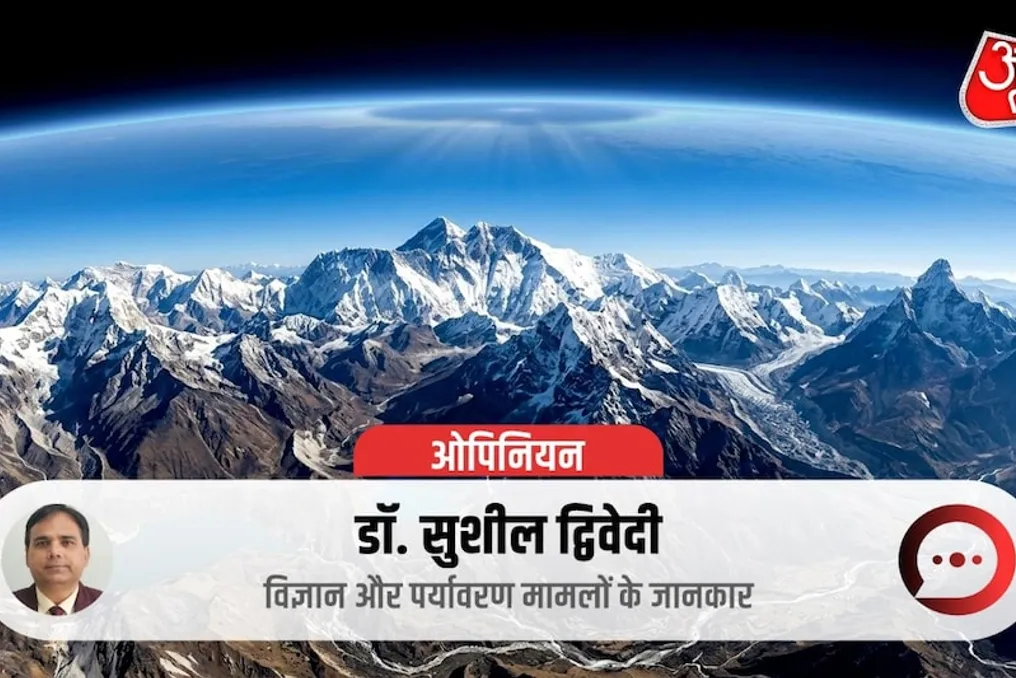
World Ozone Day is observed annually on September 16th. This day serves as a reminder of the invisible natural protective shield that exists in the stratosphere, at an altitude of approximately 15–35 kilometers above Earth, which protects life. Ozone absorbs a significant portion of harmful ultraviolet radiation coming from the Sun, especially UV-B.
If this protective barrier weakens, it can lead to serious consequences for human health, vegetation, agriculture, and ecosystems. However, the story of the ozone layer is not limited to the atmosphere; it is also connected to regions where the effects of climate change are most evident, and among these, the Himalayas hold a special place.
At first glance, the Himalayas and ozone seem like two different topics—one is a gas layer in the sky, and the other is a vast mountain range on land. Nevertheless, climatology shows a deep interconnection between Earth's atmospheric and mountain systems. There is a complex correlation between changes in ozone, the increase in greenhouse gas concentrations, temperature fluctuations, and atmospheric circulation, as well as the climate of the Himalayas.
Ozone is a molecule consisting of three oxygen atoms, and although its amount in the atmosphere is very small, its significance is extremely great. Stratospheric ozone helps maintain conditions favorable for life on Earth by absorbing solar ultraviolet radiation. In the 1980s, scientists discovered that chemical substances such as chlorofluorocarbons (CFCs), emitted by human activity, contribute to the destruction of ozone in the stratosphere.
Following this, the Montreal Protocol was adopted in 1987, which is considered one of the most significant successes in environmental diplomacy. This international agreement regulates the production and use of substances that deplete the ozone layer. According to scientific assessments, the ozone layer is gradually recovering, and if current global policies are maintained, there is a possibility that it will return to 1980s levels in the coming decades.
This success is important because it demonstrates the possibility of controlling global environmental crises through scientific cooperation, political will, and international agreements. However, this does not mean that environmental problems have disappeared. The Himalayas are often called the water tower of Asia. Their glaciers and ice sheets play a critical role in supplying water to major river systems such as the Indus, Ganges, and Brahmaputra, which sustain millions of people. Agriculture, drinking water, energy, and the livelihoods of huge numbers of people depend directly or indirectly on these Himalayan water systems.
But the Himalayas are changing rapidly. Due to rising temperatures, many glaciers are retreating, and the pattern of snowfall is changing in many areas. The expansion of glacial lakes, sudden floods, landslides, and heavy rains create new risks for mountain communities. Across the entire Indo-Himalayan region, including Nepal, India, Bhutan, and Pakistan, the impact of climate change is not limited to the mountains. Changes in the mountains reach the plains through rivers. Therefore, the Himalayas should be viewed not just as a geographical unit, but as a vast climatic and ecological system.
Scientific caution is needed here. The direct cause of glacier melt in the Himalayas is not the depletion of the ozone layer. The main reason for the current reduction of glaciers in the Himalayas is the combined effect of regional and global temperature rise, changes in snowfall, pollutants such as black carbon, and other climatic factors. Nevertheless, ozone and the Himalayas are two important parts of a broader atmospheric system. Ozone affects solar radiation and the thermal structure of the stratosphere, while the increase in greenhouse gases warms the lower layers of the atmosphere. These changes in different atmospheric layers can influence atmospheric circulation and regional climate. High mountain ranges, such as the Himalayas, themselves influence atmospheric circulation. Therefore, it is scientifically more sound to understand the relationship between ozone, climate change, and the Himalayas not as cause and effect, but as interconnected components of the Earth's system.
The ozone crisis taught us that man-made chemicals can affect Earth's natural systems, whose existence spans millions of years. Climate change expands this warning. Today, the growing amount of carbon dioxide, methane, and other greenhouse gases affects the Earth's energy balance. As a result, temperatures rise, and mountain ecosystems change. In the Himalayas, this means rapid changes in ice and glaciers, uncertainty in water availability, and an increasing risk of natural disasters. If glaciers retreat and water accumulates in glacial lakes, catastrophic flooding can occur in some cases due to a sudden glacial lake outburst flood. On the other hand, heavy rains and landslides pose a serious threat to mountain settlements, roads, bridges, and hydropower projects. Therefore, it is necessary to consider...
>