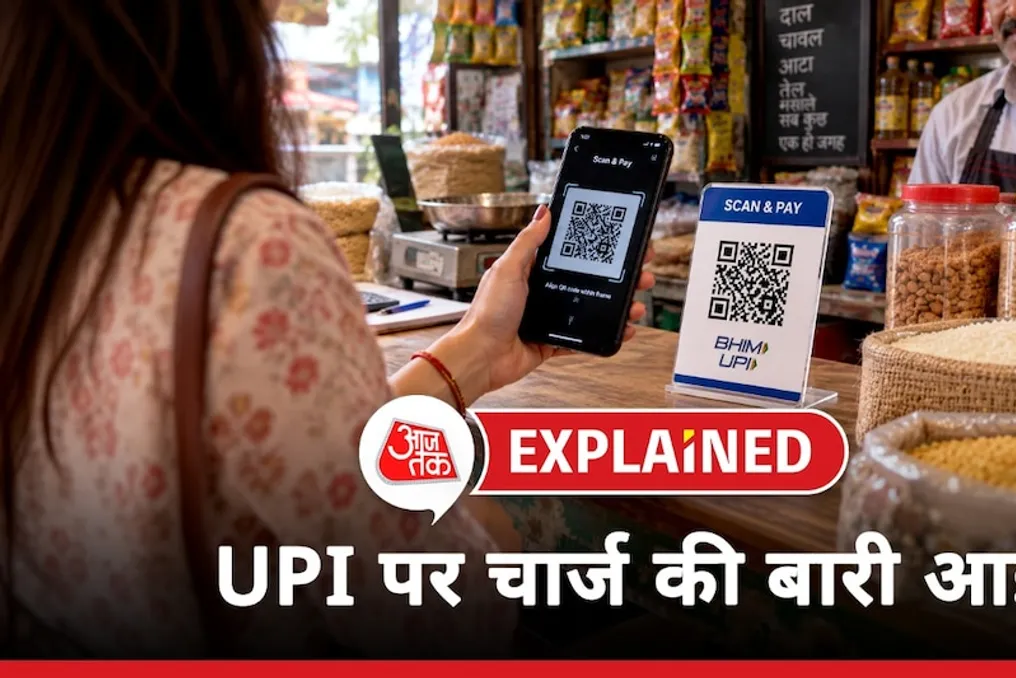
Significant changes will occur starting October 15th regarding the use of UPI, whether it is purchasing groceries in a store or paying in a mall by scanning a QR code. Specifically, a Merchant Discount Rate (MDR) of 0.4 percent will be applied to Person-to-Merchant (P2M) payments exceeding 2000 rupees.
It is important to note that this does not mean the buyer will bear the costs. For example, if you purchase an item worth 5000 rupees and pay via UPI, the MDR will be 0.4 percent, or 20 rupees. However, this amount must be paid by the seller (merchant), not the customer.
For general merchant transactions of 75000 rupees or more, the MDR will be capped at a maximum of 300 rupees per transaction. Meanwhile, Person-to-Person (P2P) payments remain free regardless of the amount.
The Indian government is clarifying the details of this decision. Starting October 15th, the MDR commission will apply to P2M payments. The 0.4% rate will apply to P2M transactions exceeding 2000 rupees. Consumers will not have to pay anything; this commission must be covered by the shopkeeper, trader, or company.
The government has set a limit: even if you pay a merchant 75000 rupees or more, the seller is not obligated to pay more than 300 rupees for the transaction. P2P transfers are completely free regardless of the amount. Furthermore, transactions up to 2000 rupees are exempt from charges, which accounts for over 95% of the total P2M volume.
Fixed fees have been established for certain sectors: in areas such as railways, telecommunications, insurance, fuel, and agricultural resources, a fixed fee of 5 rupees is charged for transactions exceeding 2000 rupees. A fixed fee of 5 rupees is also provided for public utilities and education (such as electricity, water, gas bills, and tuition fees in schools/universities) for amounts over 2000 rupees.
For investment-related payments, such as mutual funds, securities, and brokerage services, a lower rate of 0.02% applies, with a maximum limit of 300 rupees. It should be remembered that all these charges are paid by the merchant, not the customer.
MDR (Merchant Discount Rate) is a charge levied on the seller (merchant) for processing a digital payment. The funds received from MDR will be used exclusively for the development of the UPI ecosystem. These funds will go towards strengthening infrastructure, innovation, enhancing cybersecurity, protecting the UPI infrastructure, and improving customer service. The government asserts that MDR is significantly lower compared to other payment methods like credit or debit cards and wallets.
A P2P payment occurs when one person sends money to another person for personal needs. For instance, if you transfer 4000 rupees to a friend or 10000 rupees to a relative, it is considered P2P because the recipient is an individual, not a business operator accepting payment for goods or services.
A P2M payment arises when an individual pays for a good or service. For example, if you pay Amazon 3000 rupees for goods or pay for dinner at a restaurant, it is P2M. In this case, the recipient is the merchant—an individual or organization engaged in commercial sale of goods or services. The merchant can be not only a large company but also a small local vendor or an individual entrepreneur.
Small traders have special conditions: small entrepreneurs receiving up to 100000 rupees monthly benefit from zero MDR on all transactions, meaning they do not have to pay the government.
The NPCI system, which manages UPI, automatically determines the difference between P2P and P2M by analyzing the type of the recipient's account. If the money is deposited into the personal account or personal UPI ID of a regular person (friend, family, or relative), it is classified as P2P. However, if the funds are deposited into a registered account or via a merchant's QR code, it is recognized as P2M.