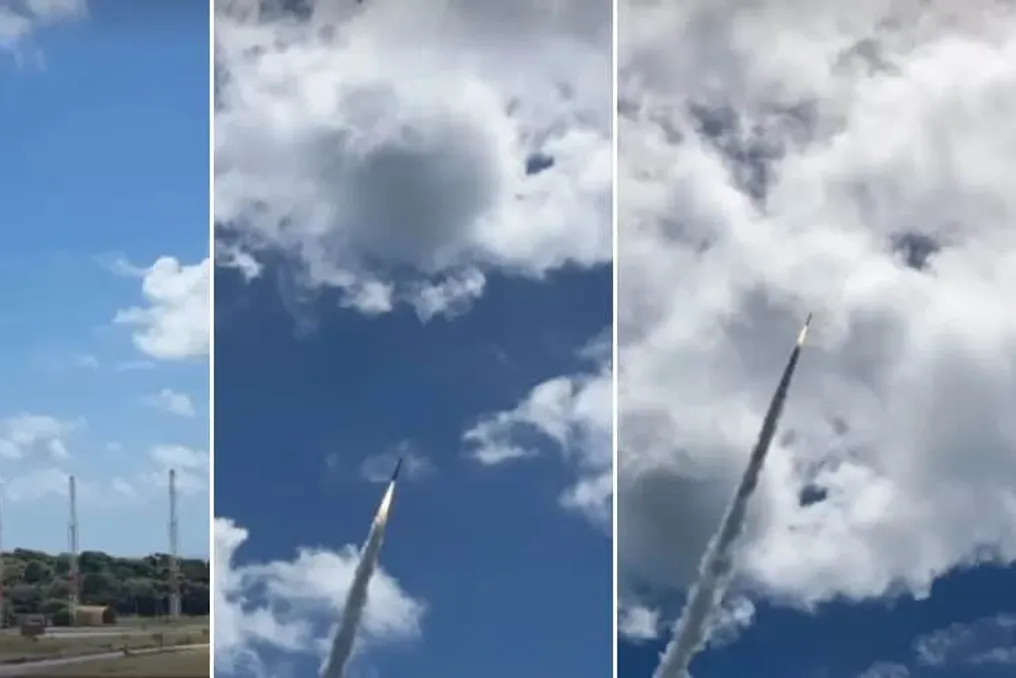
Brazil launched the VS-30 V16 rocket on Tuesday (the 15th), which delivered the Reusable Suborbital Microgravity Platform (PSM-R) from the Barrier Ada Launch Center (CLBI) in Parnamirim (RN). This mission is part of Operation Potiguar 2 and had the main goal of testing the platform's parachute return system under real flight conditions.
Operation Potiguar 2 runs from August 31st to September 19th and continues the first stage conducted in 2024, when the procedures and launch-related systems were tested. In this second phase, the focus shifted to qualifying the in-flight system, which must ensure the return of the PSM-R after the suborbital trajectory.
The PSM-R is part of the Brazilian Space Agency's (AEB) Microgravity Program and is being developed by the Institute of Aeronautics and Space (IAE), Orbital Engenharia, and the agency itself. The platform is designed to support experiments during flight, providing power, transmitting telemetry data, and controlling its orientation.
The launch was carried out by the VS-30 V16, a single-stage suborbital research vehicle developed by IAE. The rocket uses solid fuel, has a track, and is equipped with aerodynamic and rotational stabilization. It is designed to deliver payloads to an altitude exceeding 100 kilometers, allowing experiments to be conducted in microgravity conditions during part of the flight.
PSM-R is expected to reach an apogee of approximately 150 kilometers, based on previous flights. AEB also reported that in its current configuration, the platform has dimensions and mass similar to a typical VS-30 payload, and it represents the largest and heaviest payload ever launched by VS-30.
The VS-30 V16 has a length of about nine meters, a maximum diameter of 600 millimeters, and a total mass of about 1.6 tons. The payload is estimated at 401 kg.
PSM-R carried four modules for scientific and technological experiments, resulting from AEB partnerships with institutions and companies. Three technologies developed or tested by IAE were also placed aboard.
Details of Scientific Experiments
One of the experiments is the Analysis of Microgravity Effects on Microorganisms (AEMM) from Rede Space Farming Brasil, which brings together institutions such as ITA, Embrapa, USP, and INPE. The study assesses the impact of microgravity on microorganisms during suborbital flight, as well as the effect of vibrations on cellular viability.
Two agricultural bacteria are used in this experiment: Bradyrhizobium spp. and Azospirillum brasilense. The first participates in biological nitrogen fixation in soybeans, while the second promotes root development and water and nutrient uptake.
Samples were lyophilized and placed in plastic tubes inside small modules. The experiment also includes graphene biosensors and dosimeters to measure ionizing radiation. After returning, the samples will be analyzed to assess the impact of launch, microgravity, and descent on the microorganisms.
Another experiment, named CTM-Sec and developed by R-CRIO, studies the influence of extreme suborbital flight conditions on the secretome of mesenchymal stem cells. The secretome consists of bioactive proteins, growth factors, and extracellular vesicles produced by cells and possessing therapeutic potential.
The payload also carries MundoTec, a microgravity experiment platform from SENAI CIMATEC. This initiative includes three tests related to acceleration changes and oscillations, with an educational focus on physics and mathematics applicable to space travel.
The fourth experiment is the testing of Antenna for CubeSat Telemetry from Tycho Space, which will evaluate the performance of the antenna for CubeSats under real launch conditions.
In addition to the experiments supported by AEB, PSM-R transports three technologies developed or tested by IAE. One of them is the Pyrotechnic Interface System (SIP), designed to enhance the safety of pyrotechnic lines and enable remote testing and arming in research vehicles and accelerators.
On board is also Bat Li-Ion, a high-energy density battery produced by IAE for use in suborbital vehicles. RangeLoRa, developed in collaboration with the Federal University of Maranhão (UFMA), uses LoRa technology to transmit information aiding in the localization of the payload after landing.
The return of the rocket-launched platform is part of the mission logic itself. After the suborbital trajectory, PSM-R must return using a parachute and then be located and recovered at sea. For this, FAB teams conducted training on communication procedures, checklists, and helicopter positioning maneuvers.
The data obtained during the flight will be used to evaluate the performance of the return system and may contribute to future research in the field of microgravity. The mission is also aimed at generating knowledge and improving qualifications in engineering, science, and space technologies.