Maintaining stability in communication networks, television broadcasts, and data services depends on continuous orbital engineering efforts. At 36 thousand kilometers above Earth, satellites are subject to constant physical perturbations that can deviate their space trajectories. Dedicated professionals work daily on calculating and correcting these invisible routes.
For an artifact to remain in geostationary orbit—a region where the equipment follows the Earth's rotation, appearing fixed over a specific point on the globe—human intervention and constant adjustments are necessary. In conversation with Olhar Digital, astronomer Érika Rossetto, Orbital Dynamics Manager at Claro Brasil, clarified that the system does not operate in isolation, being influenced by multiple external factors that modify the natural movement of these celestial bodies in a vacuum.
Because our planet is not a uniform sphere, variations in its mass distribution cause irregular gravitational attraction, which pushes satellites out of their positions. According to Érika, the shape of the Earth causes a constant longitudinal displacement in the equipment, requiring periodic corrections to ensure trajectory stability.
In addition to the irregularities of the Earth's shape, the influence of the Sun and Moon introduces forces that tend to tilt the satellite's path relative to the Equator line. To maintain alignment with receiving antennas on the surface, orbital dynamics specialists monitor real-time tracking data, using mathematical models to predict deviations before any service interruption occurs.
The operational routine includes the incessant collection of signals from space. Érika detailed that satellites are continuously tracked using antennas to capture this data. Based on this data, it is possible to calculate the orbit and determine the exact position of the satellites, thus allowing for the projection of the orbit's evolution.
The defined area where the satellite must remain is technically called the 'control box,' representing an invisible margin around the artifact to ensure safe operation. If there is no operational intervention, the craft passes this limit and loses alignment with terrestrial antennas, directly compromising the services provided to the population.
For Érika, orbital navigation dynamics are similar to driving a vehicle on a busy highway. She compared the situation to driving a car, where, if the steering wheel is left loose, the vehicle tends to leave the safety lanes, requiring constant control.
Trajectory corrections are performed by activating thrusters powered by onboard fuel. A technical study on Control Maneuvers in Geostationary Satellites points out that optimizing these impulses is crucial for reducing propellant consumption and extending mission lifespan. Érika emphasized that managing this resource judiciously is an essential part of the operational routine.
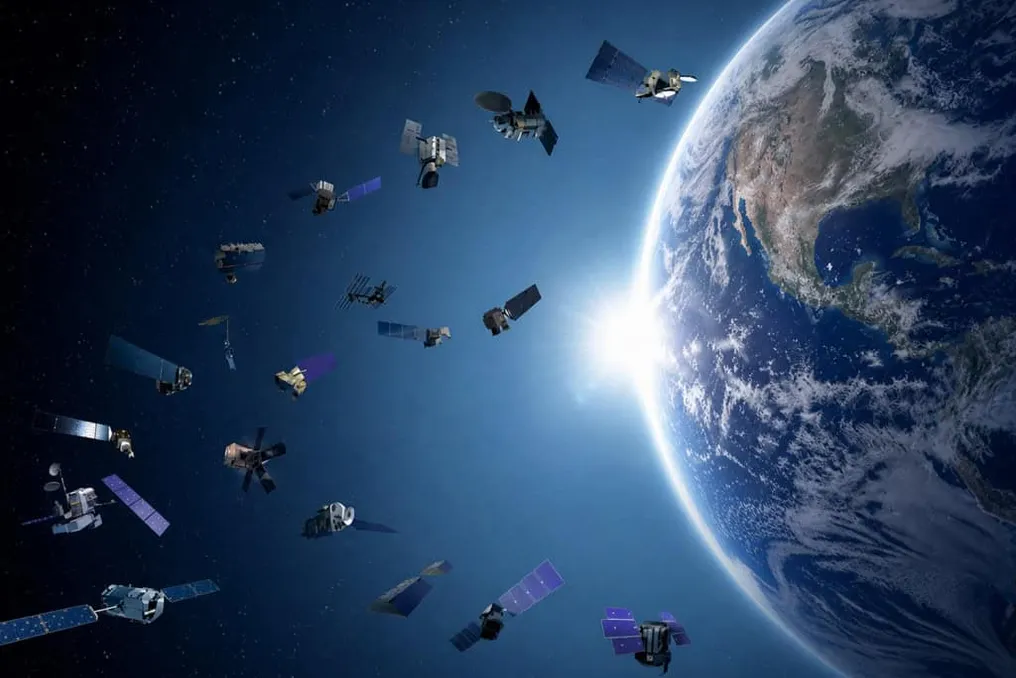
Monitoring gains greater importance with the increase in orbital traffic and the amount of debris. The Orbital Debris Report from Orbital Radar, a German space intelligence company that compiles data from global surveillance networks, indicates that the fleet of tracked objects in space is continuously growing, intensifying the need for precise corrections to prevent collisions and protect active satellites.
When orbital management fails or the spacecraft reaches the end of its useful life without proper planning, operational risks multiply in space. Uncontrolled vessels become significant targets for collisions that generate dangerous fragments. Without active control, these artifacts drift unpredictably, endangering other valuable assets operating nearby.
The astronomer assesses that the accumulation of space junk and the presence of debris constitute a serious problem, but one that requires meticulous technical analysis. She observed that, viewed from outside, the Earth would not show a swarm of bees due to the present bodies, which are mostly small and do not have a dimension comparable to the planet.
However, she stresses that even small objects can cause serious damage if they hit an operational piece of equipment at high speed. Although a catastrophic accident that completely destroys the structure is unlikely, a small debris 'can, like a bullet penetrating a large body, damage some electronic systems.'
The technical complexity of orbital control has increased exponentially in recent years with the emergence of large commercial fleets and the expansion of low Earth orbit usage. The peaceful coexistence of tens of thousands of active satellites requires an unprecedented level of accuracy in mathematical projections and constant data verification to ensure the integrity of global telecommunications networks.
Given the increasingly dense traffic around the planet, government agencies and private operators need to share routes and alerts in real time. Collaboration among space engineering teams is currently the main pillar for ensuring the sustainability of Earth orbits and the continuous safety of the entire global connectivity infrastructure.
With experience from those participating in the direction of the Space Data Association (SDA), a non-profit international organization dedicated to fostering space safety, Érika Rossetto emphasizes that corporate isolation is unfeasible in the current context. She stated that the creation of the SDA arose from the understanding that no operator could guarantee the safety of its satellites alone.
According to her, the union between competing companies demonstrates that preserving the space environment takes priority over commercial interests. 'We understand that it is useless for everyone to do their homework. It is important that companies share data to ensure that the entire community has this security. Because something that can happen to one satellite can impact several others,' explains the specialist.
The discreet work carried out by engineers on the ground allows modern society to benefit from connectivity, weather forecasts, and navigation without being aware of the physical challenges inherent in the space environment. Every adjustment made to the thrusters ensures the stability that keeps the digital world fully integrated into our daily lives.
Maintaining these routes in a vacuum represents the delicate balance between celestial mechanics and human engineering capability. Without these permanent calculations and rigorous management of remaining fuel, the orbital environment would become chaotic, making vital services that support everything from the international financial system to emergency communication unviable.