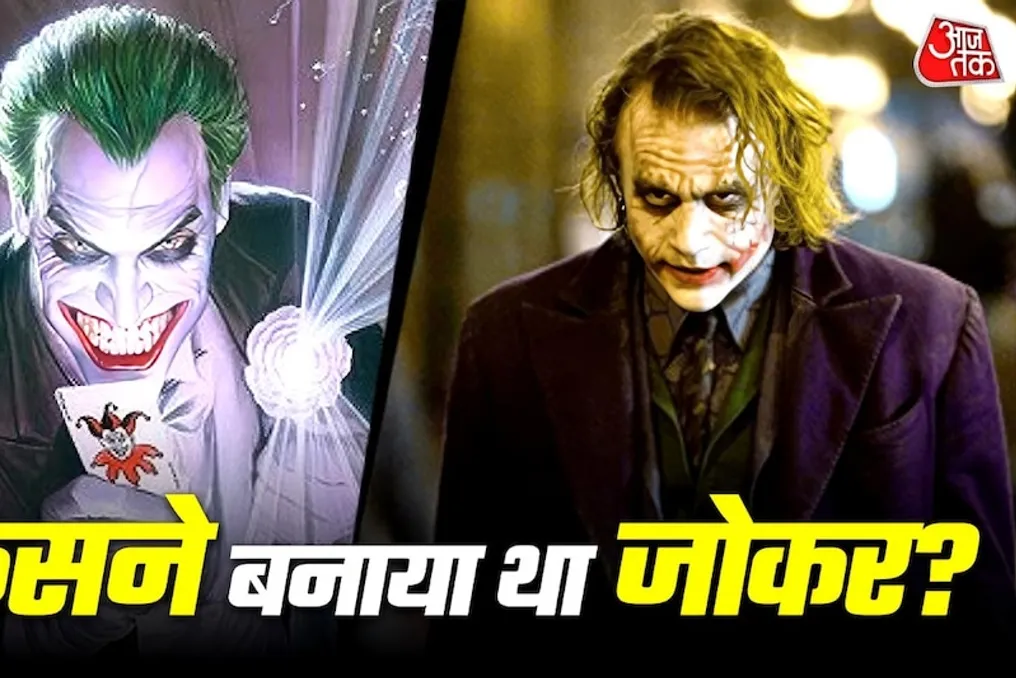
Many antagonists have appeared in pop culture history, but the image of the Joker, with his white face, green hair, and terrifying smile, has left the most profound impression. This character, who first appeared in comic books in 1940, moved to the big screen and transformed from merely a supervillain into a significant symbol of chaos and philosophical contradiction.
The story of the Joker goes beyond his frightening appearance; it encompasses his origins, mysterious past, journey from comics to television and cinema, and the reasons why this character has gained increasing significance over time.
The Joker's first appearance was recorded in Batman #1, published in 1940, and was created by Bill Finger, Bob Kane, and Jerry Robinson. Notably, the inspiration for the Joker came from the 1928 film 'The Man Who Laughs.' In this film, Conrad Veidt played a character named 'Gwynplaine,' whose face bore a permanent, eerie smile due to childhood tragedy.
The combination of this face with the Joker's playing card mask allowed for the creation of Batman's main adversary. In his first appearance, the Joker was not a clown but represented an extremely cunning, cold, and cruel serial killer. He used 'Joker Venom' to kill victims, which induced the same horrifying smile on their faces.
Although Batman's past is well-known, an official answer about who the Joker was was never given. The first hints of his backstory appeared in DC Comics #168 in 1951. According to the plot, he was initially a masked criminal named 'Red Harpe.' While escaping Batman, he fell into a vat filled with chemicals.
The effect of these chemicals changed his skin to white, his hair to green, and his lips to red, after which he lost his mind and became the Joker. Later, in 1988, Alan Moore's graphic novel 'The Killing Joke' gave his psychology a new dimension. In it, he is depicted as an unsuccessful stand-up comedian forced into crime to feed his pregnant wife.
Tim Burton's 1989 film 'Batman' was a turning point in cinema. Jack Nicholson embodied the Joker as a gangster named 'Jack Napier.' This movie was the first to demonstrate that a villain could receive the same attention and fame as the main hero.
Subsequently, in 2008, Christopher Nolan's film 'The Dark Knight' radically changed the perception of the Joker. His version of the Joker did not fight for money or power. He believed that 'some people just want to watch the world burn.' He challenged Batman's rule of non-lethality and tried to prove that societal law and order were merely a facade. Thanks to this character, Heath Ledger became a legend and won an Oscar for his role.
In 2019, the film 'Joker,' directed by Todd Phillips and starring Joaquin Phoenix, expanded the boundaries of the comic book genre. In this movie, the Joker is presented not as Batman's antagonist but as a mentally traumatized and socially rejected man named Arthur Fleck. The story shows how societal indifference and systemic failure can turn an ordinary person into a symbol of violent rebellion. For this role, Phoenix received the Oscar for Best Actor.
The Joker's journey, which began on the pages of a comic in 1940, now spans comics, television, and cinema. He has ceased to be merely a supervillain, becoming a character associated with fear, anger, chaos, and contradictions, taking on different forms in each era.