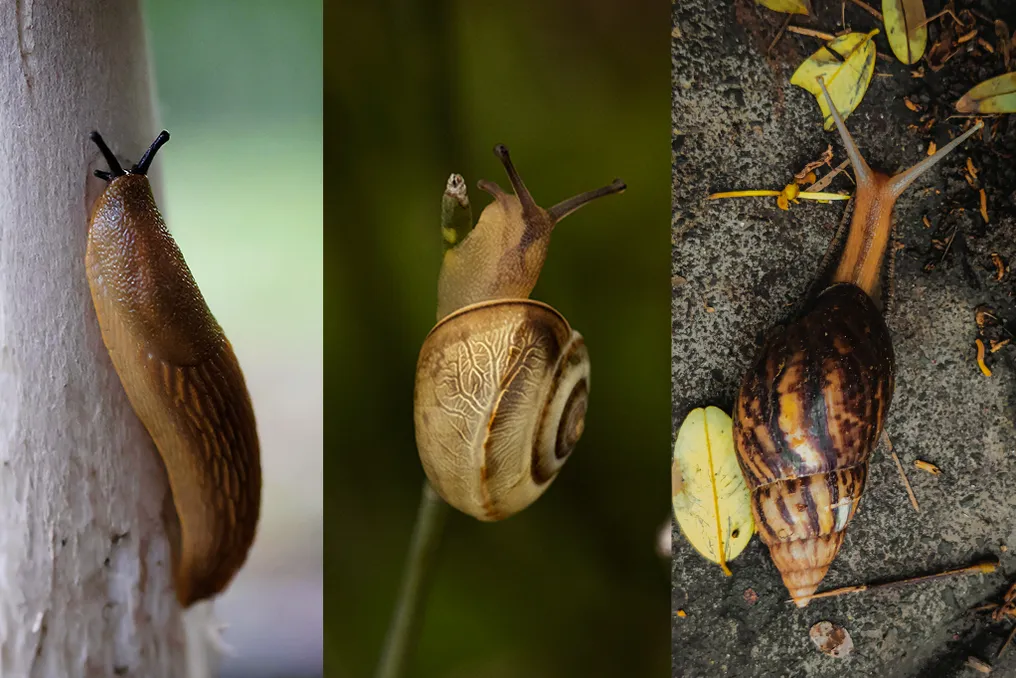
Although often confused, slugs, snails, and shells are gastropod mollusks that exhibit important distinctions. The main difference between them lies in the possession or absence of a hard external shell, a factor that determines their classification and way of life. A snail with its spiral shell serves as a classic example to understand these species.
They all belong to the same class of gastropods, but the slug is distinguished by not having a visible external shell or by possessing a vestigial structure, usually internal. Furthermore, they can be found in both terrestrial and marine environments.
On the other hand, snails and shells are defined by the presence of their protective shells. In common Brazilian usage, the term 'caracol' (snail) is typically linked to terrestrial species, while 'caramujo' (shell/snail) usually refers to aquatic gastropods, whether freshwater or saltwater. However, scientifically, this division is not so clear.
It is estimated that these animals total about 75 thousand species, and their fossils date back 500 million years. Biologist Luiz Ricardo Simone, from the USP Zoology Museum and author of 'Land and Freshwater Molluscs of Brazil', points out that there are approximately 30 to 40 families of slugs, compared to about 400 families of snails and shells.
Despite the apparent simplicity, these mollusks have a complex anatomy. Slugs and terrestrial snails share a fundamental body composition: head, foot, and visceral mass. In terrestrial species, the head has four retractable tentacles—two for vision and two for touch and smell—a characteristic that not all gastropods possess; many marine and freshwater snails have only one pair of tentacles, with eyes located at the base, not on the top of retractable stalks like terrestrial snails.
The shell of snails and shells, which originates as a protoconch, is composed of three layers secreted by a gland in the mantle: the periostracum (outer, protective, made of conchiolin), the prismatic layer (intermediate, of calcium carbonate), and the nacreous layer, or mother-of-pearl (inner, responsible for shell repair).
Respiration differs significantly among groups. Terrestrial species use lungs, exchanging gases through a lateral pneumostome, in addition to absorbing oxygen through delicate skin. Among aquatic species, the respiratory method varies according to the group: most marine and freshwater snails breathe through gills, but some freshwater gastropods, such as snails of the genus Biomphalaria—hosts of the schistosomiasis parasite—have developed lungs to surface and inhale atmospheric air.
Many terrestrial gastropods are hermaphrodites, possessing male and female reproductive organs, but require a partner for cross-fertilization. To feed, they use the radula, an organ resembling a tongue equipped with 'teeth' used to scrape and cut food, which can be plants, organic matter, or other mollusks.
For locomotion, slugs and snails rely on a mucus secretion produced by an abdominal gland, which facilitates the animal's glide. They move through undulating movements, similar to those of snakes and earthworms. Smaller animals (up to 1 millimeter in length) use thousands of cilia located on the belly, functioning as tiny feet.
The movement process begins by raising the head at an angle of 20 to 30 degrees relative to the ground. Subsequently, the rest of the body extends, and the parts moving away from the ground alternate along the slug's body, restarting the cycle.
The role of these mollusks in the ecosystem is crucial, and their absence can lead to environmental imbalances. However, certain types of snails and shells pose risks to human health. For example, some snails of the family Planorbidae are vectors of the parasite that causes schistosomiasis, a serious disease.
Another risk is presented by the African giant snail (Achatina fulica), introduced in Brazil as a substitute for the garden snail. The mucus of this animal can transmit two distinct nematodes of the genus Angiostrongylus: A. cantonensis, which causes a neurological form of the disease (eosinophilic meningitis), and A. costaricensis, linked to an abdominal manifestation with intestinal symptoms.
Nevertheless, not all gastropods are dangerous; the snail, a terrestrial snail of the family Helicidae, is appreciated as a delicacy in world gastronomy.
Regarding the belief that these animals 'melt' or die with salt, this painful practice exposes the fine and permeable skin of the gastropods to direct contact with salt, creating an external medium with a salinity concentration much higher than the animal's internal concentration. Due to osmosis, water constantly migrates from the less concentrated medium to the more concentrated one, resulting in fluid loss from the organism and death by dehydration.