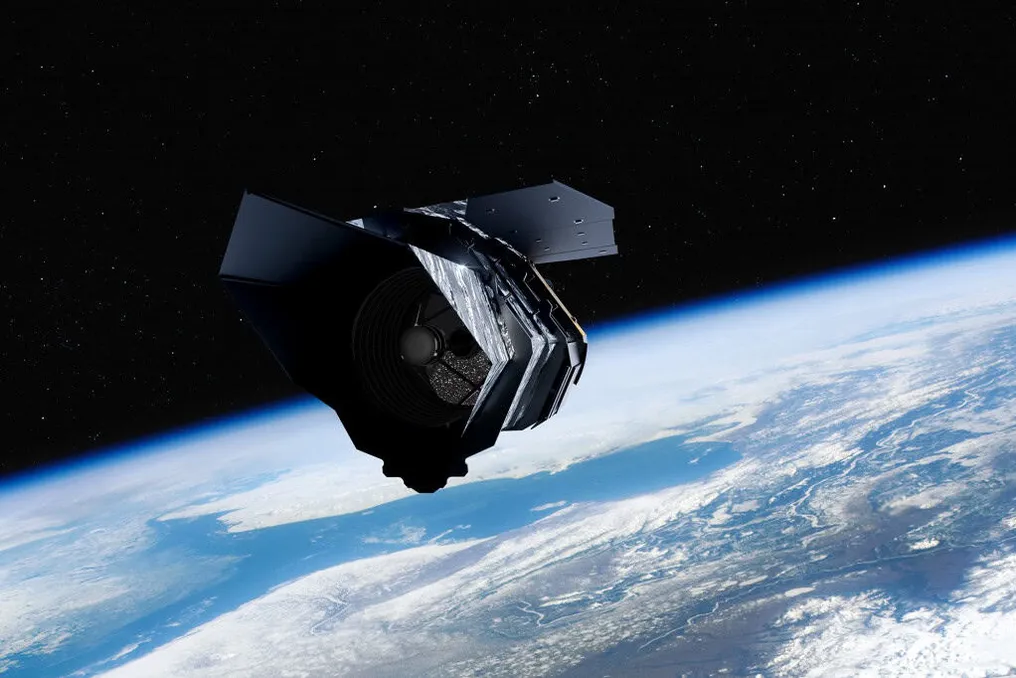
NASA's Nancy Grace Roman Space Telescope, which has not yet reached its planned orbit around the Sun-Earth system's second Lagrange point (L2), has been given a significantly longer mission outlook. Thanks to fuel savings during the initial flight phases, the probe is capable of conducting scientific observations for 22 years.
The original plan called for five years of initial observations, followed by another five years of extended mission. Now, the total mission duration could reach 22 years.
Jamie Dunn, Director of NASA's Goddard Space Flight Center, stated that 'thanks to our team's exceptional orbital dynamics planning, the brilliant execution of the operations team, and the precise launch by SpaceX, Roman has enough fuel for potential scientific operations for at least 22 years.'
Alison Rao, who is responsible for Roman's propulsion system at Goddard, explained that because Roman's mass turned out to be less than calculated, they were able to fill the fuel tanks to maximum capacity instead of just what was needed for the ten-year requirement.
The difference was substantial: the 2015 reference document assumed a total spacecraft mass of 4,166 kg, using only 107 kg of fuel. Later, as the project evolved, the projected mass increased to 9.8 thousand kg. However, upon launch, Roman weighed 8,056 kg. Since there was extra space in the tanks, the lower mass allowed for more fuel to be loaded.
According to the mission resource study, this extra fuel can provide about four additional years of observation.
Another gain came from the first trajectory correction after launch. The maneuver took place on August 31st and was completed with over 99% accuracy. In addition to high accuracy, it also benefited from the spacecraft's lower weight. During the correction, which lasted about three minutes, NASA used only 18 kg of fuel against a planned 200 kg, which is less than 10% of the initially reserved amount.
The next trajectory correction is also expected to consume less fuel than planned because the first maneuver was so accurate. The final phase of the flight should also contribute to savings. It is planned that Roman will be placed into a halo orbit around L2 in early December, and NASA expects this maneuver to also require less fuel than originally anticipated.
After reaching orbit, the telescope will only need periodic small burns to maintain its trajectory, approximately every 28 days. Collectively, these factors could provide about 12 additional years of observation.
More Details:
The first five years of the mission will primarily be dedicated to Core Community Surveys, including the High-Latitude Time-Domain Survey.
The five years originally planned for the extended mission will be devoted to the General Observer (GO) program, which provides observation opportunities for a wider community of astronomers and astrophysicists. About 50 applications have already been prepared for the GO program. NASA has not yet announced how the approximately 12 additional years of observation will be utilized, but the program should cover a significant portion of this period. Major research may also receive additional time.
Roman is still equipped with a coronagraph—an instrument that serves as a technology demonstrator for a future planet-hunting mission. If the equipment shows good results, it may also be used during the additional years of the mission.
The telescope was originally named WFIRST (Wide-Field Infrared Survey Telescope) but later received the name Nancy Grace Roman in honor of the first director of NASA astronomy. Initially, the project envisioned a 1.5-meter mirror, but during development, the telescope received a 2.4-meter mirror, which was originally designed for an observation satellite. After many years of project changes and discussions regarding funding and scientific goals, Roman is approaching the operational phase.
Upon arrival at L2, the spacecraft will undergo commissioning and testing before beginning scientific observations. The article about the Roman Telescope potentially doubling the mission duration and remaining in space for 22 years for the first time appeared in Olhar Digital.