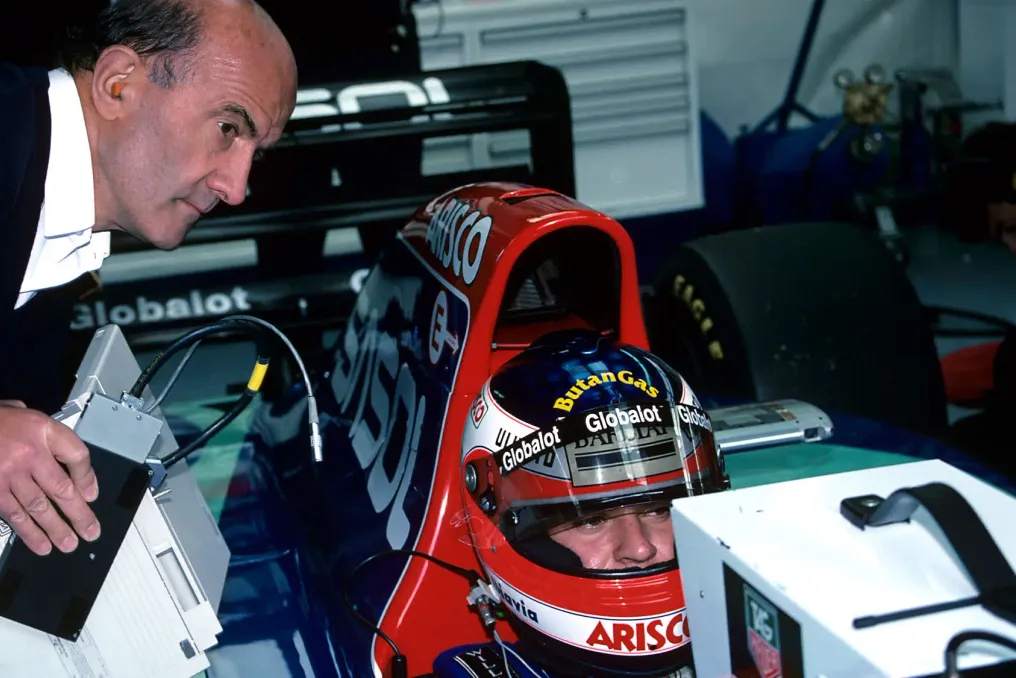
Brian Hart, who would celebrate his ninetieth birthday in September, is a historical figure in motorsport whose relevance may go unnoticed by those who do not follow Formula 1. Although the current category is dominated by large corporations, massive budgets, and complex engineering departments, Hart's legacy dates back to a simpler era focused on raw power.
Hart was one of the last engine engineering specialists in Formula 1, representing the 'romantic era' of the sport, when the main focus was building the fastest car, relegating issues such as emissions, fuel consumption, and safety to secondary plans.
Operating from a modest workshop in Harlow, Essex, with a small team, he challenged giants like Renault, BMW, Ferrari, TAG-Porsche, and Peugeot, both in the turbo engine era and the peak of powerful V10s. His career is marked by the irony of transforming modest teams into competitive forces, but the success of his creations often attracted the interest of major manufacturers, who eventually replaced his British workshop.
Brian Hart's initial contact with motorsport occurred in post-war England, starting as a driver. Born on September 7, 1936, in North London, he first worked in the aeronautical industry, learning about high-precision machining and thermal tolerances at Havilland. In his free time, he perfected his own cars, using a Lotus Seven with a Ford side-valve engine, participating in the 1172 Championship organized by the 750 Motor Club.
His talent led him to the workshop of Mike Costin and Keith Duckworth, founders of Cosworth. Initially, he frequented the place to buy parts, but soon he was invited to work full-time, working both on the test bench and as a test driver. During the 1960s, he competed in Formula Junior and Formula 2 with Ron Harris's team, even participating in the 1962 Formula 1 Crystal Palace GP with a private Lotus-Climax, finishing fifth.
A decisive moment occurred in 1967 at the Mallory Park circuit, when he witnessed Jim Clark masterfully overtake a Lotus 22 with a Cosworth engine. This friendly gesture made Hart reevaluate his future; recognizing that he would not be a driving genius like Clark, he decided to focus on engineering. In 1969, he abandoned his driving career and founded Brian Hart Limited (BHL).
The Ford Boost
Initially, BHL relied on preparation and modification work for third parties, with the main client being the British Ford racing division, managed by Peter Ashcroft. Ford needed a company to develop and improve the BDA engine, a Cosworth project for the Ford Kent. Since Cosworth did not have the necessary industrial capacity to meet the demand for the Escort in rallies, Hart took on the contract.
In 1971, Ashcroft identified the need to increase the engine from 1.6 to two liters to maintain competitiveness. Cosworth determined that the original cast iron block would not allow such an increase due to the distance between the cylinders. Taking advantage of his knowledge gained in aviation, Hart took a bold step: he designed and had a completely new block cast, made of lightweight aluminum alloy, applying an internal chrome coating, without consulting anyone.
Peter Ashcroft witnessed this innovation in 1972 when he found the gleaming aluminum block in the workshop. After testing it in a Ford Escort RS, the engine proved to be extremely light, efficient in heat dissipation, and powerful, securing victories in the 1972 Isle of Man TT and RAC Rally, initiating the Escort's dominance in the WRC for over a decade.
Not content with merely refining others' ideas, Hart decided to create his own product. Encouraged by John Surtees, he designed the 420R engine, a two-liter, four-cylinder inline engine with four valves per cylinder, intended for Formula 2. The only condition imposed by Stuart Turner, Ford's racing director, was that the engine maintain dimensions compatible with the Escort. In 1975, the Hart 420R established itself as the standard to be surpassed in F2, and it was crucial for the dominance of Brian Henton and Derek Warwick with Toleman Motorsport in 1980.
The F1 Debut
At the end of 1980, Ted Toleman and Alex Hawkridge decided to move to Formula 1, driven by their success in Formula 2. However, F1 was at the height of the First Turbo Era, dominated by Renault, Ferrari, and BMW. A naturally aspirated two-liter engine would have no chance against the 1.5-liter turbocharged engines.
Hawkridge pressured Hart: either BHL would develop a four-cylinder turbo engine based on the F2 block, or Toleman would buy turbo engines from Lancia. Hart, who had never worked with turbochargers, later admitted his lack of knowledge about intercoolers. Furthermore, he knew that entering F1 without the financial support of a major manufacturer meant the risk of bankruptcy.
The debut of the Toleman-Hart partnership in the 1981 season was extremely difficult. The Hart 415T engine suffered from turbo lag compared to European competitors and, critically, presented a persistent failure to contain internal pressure in the cylinder head gaskets, leading to gasket burnout after just a few laps.
The first car, the Toleman TG181, was described as heavy, wide, and very unstable. Hart ironically nicknamed it the