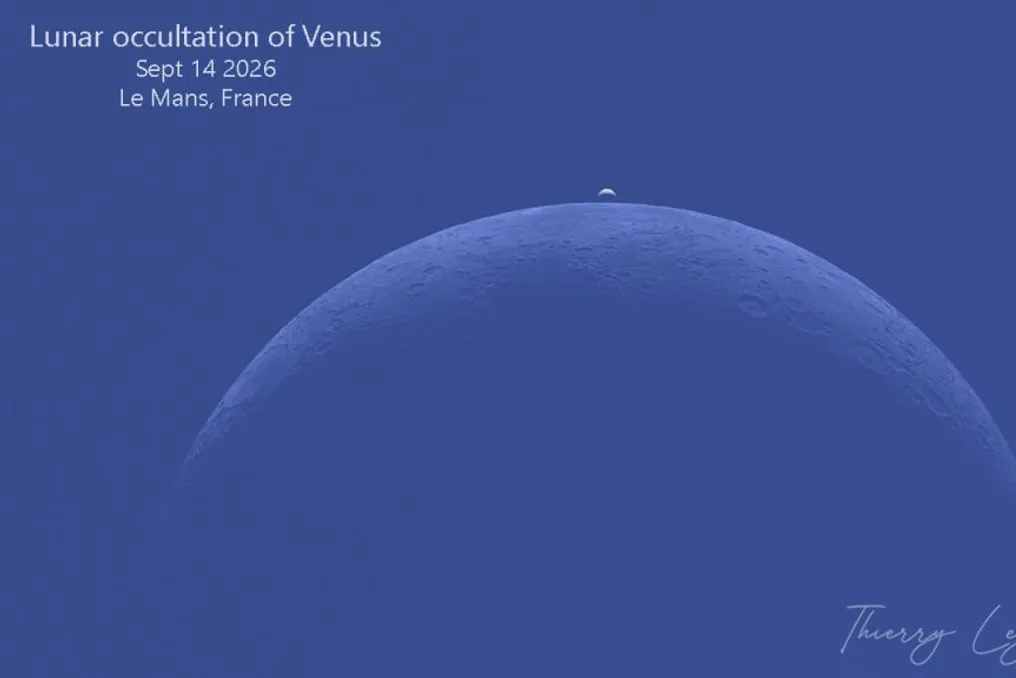
On Monday, the 14th, astronomical events involving Venus occurred in different parts of the Earth. In certain regions, a lunar occultation of Venus was recorded, while in others, the two celestial bodies appeared close together in the sky, generating notable images.
The records of this phenomenon not only evidenced the proximity between the stars but also revealed that Venus exhibited a shape resembling a crescent moon. However, this appearance hides a crucial characteristic about the planet's current stage: it is in a waning phase.
French astrophotographer Thierry Legault captured this moment in Le Mans, France, recording Venus emerging behind the Moon. He described the scene to Spaceweather.com as being of 'two crescents side by side.'
The resemblance to the crescent moon is not merely visual; Venus actually adopts this shape, but the illuminated area of the planet is decreasing. Currently, 28% of the Venusian disk is facing us and bathed in sunlight. It is predicted that in one week, this percentage will drop to about 22%, and on September 30th, it will be only 15%, indicating that it is waning.
It is important to distinguish the terminology: the classification as 'crescent' refers to the geometric configuration of the disk, which manifests as a luminous arc in the firmament. The term 'waning,' on the other hand, describes the proportion of the surface that remains illuminated. Thus, although the arc maintains its curvature, it becomes progressively narrower over the days.
This visual change is also linked to the distance between Venus and Earth. When the planet approaches, its illuminated portion decreases, while its apparent size in the sky increases. This combination explains the intense brightness it maintains, even with only a small section of its sunlit face visible.
Marcelo Zurita, astronomer and president of the Paraíba Astronomy Association (APA), member of the Brazilian Astronomical Society (SAB), and technical director of the Brazilian Meteor Observation Network (BRAMON), commented that not all planets exhibit a phase cycle as evident as the Moon's. Only the inner planets—Mercury and Venus—show variations comparable to the lunar ones, although observing them in the new and full phases is challenging due to their angular proximity to the Sun during conjunctions. Outer planets, located beyond Earth's orbit, only display full and gibbous phases.
While the Moon maintains a constant proximity to us throughout its cycle by orbiting the Earth, Venus orbits the Sun, which causes significant variations in its distance from our planet.
Details about Venus observation
When Venus approaches Earth, we perceive a smaller slice of its illuminated side. In contrast, the planet appears larger to the terrestrial observer because of this proximity. This dynamic allows a Venus in an arc shape to remain extremely bright.
Zurita clarifies that the duration of each annual phase depends on the relative arrangement of the celestial bodies. He states that for the inner planets to Earth (Mercury and Venus), the new and full phases are invisible due to solar conjunction. However, when viewed shortly after sunset, they are leaving the superior conjunction (full phase) and moving towards the inferior conjunction (new phase), thus being in a waning phase. Conversely, when observed in the early morning hours, it means they are leaving the inferior conjunction to go to the superior, characterizing the waxing phase.
According to the Time And Date platform, the inferior solar conjunction, scheduled for October 24th, will place Venus less than 41 million kilometers from Earth. At this time, its illuminated face will be practically imperceptible, as we will be facing its night side, configuring something geometrically similar to a New Moon.
In the superior solar conjunction, the planet will be positioned on the opposite side of the Sun. At this stage, almost the entire face facing Earth will be illuminated, resulting in an appearance similar to a 'full Venus,' despite being at its farthest point from us.
For naked-eye observation, Venus will always appear as an intensely bright point of light. To visualize its illuminated curve and track the change of phases, the use of optical instruments is essential. Appropriate binoculars already allow noticing the phase, but a small telescope offers much superior clarity for observing the partially illuminated disk.