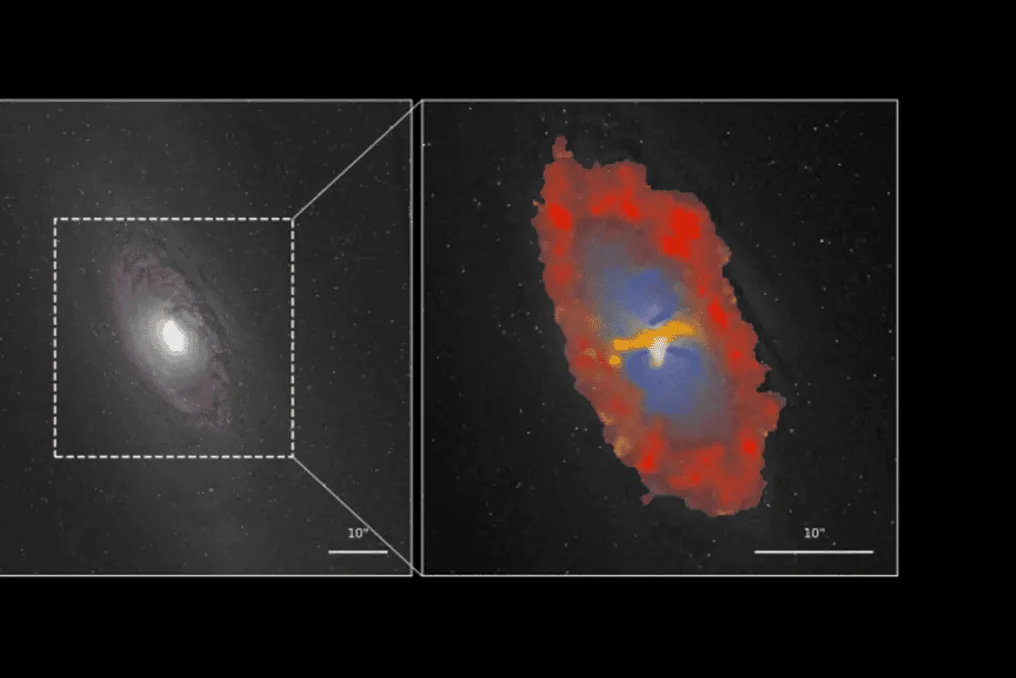
Although supermassive black holes are located at the center of all galaxies, they do not merely act as 'cosmic sinks' that attract everything around them; a large part of the matter can orbit these objects for billions of years without being affected.
However, when these black holes become active, they can profoundly influence their host galaxies. Initially, it is known that they heat the surrounding gas and can prevent the formation of new stars. However, new findings indicate that this influence can operate in the opposite direction, contributing to star birth.
An active black hole releases a vast amount of energy into the adjacent gas. This energy is emitted through powerful jets, which travel at speeds close to the speed of light, and also through winds that traverse the galaxy, heating the interstellar medium.
For stars to form, it is essential that the gas is cool enough to condense and subsequently collapse. For this reason, the impacts of a black hole's activity on star formation are more intricate than initially thought.
More information about the study
Peixin Zhu, a postgraduate student and astronomer at the Center for Astrophysics, the lead author of the research, stated: "After we managed to resolve them, we realized that they not only accumulate things but also eject things." He added that "injection and accretion are linked to each other."
According to Zhu, the shock fronts exhibit a remarkably peculiar characteristic: they appear at a right angle to the direction of the material flows injected by the black hole. He detailed: "The most interesting phenomenon about the shocks is that they always occur perpendicularly to the location where the outflows injected by the black hole are directed. It is very common, and we see this appearing consistently in all nine galaxies."
The scientists also used the Chandra X-ray telescope to independently validate the observed activity. The analyses revealed a complex cycle involving the capture of material by the black hole, the expulsion of this same material back into the galaxy, and the effects generated by this process throughout the galactic structure.
Lisa Kewley, astrophysicist at the Center for Astrophysics | Harvard & Smithsonian, director of the center and advisor to Zhu, commented: "We are seeing that black holes are not just consuming material in the centers of galaxies, but are actively reshaping their surroundings." She continued: "This work helps us understand a complex feedback cycle that plays an important role in galaxy evolution."
The study was published in the journal The Astrophysical Journal. The original news that black holes not only destroy stars: they can help form them was first published in Olhar Digital.