This article is part of the series 'Brazilian Technologies That Changed the World,' available only to subscribers of the Olhar Digital Club. Often, internet searches about the origin of the typewriter may not point to Brazil, or only mention it in footnotes, because good ideas can arise in the country but fail to thrive due to the context.
The Paraíba priest Francisco João de Azevedo (1814-1880) was initially responsible for inventing the teletype machine. This device recorded texts in an abbreviated manner, using codes. Later, after making modifications to this apparatus, he developed the typewriter. However, the final credits were attributed to the North American inventor Christopher Latham Sholes.
For this reason, Azevedo is often included, along with Father Landell de Moura (related to radio) and Santos Dumont (related to aviation), in the list of Brazilian inventors who did not receive due recognition. The central issue is understanding what happened in this process.
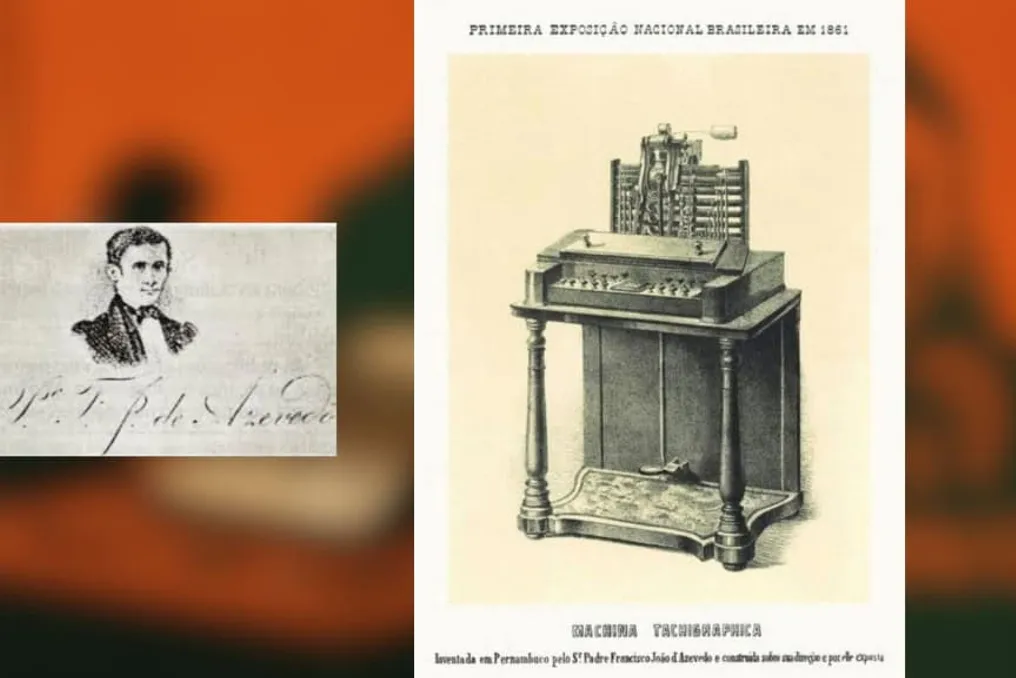
The priest conceived the mechanism in the workshop of the War Arsenal of Pernambuco, located in Recife. He adapted a piano keyboard so that the keys could print letters on paper and added a pedal to allow line changes.
Like any invention, this apparatus arose with the objective of simplifying aspects of his creator's life. In Azevedo's case, the teletype machine—which would evolve into the typewriter—was created to record speech with greater speed, being the first one to actually operate.
In 1861, the priest took his equipment to the National Exhibition held in Rio de Janeiro, where it attracted great interest. The invention remained on display for 44 days, and Azevedo was one of nine participants to receive a gold medal for his work, competing against 1,136 other inventors.
The priest wanted to take his machine to the Universal Exhibition in London in 1862, but the Brazilian government denied permission, citing insufficient space on the ship. What managed to reach Europe from Brazil were only raw materials and basic tools.
Without financial resources to register the patent or start large-scale production in Brazil, Azevedo handed over the prototype, or his technical drawings (which is unconfirmed), to a foreign merchant around 1872. There was an expectation that this merchant would find investors in the United States.
It is at this point that Christopher Latham Sholes, the American, enters the narrative. Curiously, the typographer presented in 1873 a model that was almost identical to the one developed by the Paraíba priest for the Remington arms factory. This company, unlike others, had the necessary conditions to manufacture and distribute the typewriter globally, which effectively happened.
Francisco João de Azevedo died in 1880 without his invention being recognized or patented. In contrast, the American, Christopher Latham Sholes, is widely known as the inventor of the typewriter.