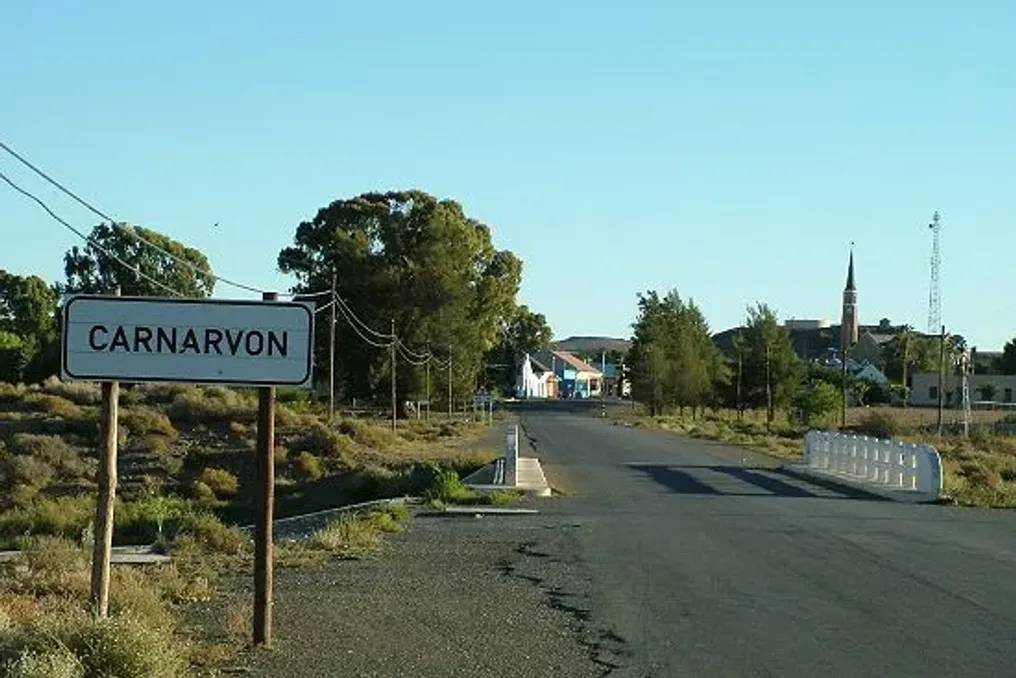
Carnarvon may be little known to the general public, yet it is associated with its rich offering in astrotourism. Nevertheless, this town offers travelers much more than just a magnificent night sky.
Located in the Northern Cape of South Africa, this small town in the Karoo region lies among hills with flat tops, dry plains, and vast open skies. In the modern world, Carnarvon is increasingly linked not only to sheep farming and Karoo architecture but also to some of the country's most ambitious astronomical projects.
However, the residents and the town itself existed long before the arrival of telescopes. The history of Carnarvon dates back to the Rhine Mission station, established in the 1840s in Hetfontein. The settlement was later named Harmesfontein before being renamed Carnarvon in 1874 in honor of the British colonial secretary Lord Carnarvon.
The city's historical heritage can be seen in its buildings. The Carnarvon Museum is located in the former hall of the Dutch Reformed Church, dating from 1907. Standing outside is one of the town's characteristic houses—a traditional Karoo structure built from layers of flat stone curved inwards to form a dome-like roof.
These structures are not merely picturesque testaments to the past; they reflect how people adapted to the dry Karoo climate, where building materials such as wood were scarce. A walk through the town allows one to see more of this architectural history, including old Victorian houses and other historic buildings. The nearby Skietfontein trail also provides insight into the earlier history of the settlement in the area.
Approximately 90 kilometers from Carnarvon, the landscape changes drastically. This is where the MeerKAT observatory is located. The 64-antenna radio telescope is one of South Africa's most important scientific projects and a precursor to the Square Kilometre Array. The antennas are spread across the Karoo landscape, where the remote location and low level of radio interference make the region exceptionally suitable for radio astronomy.
Ultimately, MeerKAT will become part of SKA-Mid, which is planned to consist of 197 antennas, including the existing MeerKAT system. This project aims to investigate issues ranging from pulsars and gravitational waves to the possibility of detecting signs of life in other galaxies.
For a small town like Carnarvon, the presence of such a large international scientific project nearby has changed the perception of the area. It has also opened opportunities beyond astronomy itself. The project has contributed to job creation, training programs, scholarships, and collaboration with local businesses and technical specialists.
Astronomy has also entered the town's tourism history. Carnarvon has developed astrotourism initiatives that combine stargazing with local knowledge and stories. The goal is to allow visitors to experience the darkness of the Karoo not just as an absence of light, but as something of cultural and scientific value.
In 2024, the National Astrotourism Strategy of South Africa was launched in Carnarvon, with the government designating the town and the surrounding Karoo corridor as an opportunity to connect science, tourism, and rural economic development.
Perhaps this is what makes Carnarvon so intriguing now. Its future is not about replacing the past, but about adding a new layer to it. It is easy to come to Carnarvon thinking only of telescopes, but spending time in the town itself, the astronomical history becomes part of something much older.
Here, you can discover historic buildings, remnants of the town's past as a mission station, the Karoo landscapes stretching to the horizon, and the dry, quiet setting that originally made this region valuable to astronomers. Even the relationship between the town and its environment is part of this history. Sheep farming remains an important part of the local economy, while the characteristic kopjes and open plains give Carnarvon a sense of seclusion that defines this part of the Karoo. The stars may have attracted new international interest to Carnarvon, but they did not create the character of the place—it already existed.
Carnarvon serves as a remarkable reminder that a place does not need a long list of attractions to be interesting. It possesses a multilayered appeal: it is a small Karoo town with a complex history, unique architecture, a resilient agricultural identity, and a vantage point overlooking one of the world's most ambitious astronomical projects. Telescopes may look deep into space, but on Earth, the history of Carnarvon is much closer to home.