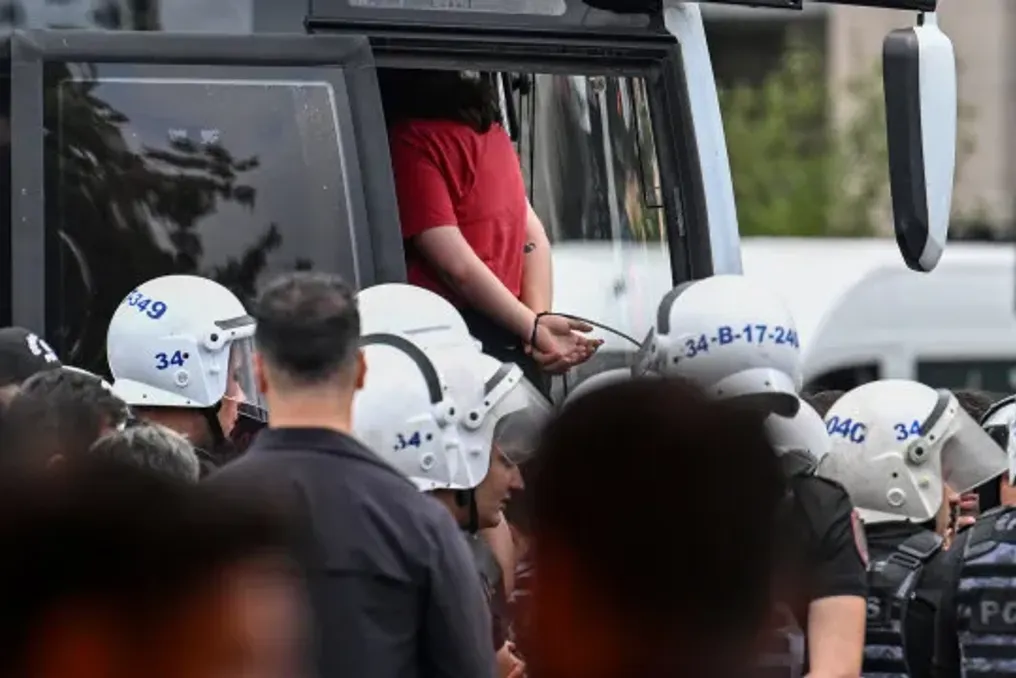
A large-scale police operation was conducted in Turkey against LGBTQ+ community associations, activists, and venues under the name 'My Family is Safe.' This operation, which took place on Sunday, resulted in the investigation of 162 suspects and the detention of about 70 people. Of these, 26 were detained in Istanbul, and 18 in Izmir, where a court ruled on Tuesday to place 16 detainees under pre-trial detention.
Many activists gathered today in front of the Palace of Justice in Istanbul, in the European part of the city, to protest these arrests. They repeated slogans such as 'Long live the fight for freedom,' 'Live life despite hatred,' and 'Release the detainees immediately!', while also holding a sign that read 'Being LGBTQ+ and organizing is not a crime. Freedom for our comrades,' and reading a manifesto for the release of the detainees.
Police dispersed the protest and made dozens of arrests: about 80 demonstrators, according to the Association of Progressive Lawyers (ÇHD), and about 90, according to the newspaper Cumhuriyet.
The newspaper BirGün reported that among those detained on the day of the protest were its reporter and a Turkish journalist from the German television station ARD who were covering the demonstration.
The Turkish Journalists' Union stated on the social network X: 'We do not accept the criminalization of journalism or illegal interference suffered by our colleagues.' Furthermore, the NGO MLSA reported that another female journalist, detained on Sunday evening for material on the LGBT movement in Georgia, would be summoned to the prosecutor's office today.
On Tuesday, Turkish courts ordered the blocking of about 20 accounts on the social network X belonging to LGBTQ+ activists, feminists, and human rights groups, and banned access to the website of KAOS GL, one of Turkey's oldest and most authoritative organizations for the protection of the LGBTQ+ community.
Council of Europe Human Rights Commissioner Michael O'Flaherty expressed concern in a statement today about reports of a series of detentions, police clashes, as well as the blocking of websites and accounts of LGBTQI civil society and human rights defenders across Turkey.
O'Flaherty reminded that 'LGBT organizations perform human rights work' which is directly protected by the European Convention on Human Rights, of which Turkey is a party, and that 'a simple reference to 'family values' or 'child protection' cannot serve as a legal justification for restricting human rights.' He called on Turkish authorities to 'release all people detained for participating in civil society work or [human rights] defense, and ensure fair judicial processes.'
Homosexuality has been legal in Turkey since 1858, but it is widely condemned, and the Chief Public Prosecutor's Office accuses the detainees of spreading 'immoral content' or 'aiding prostitution.' Another demonstration was announced for this evening in the capital of Turkey, Ankara.