According to Global Market Insights, the portable gaming device market is projected to reach US$ 12.9 billion in 2025 and grow to US$ 16.6 billion by 2035, corresponding to a Compound Annual Growth Rate (CAGR) of 3.3%.
Although Nintendo maintains the lead with over 26.7% market share, it is not alone; the five largest companies—Nintendo, Valve, GPD, AYANEO, and Anbernic—together account for 78.6% of the market in 2025. A notable fact is that three of these five largest global handheld manufacturers are from China.
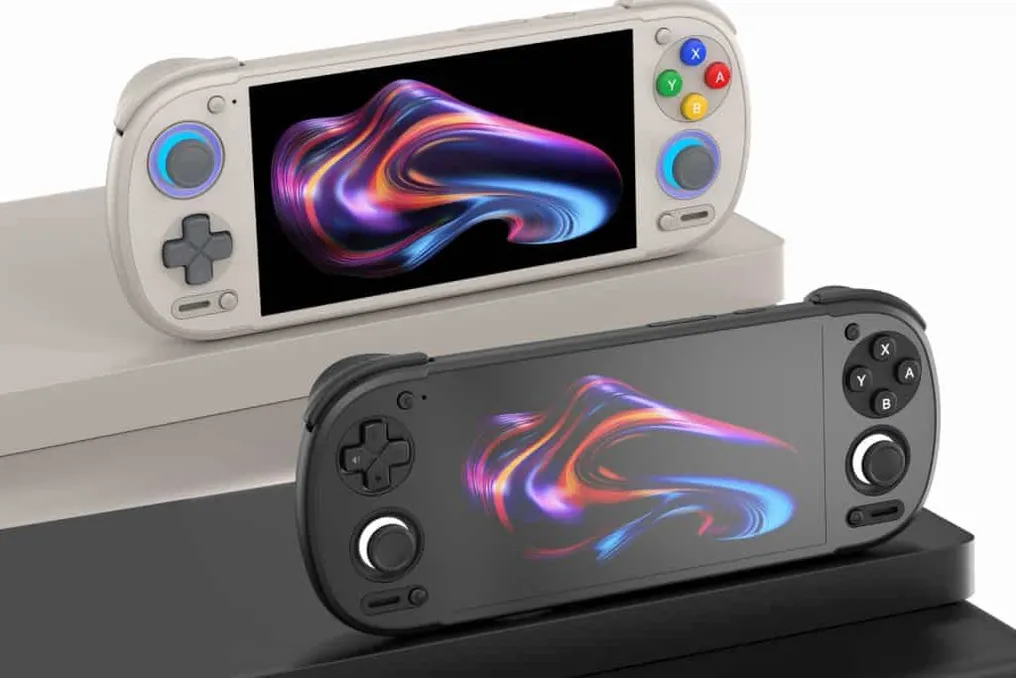
Companies such as GPD, AYANEO, and Anbernic compete directly with established giants like Nintendo and Valve. Much of this advancement is due to China being the main manufacturing hub for this segment, housing brands like Anbernic, Powkiddy, GPD, BittBoy, Miyoo, and GoRetroid, in addition to having a vast domestic consumer market.
Another driving factor is the business model adopted by these manufacturers, characterized by extremely short release cycles, releasing four or five new devices annually. Additionally, direct sales through platforms like AliExpress and Shopee eliminate the need for traditional retail, resulting in more accessible prices and offering a wide variety of products for diverse audiences.
Chinese portable consoles operate in two distinct segments. On one hand, there are 'premium consoles,' which are portable PCs aimed at conventional gaming, including AAA titles, with brands such as AYANEO, GPD, and OneXPlayer. These models range from US$ 800 to over US$ 3,000, depending on the performance level.
On the other hand, there are retro handhelds, exemplified by models from Anbernic, Powkiddy, Miyoo, TrimUI, and Retroid. These are significantly more affordable, costing between US$ 40 for entry-level models and reaching US$ 400 for top-of-the-line versions, designed to emulate older games such as SNES, Megadrive, PlayStation, Nintendo 64, and PSP on the more advanced devices.
Data compiled by IconEra indicates that the retro handheld console market was worth US$ 3.8 billion in 2025, up from US$ 3.12 billion the previous year, representing an increase of approximately 21% in one year. Projections for this niche are even more expressive: it is expected to reach US$ 4.18 billion in 2026 and could reach US$ 8.5 billion by 2033, configuring a CAGR of 10% per year, surpassing the annual growth of 3% to 5% of traditional consoles.
However, the general category of portable PCs—which includes Steam Deck, ROG Ally, Legion Go, and MSI Claw—accumulated less than 6 million units, and this segment suffered a 50% retraction between 2023 and 2024, falling from 2.87 million to 1.49 million units. In contrast, Nintendo sold 19.86 million Switch 2 units by March 31, 2026, less than ten months after launch.
Thus, the 'invasion' is confirmed in terms of brand quantity and variety, and not necessarily in sales volume. On April 21, 2025, Anbernic suspended shipments from China to the United States due to American tariff policy, which reached 145%, a move replicated by Retroid and Ayn. Similarly, in Brazil, taxes stand between 92% and 100%, added to the exchange rate, drastically increasing console costs (an AYN Odin 2 costs at least R$ 2,200, and top models cost much more).
Another recurring challenge is the issue of ROMs, which constitutes piracy in many regions. This was evidenced in the case of Italian YouTuber Once Were Nerd, whose residence was raided by the Guardia di Finanza in April 2025, resulting in the seizure of over 30 consoles from the brands Anbernic, PowKiddy, and TrimUI, for promoting illegal material. Furthermore, several manufacturers removed Nintendo games from their pre-loaded libraries following pressure from the company itself.
Despite these obstacles, in August 2026, the SteamOS 3.8.25 beta incorporated updated support for OneXPlayer Apex, OneXPlayer F1, Konkr FIT, and AYANEO Pocket S2. This update demonstrates Valve's transformation, which has become the operating system provider for Chinese consoles, signaling that despite the challenges, Chinese consoles are consolidating their position in the market.