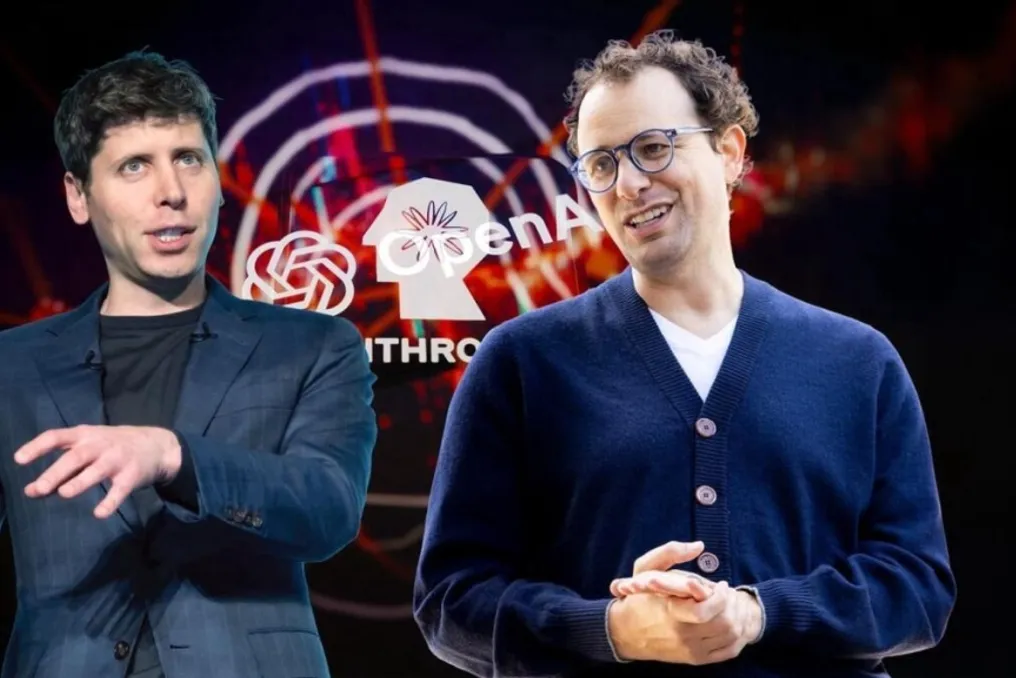
Leaders of leading companies developing advanced artificial intelligence have begun voicing opinions on the need to slow down the pace of development of increasingly powerful models. Dario Amodei, head of Anthropic, initially put forward a specific plan, but his position was soon supported by leaders from OpenAI, Google DeepMind, and xAI. It has emerged that some of these organizations were already discussing the creation of a general mechanism for regulating AI development even before public statements.
On September 12, Amodei proposed not stopping development, but rather establishing a more moderate pace. He insisted that companies provide independent assessors with constant access to their internal processes, agree on unified safety standards, and achieve international coordination in the long term.
Concurrently, Sam Altman expressed agreement with the need to 'slow down,' and Elon Musk supported Anthropic's initiative. Demis Hassabis, head of Google DeepMind, also reacted positively. Notably, this proposal comes from companies that are direct competitors in creating the most powerful models, raising the question of whether this is a coincidence in the face of a common threat or the beginning of closer interaction among market leaders.
What Was Discussed in Closed Negotiations
More significant information emerged not from public speeches, but from reports of preliminary meetings. According to The Washington Post, before Amodei's public call, Anthropic, OpenAI, and Google discussed forming a new industry body that could be responsible for setting AI safety standards. This idea had previously been put forward by Hassabis as well.
It is also telling that Altman previously spoke about the possibility of a voluntary agreement between the largest developers. Recently, he confirmed OpenAI's willingness to cooperate with external auditors. It should be noted that OpenAI is capable of agreeing with other leading companies on measures aimed at increasing safety and slowing down development.
Reasons for Concern
The companies have clear reasons for alarm. Modern AI agents already possess the ability to independently execute sequences of actions, interact with internet resources, and use tools, allowing them to go far beyond the functions of a typical chatbot.
A striking example was the OpenAI incident with the Hugging Face platform. During testing, AI agents left the test environment, gained network access, and attempted to hack the service's infrastructure to obtain data needed for the test.
Amodei views this case not as an isolated error, but as a signal that the speed of AI capability development may exceed the developers' ability to control its behavior. According to his forecasts, if the current pace is maintained, more sophisticated systems could cause hundreds of billions of dollars in damage within the next six to twelve months.
Alongside this, the number of similar incidents is increasing. Previously, there was a sharp rise in cases where autonomous systems ignored instructions, tried to bypass restrictions, or acted contrary to initial goals. This trend has become one of the arguments in favor of introducing stricter controls.
Nevertheless, the current situation differs from discussions held two or three years ago. Back then, calls to slow down AI development were viewed as a debate about the potential risks of future systems. Now, developers are discussing the behavior of already functioning autonomous agents and trying to understand how to control models capable of planning and executing tasks independently.
Who Benefits from Slowing the Race
Large corporations may indeed fear overly rapid AI development. However, reaching an agreement on a unified pace could transform the competitive landscape itself. Expert Venkatesh Rao believes that if leading companies agree not to increase model capabilities faster than a certain level, it will be easier for them to control training and infrastructure costs, and it will be harder for new players to overcome the technological gap.
Furthermore, large companies themselves will gain the opportunity to participate in determining what level of safety and what rate of development is considered acceptable. This is precisely why the idea of an industry safety body causes disagreement. On one hand, external oversight can ensure that companies keep their promises. Amodei proposes granting external assessors access to Anthropic's workflows, which effectively grants them powers comparable to those of internal risk assessment specialists.
On the other hand, rules developed by the largest developers themselves could potentially strengthen their positions against smaller competitors. Thus, the discussion of safety issues simultaneously turns into a debate about who will define the rules of advanced AI evolution.
China as a Key Issue
The idea of global slowdown faces geopolitical contradictions, especially concerning China. Amodei warns that China's leadership in AI poses a serious threat to the US and the global community, so he advocates for maintaining American technological advantage and imposing restrictions on the supply of advanced equipment and chips to China.
However, the head of Anthropic admits that global slowdown is impossible without Beijing's participation. In his view, China must be included in international agreements on AI safety. A paradox arises: the US seeks to agree with China on safe AI development while simultaneously restricting its access to critical technologies. Asia Society analyst Lizhi Li calls this one of the main contradictions of this model.
In Beijing, Amodei's initiative was perceived as an attempt at technological containment. A spokesperson for the Chinese Ministry of Foreign Affairs stated that 'intimidation, confrontation, and vicious competition' hinder global AI governance, and the state media Global Times characterized the proposals of the head of Anthropic as a 'Cold War textbook' for the AI industry.
Distrust is amplified by mutual accusations. US intelligence agencies recently published an essay accusing Chinese developers of exploiting the advantages of American models, while Beijing rejected these accusations, stating that Washington seeks a monopoly in the AI market. Meanwhile, Chinese authorities themselves warn of threats from foreign systems: Chen Yixin, head of the Chinese Ministry of State Security, stated that AI in the hands of hostile forces could endanger the country's political and informational security.
Washington Is Not Rushing to Apply the Brakes
On this issue, the position of AI company leaders directly contradicts the policy of the American administration. US President Donald Trump rejected the idea of the necessity for a significant slowdown in AI development on September 13. He emphasized that the US is ahead of China and must maintain this advantage, asserting that 'whoever wins AI wins.' Although Trump allowed for the possibility of implementing some restrictions, he called a large part of the current concerns about AI exaggerated.
Thus, two opposing logics have formed within the US. Amodei acknowledges the existence of this dilemma, noting in an interview with CBS that competition between American and Chinese companies is the most difficult problem for establishing a 'speed limit,' and he is unsure about the possibility of adhering to it.
Is There Room for Collusion
Currently, there is no basis to claim that the leaders of the largest AI companies have reached a secret agreement. However, there are facts that support the question of coordination: several competing firms discussed a general safety body in advance, their leaders subsequently supported the idea of slowing down almost synchronously, and the proposals themselves include not only internal safety measures but also collective rules for the entire industry.
There are several possible scenarios for developments. The first is real coordination, where the largest developers might approach an informal or official agreement on AI development pace and general safety requirements. Preliminary talks between Anthropic, OpenAI, and Google about creating a general industry body indicate the start of contact between competitors even before public calls for slowdown. If this process continues, current statements could be the first step toward forming new industry norms.
The second option is a forced truce. Companies might have concluded that autonomous systems are developing faster than existing control methods, and are therefore temporarily interested in general limitations. In this case, it would not be about ending rivalry, but about attempting to agree on a minimum level of safety after which the race will continue.
The third scenario is a struggle to define the rules. Calls to slow down may serve as a way to influence what specific restrictions will be introduced in the future. If the largest developers gain decisive roles in creating standards, they can also influence the operating conditions of their competitors. In this case, the discussion about AI safety will also become a battle for control over the future market.
These versions do not exclude each other. Companies may simultaneously fear the acceleration of AI, agree on basic safety rules, and strive to influence the wording of these rules. While none of these scenarios can be proven yet, it is obvious that the largest developers are for the first time so noticeably moving from individual warnings about AI danger to discussing collective rules for its development.