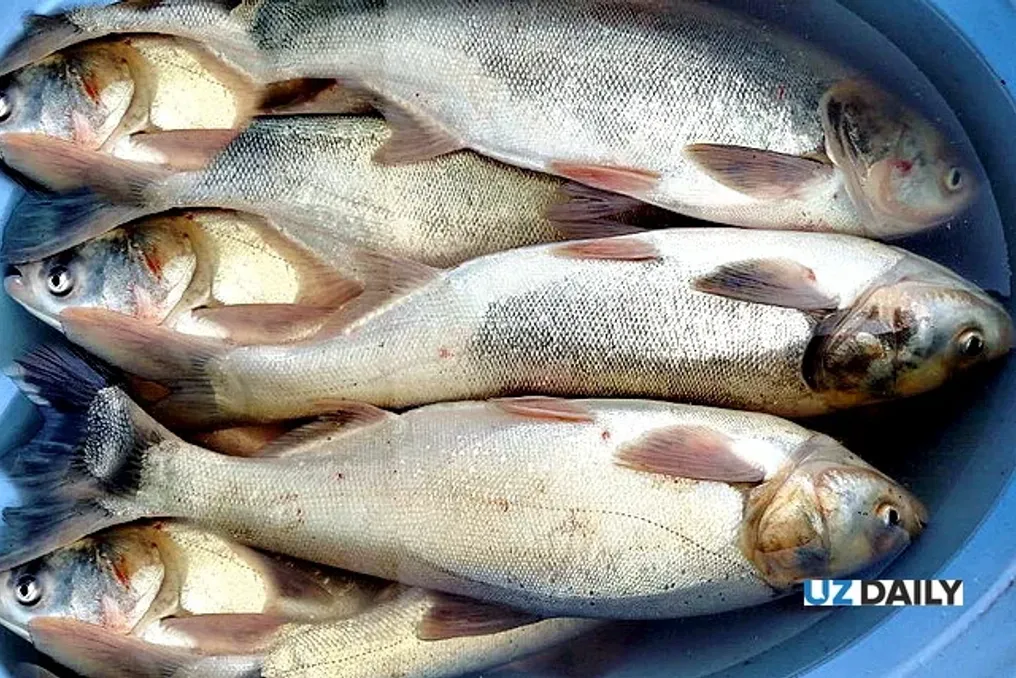
A test was conducted in the Tashkent region of Uzbekistan on an automated system that regulated carp feeding based on water temperature and oxygen concentration during extreme heat. During the trials on four experimental ponds, researchers recorded higher fish weight, better survival rates, and reduced ammonia concentration when using an adaptive feeding approach. Nevertheless, the authors warn that the results obtained require repetition on a larger number of farms and in various climatic zones.
The experiment conducted by Uzbek scientists suggests a non-trivial approach to feeding fish under severe heat: sometimes it is necessary to feed the fish less or stop feeding entirely for a certain period.
The results of the field study on climate-adapted feeding of common carp were presented at the Second Regional Conference on the 'One Health' concept in Bishkek by Abdulla Kurbanov from the Research Institute of Fisheries of Uzbekistan. The tests took place from June to August 2025 in the Yangiyul district of the Tashkent region.
The scientists used four earthen ponds, each with an area of one hectare. Each pond was stocked with 5000 fish per hectare, with an initial average weight of about 150 grams. Two ponds served as controls, and two as experimental groups.
How sensors determined the feeding regime
In the control ponds, carp were fed traditionally—manually three times a day, regardless of water condition or temperature. In the experimental ponds, feeding decisions were made based on data from sensors that measured water temperature and dissolved oxygen every half hour.
Under favorable conditions, when the water temperature was 22–28°C and dissolved oxygen exceeded 5 mg/L, the fish received the full ration. When the temperature rose to 28–30°C and the dissolved oxygen level dropped to 3.5–4.5 mg/L, the food portion was reduced by 30 percent. If the dissolved oxygen dropped below 3 mg/L or the water temperature exceeded 31°C, feeding was completely suspended.
The logic of this approach is simple: warmer water retains less dissolved oxygen. Continuing to supply the same amount of feed can lead to an increase in uneaten material in the pond, which raises the organic load and potentially worsens water quality.
The trial coincided with a period of extreme heat
Summer proved to be a serious test for this system in real-world conditions. During the experiment, peak air temperatures reached 42–44°C, and peak water temperatures reached 30.5–32°C. As conditions approached critical thresholds, the automatic system either reduced or completely stopped feeding. In the control ponds, the fish continued to receive feed on a fixed schedule three times a day.
By the end of the experiment, the differences were quite significant. The average final weight of the carp in the control ponds was 630 grams, whereas with climate-adapted feeding, it reached 975 grams, which is 54.8 percent higher. The difference in survival rate was also significant: in the control ponds, the survival rate was 76.5 percent, while in the experimental ponds, it was 93.2 percent.
Simultaneously, the feed conversion ratio—an indicator of how much feed is required for fish weight gain—improved from 2.25 to 1.48, representing an increase of 34.2 percent. The differences between the groups noted by the researchers were statistically significant at p<0.05.
Less feed—cleaner water
The differences were not limited to the fish itself. The average ammonia concentration in the experimental ponds was 0.6 ± 0.2 mg/L compared to 1.8 ± 0.4 mg/L in the control ponds, which represents a reduction of 66.7 percent. The authors suggest that this may have occurred due to a decrease in the accumulation of uneaten feed and organic sediment. However, they emphasize that this mechanism was not directly measured in the study, so it remains only a hypothesis, not a proven causal link.
This experiment goes beyond the ordinary problem of aquaculture because, from the perspective of the 'One Health' concept, one feeding algorithm simultaneously affects three areas: fish health, water ecosystem quality, and food production reliability.
Why four ponds are not yet a ready solution for the entire country
Despite the impressive results, the study remains small. Only four ponds were included: two control and two experimental. The statistical unit was an individual pond, not each fish. Consequently, the findings cannot be automatically generalized to all fish farming enterprises in Uzbekistan or Central Asia. The researchers themselves acknowledge this limitation.
The next step they propose is multi-site testing in different climatic zones of Central Asia, using a larger number of ponds, repeating the tests in different seasons, and implementing standardized water quality monitoring. Such work is necessary to confirm the reproducibility of the results before this method can be widely adopted.
Nevertheless, the experiment points to a potentially important direction for adaptation to climate change in aquaculture. As heatwaves become more frequent, the question facing fish farming enterprises may not simply be how much feed to give the fish, but whether the management system can recognize that feeding might actually harm more than it benefits. In a hotter climate, this difference could mean more surviving fish, less pressure on water quality, and more sustainable food production.