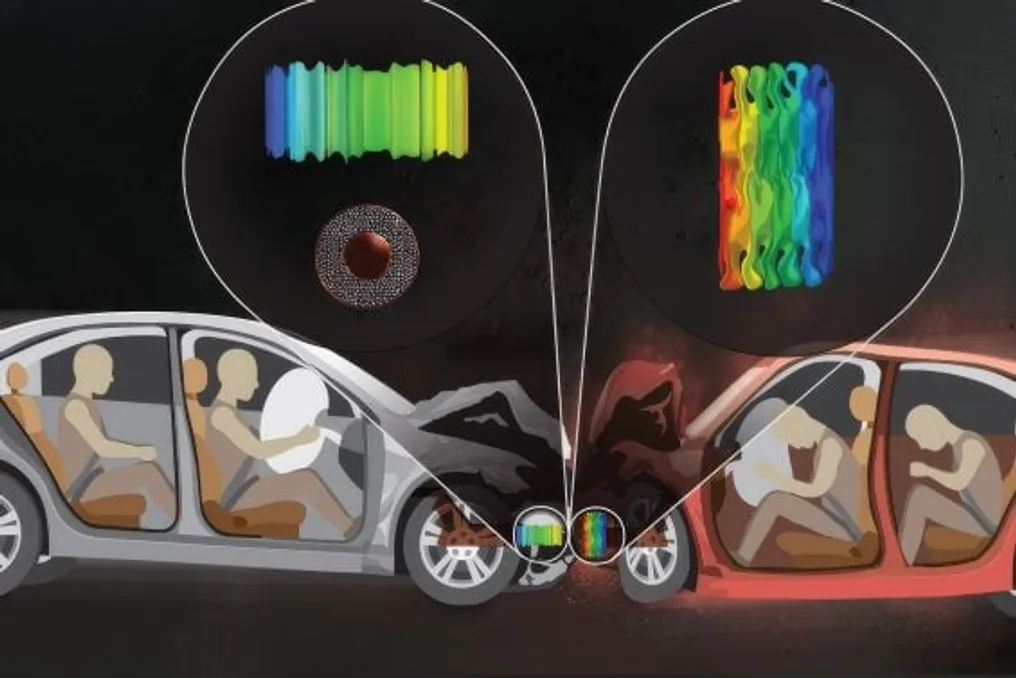
A material resembling metal foam is capable of significantly reducing the danger of frontal collisions without increasing the overall weight of the vehicle. This is reported in a study conducted by the University of North Carolina in the USA and published in the Journal of Composites Science, information which was noted by the website Inovação Tecnológica.
Researchers modeled accidents by replacing the front frame rails—beams located behind the bumper and designed to absorb impact—with aluminum tubes featuring a metallic powder core. In a collision at 88 km/h, this component reduced the maximum deceleration experienced by the vehicle by approximately 84% compared to the rectangular steel rail widely used in most cars.
Although this may seem illogical, collision injuries are caused not so much by the force of the impact as by the speed of the body's deceleration. This is why frame rails are designed to deform in a controlled manner: the slower the deceleration occurs, the less damage is inflicted on passengers.
In this case, the metal foam demonstrated superior results. The head injury index, which assesses the probability of severe traumatic brain injury, decreased by approximately 83% compared to the rectangular rail and by 45% compared to an octagonal aluminum design with a double cross-section. In practice, this means the vehicle could travel 32% to 48% faster before reaching critical limits.
Metal foam, or CMF (Composite Metal Foam), is manufactured from tiny hollow steel spheres immersed in a metallic matrix. This results in a lightweight, strong material that is excellent for absorbing compression. It is already being studied for use in body armor, aircraft wings, and bulletproof vests.
Professor Afsaneh Rabiei, who is a co-author of the work with Aman Kaushik, emphasized that identical weight and length parts were used in all comparisons. Thus, increased safety does not entail additional costs in terms of fuel consumption. She also noted that it might even be possible to reduce the length of these components.
Since metal foam resists heat and fire well, the authors suggest using it in electric vehicles, especially in battery protective structures. It should be noted that the results obtained are based on computer models, not physical tests.
Several decades ago, bumpers were made of steel: they protected the body but absorbed almost no energy—the passengers paid the price. This prompted the industry to switch to polypropylene. Now, metal threatens to return, but in a different form.