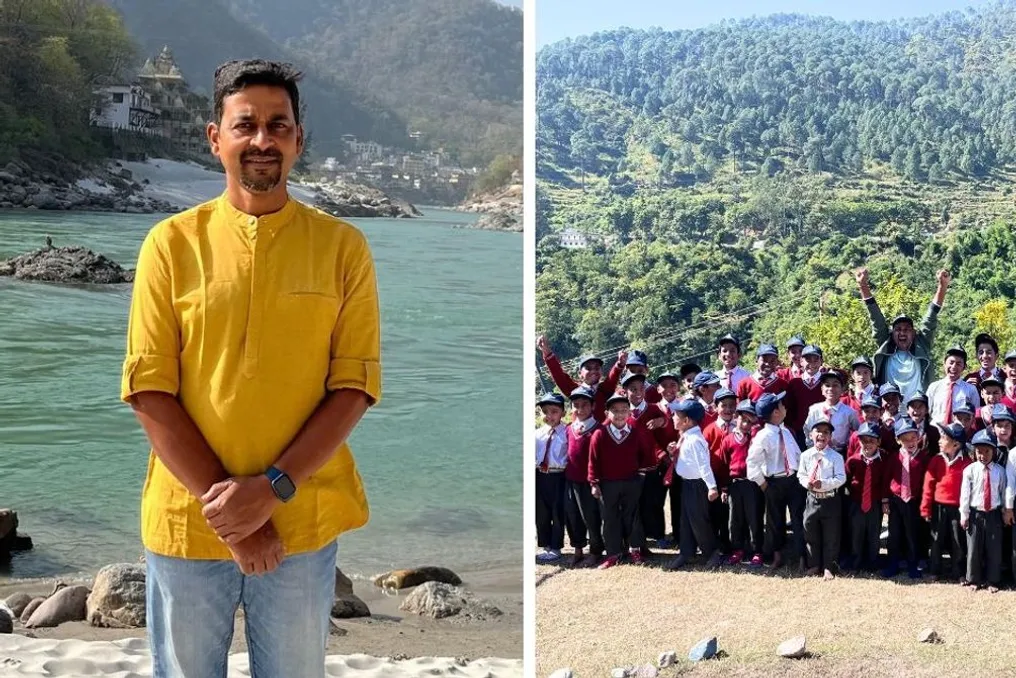
Rohit Chaudhary, an army veteran, has revived a small rural school in the village of Dunda, located in Uttarakhand, transforming it from an institution with 30 students into a school where 180 children are educated. He joined the Ganga Valley Educational Trust (GVET) in 2022 as a managing trustee, drawn by the desire to restore this school, which he named 'Happy By Nature School.'
Chaudhary, who grew up in Dehradun, often looked at the villages nestled in the mountains of Uttarakhand, and his memories of school trips there remain deeply etched in his mind. He noted that during his studies at the Rashtriya Indian Military College in Dehradun, he was taught a discipline that is now a value instilled in the students at Happy By Nature School.
He emphasized the importance of clear thinking, stating: 'If there is chaos in the mind, that chaos is reflected in all areas of life. Therefore, we strive to nurture a generation of children who can think clearly, speak clearly, and act clearly, and hopefully change the world for the better someday.'
Despite the landscape rarely being as warm as on summer days, Rohit shared that the children have to overcome heavy rains and severe cold, walking or traveling on dirt roads for several kilometers to reach the school.
When asked why the children continue to come to school daily, Angana Uniyal, a 14-year-old student who has been attending since kindergarten, smiled and replied that there was never a reason not to come, except for one instance when her favorite teacher moved to another village.
Despite the rugged terrain and extreme weather conditions, the children demonstrate great courage. The roads are winding and steep, and the mountains have complex topography. However, as Angana's story shows, many reasons to miss classes—poor infrastructure, dangerous roads, distance, cold, and heavy rains—pale in comparison to the reasons why they must continue attending school.
In May, during interviews, an additional reason was the organization of a Summer School run and managed by volunteers from all over India, who shared their knowledge and skills with the children during the holidays. One such volunteer, Akanksha Patnaik, a psychology graduate from St. Xavier's College in Mumbai, noted that they themselves learn a lot, saying: 'We came here expecting to teach them, but we leave with many lessons for ourselves.'
Angana is one of the 180 students at Happy By Nature School. This figure is considered an achievement, according to various reports studying the academic situation in Uttarakhand. In 2025, The Indian Express reported on a girl who was the only student in a government primary school in Batoli, a village in Tehri district, Uttarakhand, exploring how mountainous terrain and migration patterns contributed to low enrollment. In the same year, parliamentary data showed that 7,073 schools had fewer than 20 students, and 1,740 had only one teacher.
However, the situation at Happy By Nature School is different. A different story of hope is unfolding here. The school's curriculum follows the NCERT model and includes classes from kindergarten to Grade 8. Students moving on to Grade 9 in other schools often miss how they learned here. One of them, Anushka Nautiyal, 15 years old, continues to visit her old school.
She shares that she tells her friends at her new school how wonderful it was to study here. 'We didn't just study science in theory. We conducted classroom experiments to understand. They also taught us to make our own notes so we could absorb concepts.'
A senior school, designed for 520 students, is being built in Singuni village to serve students from Grade 9 to Grade 12. This new school, funded by non-profit contributions collected across India and globally, and spanning 20,000 square feet, will be equipped with modern amenities and infrastructure.
The goal of the innovative teaching methods at Happy By Nature School is to encourage children to use their imagination and think beyond what the textbook dictates. The idea is to bring the children on par with their peers in urban areas.
Volunteer Mannat Kaur Atwal, a young teacher from Mumbai specializing in early childhood education, shared that she was amazed by the children's knowledge of advanced topics. 'When Kunal (one of the volunteers) explained concepts of LED connection and control using Arduino, they knew how the electrical grid works! It was very impressive.'
Beyond cognitive skills, the children possess talents waiting to be developed. Jiya Goswami, a volunteer and musician trained in the Gandharva style from Vadodara, was surprised by how well they play mountain songs on the keyboard. She notes: 'Although the school has musical instruments, if someone regularly came and taught them to play, the children would benefit immensely and be able to maximize their skills.'
Rohit says that attention is currently focused on these areas, and they are making great efforts to achieve this goal. Ultimately, he wants the school to develop into a place that truly supports the holistic development of children. He thanks his fellow trustees, Ramesh Ramol and Vinay Kumar Singh, for playing a crucial role in upholding a high standard of excellence at the school.
Rohit, a retired army officer, asserts that they are focused not only on creating good students but also good citizens of the country. 'Through the school, we try to create a center of excellence that becomes a model to emulate. We try to show that it is possible to educate children in a remote location; to build a sustainable campus and attract good teachers who want to contribute at the grassroots level. Someday I hope people from all over the country will want to bring their children to such schools,' he says.
The transition from a career in the Indian Army (1990–2004) to a corporate career (2004–2021), and then to education, was unplanned. He feels fate led him to these turns. 'In 2019, I was vacationing in Varanasi. One evening, while taking a boat ride with an elderly couple, a gentleman told me about a 'school in the Himalayas' that I should visit (Happy By Nature School),' Rohit recalls. He did not go immediately, but eventually visited it. The state of the school was 'depressing.'
'Everything was in a state of disrepair. There were about 30 children, almost no furniture, no suitable seating for the children, very few teachers, and hardly any books. The students constantly used the same textbooks and notebooks. It seemed like a school barely functioning and on the verge of closure,' he shares. But despite the condition of the school, he saw one bright detail: the children. 'They were energetic, curious, excited to learn, full of questions. I felt they deserved the same quality of education, guidance, and opportunities as our own children,' he reflects.
The memory of that visit stayed with him. Only after the COVID-19 pandemic, when he 'had time to reflect on life,' this memory resurfaced. 'I was struck by how the lack of opportunity meant they wouldn't be able to realize their dreams, and life would pass in vain,' he says. And so, Rohit gave up his prosperous corporate career and decided to manage the school. Founded on alternative learning, the school focuses on the holistic development of the child.
While academic knowledge is central, priority is also given to topics such as reforestation, teamwork, and village development. Volunteer Neeraj, who has experience in agriculture, introduced the students to the concept of food forests, helped them assess the diversity of flora and fauna, and organized nature walks where they could view their forests from a new perspective.
Regardless of the subject, the goal of the curriculum, according to Rohit, is to ensure that learning does not happen in isolation. 'We also advise parents to reinforce the values and approach we use in the school. Otherwise, the child receives contradictory messages. We conduct consultations through structured Parent-Teacher Meetings (PTMs), tea-time discussion sessions, and have parent associations where we discuss common issues. These conversations cover everything from the child's academic performance to community initiatives, such as cleanliness and sanitation around the school.'
In cases where children face issues such as alcoholism or domestic violence, separate counseling is provided. 'We must approach these situations with sensitivity. Many of our children are pioneers in learning, and parents are deeply invested in their future. They strive to participate, seek guidance, and work together to create a better environment for their children,' explains Rohit.
This mindset is also transmitted to the students. As Angana says, her dream is to become an IAS officer and serve the nation. She draws inspiration from her 'beloved Rohit Sir.' 'I feel that if I don't do something significant for my country, I will waste my time,' Angana muses. When asked what she would change in the village, she replies that it is the caste system. 'There is still a lot of discrimination. If someone from a lower caste comes to our house, they are not welcomed. My grandmother tells me not to eat in the houses of my friends who are not of my caste. But at school, we don't follow these things. Everyone is equal. And that's what I like about it.'
Angana and other students enthusiastically participated in an event organized by Pragati Bhatia, a teacher from Jaipur, who asked every child to wear a mask depicting the face of different animals. She then prompted them to talk about their unique skills. Through this, Pragati wanted to convey the idea that the superiority of an animal (or a human) is something constructed by society. No one is 'bigger' or 'smaller' than another.
Rohit agrees with this. 'Our education system often trains us to define success in a very narrow way: getting a good job in a big city, earning a high salary, and working in a corporate office. At the primary or middle school level, it is difficult for us to completely challenge this narrative. What we tell our students is: work hard, study well, and arm yourselves with the skills and knowledge necessary to build a safe future and earn a livelihood. Once you establish yourself in life and even while building your career, remember to give back to society and the nation. We try to demonstrate this through our own lives.'
_