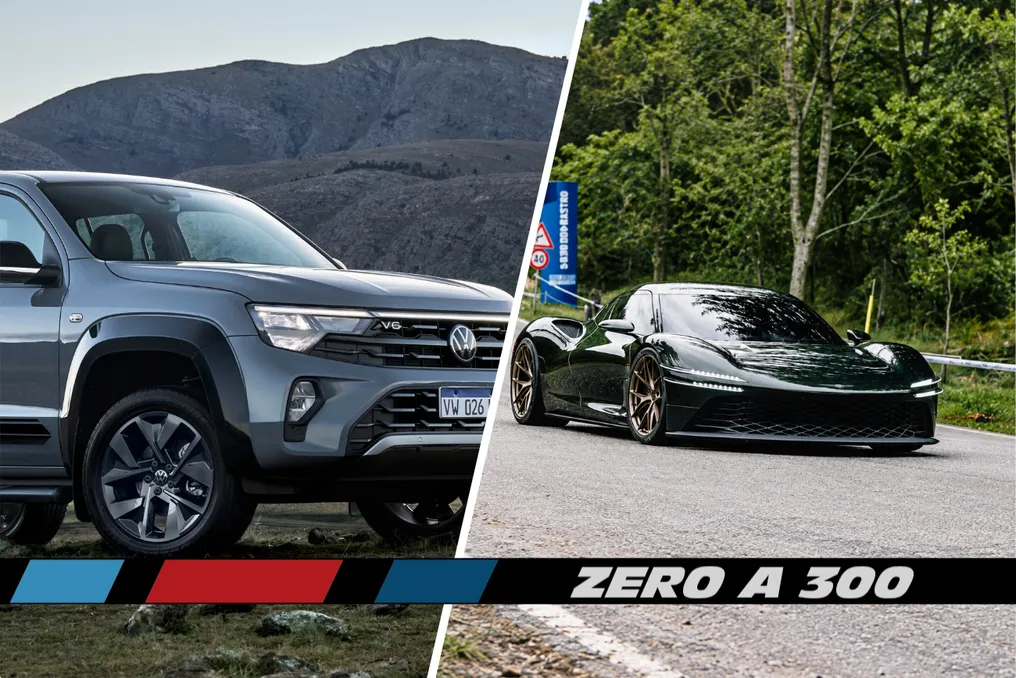
VW Amarok Unlimited farewell and highlight of the Genesis Magma GT at a hillclimb event
Read more
FlatOut
flatout.com.br

VW Amarok Unlimited farewell and highlight of the Genesis Magma GT at a hillclimb event

Volkswagen is launching the special Amarok Unlimited series, which marks the end of the current generation of the pickup truck. This model was recently presented in Argentina and is now available in Brazil, being a limited edition with only 200 units available, although the price has not yet been disclosed.

Volks used the characteristic design of the Amarok, which maintained its appearance after 16 years of updates, to decorate the body. The exclusive paint is in Moonstone Gray, complemented by sill stripes with the inscription "V6 Unlimited," glossy black wheel arch moldings, and diamond-finished alloy wheels. The Saint Anthony on the bed also has a glossy black finish, resulting in an aesthetically pleasing look.

The interior features various resources, including leather-upholstered seats and steering wheel, two-zone digital air conditioning, 9-inch Composition Touch multimedia center, six airbags, ABS brakes with off-road function, automatic post-collision braking, and rear differential with mechanical lock. A numbered plaque on the dashboard confirms that it is a special edition.

The Amarok Unlimited will be equipped exclusively with the three-liter V6 turbodiesel engine, which delivers 258 hp (reaching peaks of 272 hp with the overboost system) and 59.1 kgfm of torque, coupled with the eight-speed ZF automatic gearbox, maintaining 4Motion all-wheel drive. The pickup is expected to arrive at dealerships in October, but before that, it will be displayed at the Circuito Sertanejo event in Jaguariúna (SP) next weekend.

Genesis Magma GT roars loudly at hillclimb event

The Genesis Magma GT, a supercar from the Genesis brand—which emerged as a luxury division of the South Korean manufacturer—proved to be a serious competitor in the supercar segment, rivaling models such as the Chevrolet Corvette, McLaren Artura, and Ferrari 296 GTB. Its performance was noted during the Tutto Bene Hillclimb, held near Lake Maggiore, Italy.

Besides having a sophisticated design that reflects the Genesis visual language, what caught attention was the powerful sound of the V8 engine. Even at moderate accelerations, the Magma GT emits a deep, loud, and bubbling roar. This 3.2-liter V8 engine is derived from the 1.6-liter four-cylinder engine used in the Hyundai i20 N rally car. Hyundai already uses a hybrid version of this engine in its GMR-001 LMDh prototype, which participates in the Hypercars category at Le Mans; however, in the Magma GT, the system is purely combustion.

Although the Genesis Magma GT is still an official concept, the manufacturer keeps other technical specifications confidential. It is expected that this project will give rise to a family of vehicles, including roadster and track versions compatible with FIA GT3 regulations. The launch date for the final production version has not yet been defined, but the most optimistic estimates point to 2027, with 2028 considered more likely.

AI Cameras: A fine every 19 minutes

Two cameras equipped with artificial intelligence, installed at kilometers 17 and 18 of the Raposo Tavares Highway, at the entrance to the city of São Paulo, registered 2,316 fines in just one month, equivalent to one citation every 19 minutes, operating 24 hours a day. Of these infractions, none were for speeding; between August 3 and September 3, 1,386 infractions related to seatbelt use and 930 for using a cell phone or headphones were recorded.

The system works by analyzing internal images of vehicles to identify possible infractions, which are later checked by the Highway Military Police before the fine is issued. The technology also has OCR plate reading capability, although there is no confirmation that these devices are used to automatically locate stolen or stolen vehicles.

A debated point raised is the priority given to inspection automation. In this initial phase, the cameras cannot yet automatically detect stopped vehicles, pedestrians, or objects on the road—situations where AI detection followed by immediate intervention could prevent accidents. This raises the issue of the dehumanization of inspection, as the driver receives the fine weeks later, without the dangerous conduct being interrupted at the moment it occurs, unlike a police approach.

It is questioned whether these devices are effectively preventing accidents. After 2,316 monthly citations, it would be relevant to know how many accidents were avoided, how many risky situations were interrupted, and how many stolen vehicles were recovered with the help of these cameras, since the efficiency of the inspection must be measured by the safety provided, and not just by the volume of fines issued.

US Manufacturers Want to Ban Chinese Brands, But Trump Accepts Local Production

While traditional manufacturers in the United States seek to convince the American Congress to permanently restrict the entry of Chinese cars, President Donald Trump shows openness to Chinese brands, provided they establish local factories and hire American labor.

In an interview with Fox News, Trump mentioned that the problem would be the production of vehicles in Mexico for subsequent export to the US. He drew an analogy with Japanese manufacturers, who faced similar resistance decades ago but ended up investing in the country, employing thousands of Americans, and achieving leadership in certain sectors.

This stance diverges from the Alliance for Automotive Innovation, an association bringing together major American manufacturers such as Ford, GM, Stellantis, Toyota, Volkswagen, Hyundai, and Honda. At the beginning of the month, the group requested a definitive ban from Congress on the sale, import, and manufacturing of connected Chinese vehicles, hardware, and software, alleging that Chinese government subsidies and connectivity pose national security and economic risks.

Currently, Chinese cars already face barriers in the United States. In addition to tariffs exceeding 100% on Chinese electric vehicles, a regulation approved during Joe Biden's term limits automotive hardware and software linked to China, making the commercialization and production of connected Chinese cars difficult.

It is notable that, despite Trump accepting Chinese factories with American employment, members of his government and parliamentarians of his party have pressured Ford regarding its partnerships with Chinese companies such as CATL and Geely. It seems that the American conclusion converges with that of other countries: if a total ban is not feasible, the alternative is to force local production to foster jobs, investments, and technological development.

Route 66, one of the most iconic roads, can now be virtually traveled in its total length of 3,539 kilometers through mobile applications and computers. The idea came from Jake Boyles, developer of the Pit Stop application, which maps support points near American highway exits.

To celebrate the road's centenary, he created a specific version that covers the entire extent, including all existing restaurants, gas stations, and businesses. Although it may not be practical for the Brazilian public, the feature helps gauge the vastness of Route 66, which crosses the United States from coast to coast, passing through seven states.

The application catalogs not only commercial establishments but also notable tourist spots, such as the Santa Monica pier, the final point of the crossing in the Pacific, the famous corner in Winslow, Arizona, cited by the Eagles, and the meteor crater used by NASA in the Apollo mission training. In total, Boyles mapped about 2,400 dining locations, 1,300 motels, and 280 cities along the route. Inaugurated in 1926 and consecrated as the "Mother Road" by John Steinbeck in The Grapes of Wrath, Route 66 symbolizes the culture of automobile travel. Despite losing relevance to the interstates in the 1950s and 1960s, culminating in its federal decommissioning in 1985, the road remains alive in the popular imagination.
Similar stories

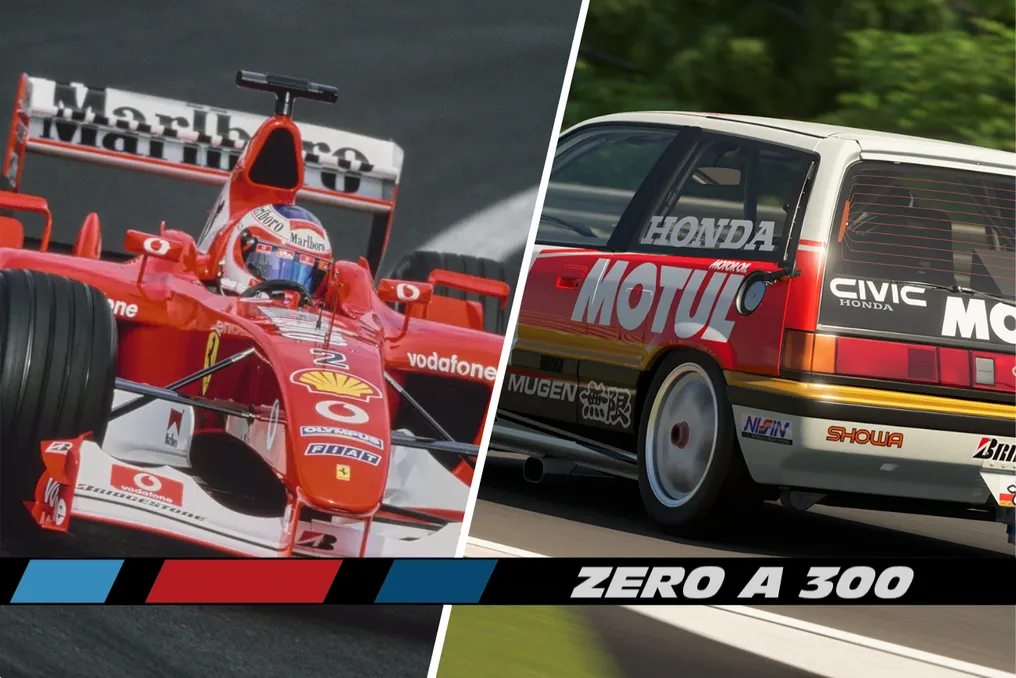
Barrichello returns to Monza with Ferrari F2002; Gran Turismo 7 receives update with new tracks and content
Read more
flatout.com.br

Barrichello returns to Monza with Ferrari F2002; Gran Turismo 7 receives update with new tracks and content

Ferrari paid tribute to Michael Schumacher at the Italian Grand Prix by bringing back the Ferrari F2002 to the track. This historic car will be driven by Rubens Barrichello and Sebastian Vettel as part of the celebrations marking the 30th anniversary of Schumacher's arrival at the team in 1996.

The F2002 will return to the circuit on Saturday (5), driven by Barrichello, who won the Italian GP in 2002, leading a Ferrari duo with Schumacher in second place. On Sunday (6), before the start, Sebastian Vettel will make another demonstration lap in the F2002. Vettel, who raced for Ferrari between 2015 and 2020, always considered Schumacher a great inspiration and later became his friend.

The F2002, launched in the 2002 season, demonstrated great dominance, winning 14 out of the 15 races held that year. Schumacher won the title already at the French GP in July, equaling Juan Manuel Fangio's five championships, while Ferrari secured the Constructors' World Championship early in Hungary. At the end of the season, the team accumulated 15 victories in 17 races.

This vehicle also represents one of the last great Ferraris of the V10 engine era, using the 3.0 naturally aspirated Type 051. It was developed during the period when Rory Byrne, Ross Brawn, and Jean Todt formed the technical and administrative core responsible for transforming the team into the dominant force in Formula 1 at the beginning of the decade.

The tribute extends to Hamilton's and Leclerc's SF-26 cars, which will receive a special paint job inspired by the red of the 1996 Ferrari. The drivers' racing suits will also feature Schumacher's logo and the seven stars, referencing the German driver's seven world titles.

The Return of the Jensen Interceptor

The original Jensen Interceptor was a European sports car with an American engine popularized in the 1970s. Its chassis engineering was British, but the engine was always a Chrysler V8, available in 360, 383, or 440 cubic inch versions, characterizing it as a true muscle car manufactured in the United Kingdom.

It is currently back, but not as a restomod. The new model, named Interceptor GTX, is an entirely new sports car, without retro intent, equipped with a Texas-produced V8 featuring a supercharger capable of generating nearly 1,000 horsepower. Jensen International had been gradually providing information, and now the complete package has been revealed.

The design of the Interceptor GTX is appealing, presenting the expected proportions of a coupe with the V8 positioned behind the front axle: elongated hood and short rear in a fastback style. Although the reference to the original silhouette is subtle, details such as the rear side windows, the C-pillar, and the wrap-around rear glass are elegant allusions to the classic.

This specific version is designed as a track car and features various aerodynamic components, including a large front splitter, a robust rear diffuser, a prominent rear wing, and side skirts. The interior reinforces its track purpose with carbon fiber elements, competition seats, leather straps replacing door handles, and a full roll cage. The dashboard architecture also evokes the original Jensen Interceptor.

Mechanically, the Jensen Interceptor GTX uses a 6.2-liter Chevrolet V8 engine, prepared and assembled by Late Model Engines, a Texas company. The 2.65-liter supercharger helps the engine reach 973 hp, although Jensen guarantees it can handle over 1,100 hp. The transmission is a six-speed sequential gearbox, controllable both via the console and levers behind the steering wheel. Acceleration and top speed data have not yet been released.

Structurally, the GTX opts for aluminum, both in the monocoque and the hand-molded bodywork, instead of carbon fiber. This choice, although technically less sophisticated, aims to reduce costs and align with the vehicle's classic proposal. The suspension features overlaid triangular arms on all four wheels and Nitron shock absorbers with three distinct adjustments, and the steering is hydraulic, aiming for a more engaging drive.

Historically, the Jensen Interceptor was more of a grand tourer than a pure sports car. The GTX represents a more economical way to introduce a new model into the catalog and generate revenue, without the need for heavy investment in homologation testing. Next steps include street models, which are in advanced development, with the promise that at least 80% of the GTX's aesthetic elements will be present in the legalized version. This street version may feature a torque converter automatic or a six-speed manual transmission. Jensen plans to launch the Interceptor GTR, the version closest to the GTX for public road use, and eventually a four-door variant, targeting competitors like Aston Martin.

Gran Turismo 7 Update Brings New Cars and the Return of Autumn Ring

The Autumn Ring circuit has always been one of the most notable original layouts in Gran Turismo, known for its highly technical curves, diverse terrain variations, and a layout that demands calculated overtakes. Launched in the first Gran Turismo almost thirty years ago, it has been present in all subsequent titles up to Gran Turismo 6, appreciated by old-school enthusiasts.

After its absence in Gran Turismo Sport, the Autumn Ring will return to Gran Turismo 7 through the latest free update, named Spec IV. However, this update is extensive and will be released in two phases: the first in October and the second in December. It is important to note that the Autumn Ring will only be available in the second part.

The first phase of the update will also bring a new real circuit: the Sportsland SUGO, located in Japan, which has hosted rounds of Super GT and Super Formula. This track measures 3.7 km and is recognized for its altitude changes and sections that require great driver skill.

Players will be rewarded for their wait with the arrival of the Autumn Ring in December. In addition to the original layout, which favors lower-powered cars with good dynamics, Polyphony Digital will develop an expanded version suitable for more powerful and faster vehicles.

The update will also include 12 new automobiles, distributed in two groups of six. Although the official list has not yet been released, promotional material shows a variety of models, such as the BMW M5 E60, the Mugen Motul competition Honda Civic, the Citroën 2CV Charleston, the Honda Stepwgn Spada minivan, the Mazda RX-Vision GT3, and the Xiaomi Vision Gran Turismo.

Other functionalities will be added to the game. An interesting feature is the Car Concierge service, which will facilitate the acquisition of desired vehicles, allowing orders for used and Legendary models. A Family Mode will also be implemented, offering simplified driving challenges for beginners. Additionally, there will be a Random Race Mode, with randomly selected track and opponents, a new store called Retro dedicated to cars unavailable for new purchase, and an increase in both the Collector Level limit and the difficulty selector.

Sony announced that more details about the update will be shared later, including during a 'Gran Turismo World Series' event in Singapore, scheduled for October 3rd.

Volkswagen Restructuring Plan and the Future of SEAT

The Volkswagen Group is seriously planning to discontinue one of its oldest brands, SEAT, its Spanish division, as part of a restructuring plan focused on cost reduction and return to profit. Although there is no official confirmation, internal documents and comments from executives linked to the group suggest that the brand will be phased out by the end of this decade.

Reports from the German press indicate that the group has already removed SEAT from its long-term strategic planning, forecasting the gradual discontinuation of its portfolio over the next three years, culminating in its total extinction in 2029. The German portal WirtschaftsWoche obtained a document detailing that the closure of SEAT will occur in an organized and efficient manner, ensuring support for current customers and fulfillment of all outstanding obligations.

However, the Cupra brand, which emerged as SEAT's sports division, will be preserved. Unlike SEAT, Cupra has proven to be profitable: while sales of the first fell by 17% in 2025, the second registered a growth of 33% in the same year.

When contacted, Volkswagen declined to officially comment on the information. However, the company acknowledged that, like the automotive sector in general, the VW Group and SEAT are undergoing a profound transformation, but stated that no decision has been made at this time and that any strategic decisions regarding SEAT will be communicated in due course.

Ford Resuscitates Its Secret V10 Mustang

In the early 2000s, Ford engineers decided that an eight-cylinder engine was insufficient for the Mustang. They adapted the architecture of the 4.6 Modular V8, adding two cylinders to build a 5.8-liter naturally aspirated V10. This vehicle never reached widespread commercialization in dealerships.

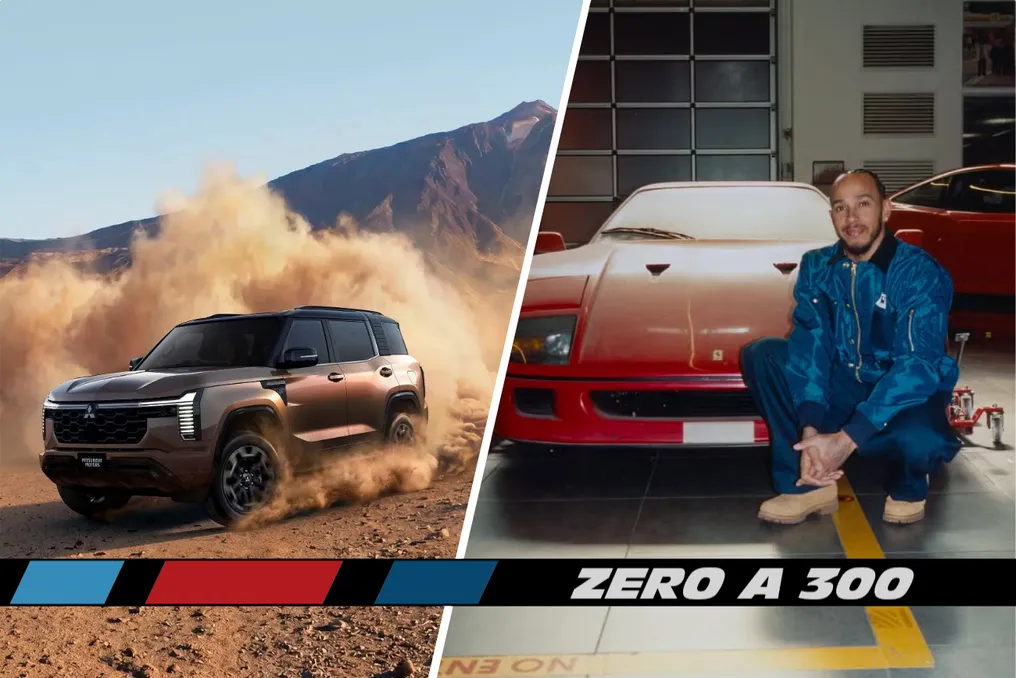
Launch of the new Mitsubishi Pajero and details on the restoration of Lewis Hamilton's Ferrari F40
Read more
flatout.com.br

Launch of the new Mitsubishi Pajero and details on the restoration of Lewis Hamilton's Ferrari F40

The Mitsubishi Pajero has returned after a five-year hiatus, maintaining its classic SUV essence, utilizing a chassis derived from the Triton and equipped with a turbodiesel engine, along with 4x4 low range traction, ready for long-distance rally competitions.

Visually, the new model presents a contemporary language, characterized by straight and muscular lines. It features side windows that merge with the rear glass and, in promotional images, displays a two-tone paint job, combining a glossy black roof with a bronze-toned body.

The front end features boomerang-shaped (or steak bone) LED headlights and an upper light bar on the grille. The taillights follow a similar concept, with vertical rectangular elements, although they are interrupted by an identification plate.

The dimensions of the new Pajero are 4.92 meters in length, 1.93 m in width, 1.91 m in height, and 2.87 m wheelbase, offering space for seven passengers in three rows. The suspension combines overlaid arms at the front and a multi-link arrangement with a solid axle at the rear, highlighting its off-road capability with a ground clearance of 230 mm.

In contrast to the dated architecture of the previous generation, the interior of the new Pajero adopts a more minimalist and horizontal design. However, much of the physical controls has been replaced by a 14.3-inch touchscreen, which serves as the main panel and replaces indicators such as altitude, compass, and inclination.

The interior finish is marked by the elevated center console, horizontal air vents on the dashboard, and extensive use of leather. The initial equipment list is robust, including tri-zone automatic air conditioning, ventilated seats, 3D external cameras, and a Yamaha sound system with 12 speakers. Safety features include eight airbags, adaptive cruise control, lane assist, and cross-traffic alert.

The initially announced engine is a 2.4-liter four-cylinder turbodiesel, based on the Triton's 4N16. While the Triton uses two turbochargers, the Pajero employs a variable geometry turbocharger. Furthermore, the SUV debuts a new eight-speed automatic transmission, unlike the pickup's six-speed automatic gearbox. The Super Select 4WD-II system allows for various traction configurations, working with S-AWC to offer seven driving modes.

The vehicle will be produced in Thailand and is scheduled to arrive in Japan and Australia, with a planned launch in over 100 countries, including Latin America, starting in 2027.

Lewis Hamilton rescues Ferrari F40 stored for 30 years

Formula 1 driver Lewis Hamilton managed to acquire an original Ferrari F40 that had been stored for three decades. The Scuderia driver announced the acquisition on his social media, confirming that the car would be completely restored by the Maranello engineering team.

Hamilton expressed great enthusiasm, describing the vehicle as the car of his dreams. After finding the dusty example, he first took it to Maranello, where specialists worked on its revitalization. He thanked everyone involved in the project.

This supercar, equipped with a 2.9-liter twin-turbo V8 engine, 478 hp, a manual gearbox, and traction, retains characteristics of the analog era of Ferrari, achieving 0 to 100 km/h in 4.1 seconds and a top speed exceeding 320 km/h.

Previously, Hamilton had mentioned the idea of developing a modern supercar based on the F40, possibly named F44, keeping the manual gearbox but modernizing the engine and style, although preserving the originality of the F40 is considered superior by many.

Laguna Seca's Corkscrew is now called Zanardi Corkscrew

Those responsible for Laguna Seca announced that the Corkscrew curve will officially be named Zanardi Corkscrew, in tribute to Alex Zanardi and 30 years of one of the most iconic overtakes in Indy history.

This legendary maneuver occurred on the last lap of the CART season when Zanardi, chasing Bryan Herta, used the Corkscrew as his last chance to win. The Italian driver dove inside during braking, overtook Herta at the curve entrance, and crossed part of the runoff area before returning to the track in the lead, an action validated by the stewards.

The Corkscrew corresponds to the section formed by curves 8 and 8A, covering 137 meters between entry and exit, with a drop of approximately 18 meters in this section. The altitude difference between curve 8 and curve 9 exceeds 33 meters.

The official ceremony for the Zanardi Corkscrew took place last Friday during the final IndyCar events at Laguna Seca, attended by Chip Ganassi, owner of Zanardi's CART team, and Max Papis.

Audi Nuvolari may give rise to a new Porsche supercar

Despite the delicate situation of the Volkswagen Group, rumors suggest that the Audi Nuvolari, a supercar recently presented by Audi, could serve as a basis for a successor to the Porsche 918 Spyder.

According to Automotive News, Porsche is reportedly evaluating the use of the Nuvolari to create a new top-tier model, which would simplify the engineering process, avoiding a complete restart like what happened with the 918 Spyder. The Nuvolari shares components with the Lamborghini Temerario, including a four-liter twin-turbo V8 assisted by three electric motors, capable of generating 920 hp, while Audi promises something exceeding 1,000 hp.

Considering Porsche's current challenges, where the 911 sustains the brand while other models face changes and delays, utilizing existing parts would be a viable solution to introduce a new super sports car above the 911. However, Automotive News points out that negotiations between Audi and Porsche are still in the preliminary phase, awaiting an opportune moment for any announcement.

Porsche 911 GT3 receives special series in honor of the Alps

Porsche has launched a limited special edition of the 911 GT3 RS, named 911 GT3 Bergsport, as a tribute to the European Alps. Production will be restricted to only 100 units, and sales will be exclusive to Switzerland, Italy, Austria, and France.

This creation was developed by Porsche's Exclusiv Manufaktur division. The goal is to celebrate both the mountain roads of the Alps and the origins of Porsche itself, given that the dynamic development of Stuttgart's first road sports cars occurred on these routes, as well as some of the brand's early victories in competitions.

Based on the Touring version, the GT3 Bergsport maintains its original mechanical package, consisting of a four-liter naturally aspirated flat-six engine with 510 hp and a six-speed manual gearbox. The main distinction lies in the body color.

Popular