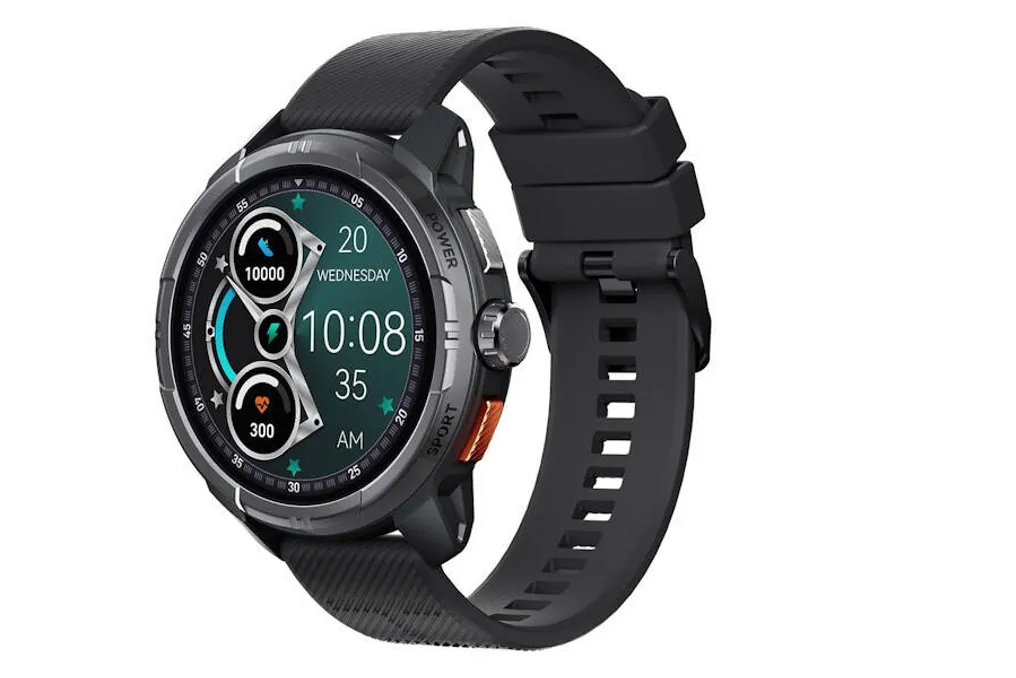
The Haylou Solar Ultra is a smartwatch that offers features typically found in more sophisticated models, but at a significantly lower price. This watch is specifically aimed at people who engage in physical activities and includes integrated GPS, allowing for runs or walks without needing to carry a cell phone.
Olhar Digital conducted a detailed analysis of the device to determine if it justifies the investment, presenting its main features, drawbacks, and whether it could be the consumer's next smart watch.
In terms of design, the Haylou Solar Ultra is a considerably sized and notably heavy watch. Its construction combines a metallic bezel on the front with a plastic back structure, making it unsuitable for those seeking a discreet device or having slim wrists. The included strap is simple silicone and can be replaced according to user preference.
The device features a water resistance rating of 5 ATM, allowing its use in activities such as swimming, running in the rain, and even during bathing.
Interaction with the watch occurs via a touch-sensitive screen, buttons located on the right side, and a rotating crown. The 1.6-inch AMOLED display ensures high sharpness, vibrant colors, and strong contrast, even under direct sunlight. However, it lacks automatic brightness adjustment, requiring manual user intervention depending on the environment.
The Haylou Solar Ultra has the feature to keep the screen permanently on, facilitating quick time viewing, although this results in reduced battery life. The watch face is customizable via the smartphone app, allowing replacement with options beyond the pre-installed ones.
For communication, the watch integrates internal microphone and speaker, enabling answering and making voice calls directly from the wrist, provided there is a stable Bluetooth connection with the phone and the environment is not excessively noisy. Furthermore, it offers everyday tools such as an alarm, stopwatch, calculator, weather forecast, compass, and flashlight.
As a fitness-focused smartwatch, it incorporates valuable features for those who train. The inclusion of built-in GPS is a positive point, as it ensures the device accurately records outdoor walking and running routes, eliminating the need for a cell phone. The watch supports over 170 types of exercises and automatically detects the start of walks or runs. During exercise, the screen displays metrics such as speed, distance, step count, and calories burned, and the history can be synced with apps like Strava.
However, the device does not calculate advanced training data, such as the necessary body recovery time before the next activity, a feature present in more expensive models.
Regarding health monitoring, the model tracks heart rate, blood oxygen saturation, and stress levels throughout the day. Measurements are fast but provide only a basic view of physical condition, lacking the depth of detail offered by more advanced devices. It also monitors sleep, recording hours slept and segmenting the night into light, deep, and REM phases. Additionally, the watch alerts about long periods of inactivity and offers guided breathing exercises. All this data is easily accessible through the mobile application.
The average battery life is 10 to 12 days under normal use, considering heart rate monitoring and notifications. In extremely basic use, just checking time and steps, the charge can exceed two weeks. Power consumption increases considerably when GPS is active during outdoor workouts or when the always-on display mode is operating, requiring recharging every three or four days in these intensive scenarios.
A full recharge takes approximately two hours and uses a specific magnetic cable. A drawback is that the magnet on the end of the cable is weak, which can accidentally cause the cable to detach from the back of the watch.
Considering the integrated GPS, long battery life, and large screen with good visibility, the Haylou Solar Ultra represents an excellent alternative for those who want a smartwatch that goes beyond the basic without incurring the costs of top-of-the-line models. It also allows voice calls from the wrist and offers exercise tracking and health data with reasonable accuracy.
However, some aspects warrant attention before purchasing: the design is bulky and heavy, not discreet, and the physical activity reports are considered simplistic, lacking more detailed information. In summary, it establishes itself as a good mid-range model, superior to very cheap devices, but without the advanced features of premium models.