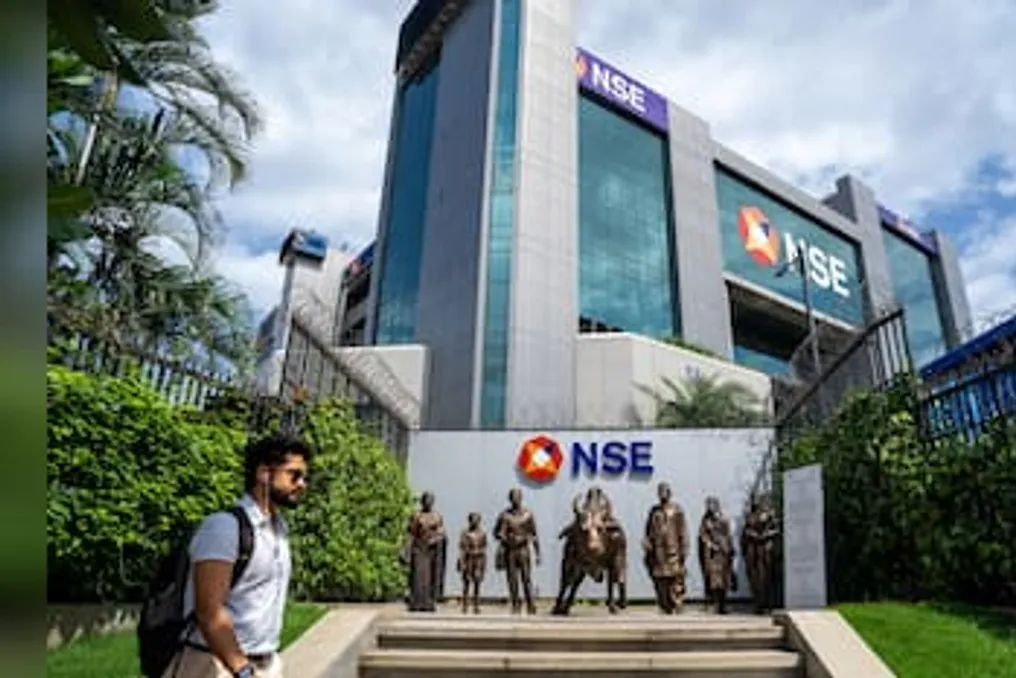
India's National Stock Exchange IPO attracts unexpectedly high demand, book size reaches over 6000 crore rupees
Read more
Business Standard
business-standard.com

India's National Stock Exchange IPO attracts unexpectedly high demand, book size reaches over 6000 crore rupees

The National Stock Exchange of India (NSE) reported that its Initial Public Offering (IPO) attracted 'unexpectedly large' demand, significantly exceeding the number of shares available for distribution, stated Managing Director and CEO of NSE Ashishkumar Chauhan on Tuesday.

Chauhan did not disclose the ratio between Domestic Institutional Investors (DIIs) and Foreign Portfolio Investors (FPIs), noting that the allocation process is still ongoing. He also mentioned that the initially expected book size of around 9000 crore rupees was reduced to over 6000 crore rupees, despite sustained high demand.

'The demand is unexpectedly large,' emphasized Chauhan, adding that the offering interested a large number of investors wishing to acquire a limited number of shares.

The allocation will be made among various categories of institutional investors, including domestic mutual funds, other domestic institutions, and FPIs, in accordance with prevailing regulations. The NSE IPO is scheduled to begin subscription on September 17 and conclude on September 21. The price band is set at 1700–1785 rupees per share. The offering is a Follow-on Public Offer (OFS), wherein existing shareholders sell up to 12.64 crore shares; no new NSE shares are being issued.

Chauhan also noted that initially, some shareholders were reluctant to sell their stakes at the proposed valuation, which led to a reduction in the offer from the previously stated 6.2% to 5.11%. Furthermore, NSE had to approach some of its shareholders to participate in the OFS so that the exchange could meet listing requirements.

Listing the exchange will provide existing shareholders with a more transparent and liquid way to realize their assets. Currently, NSE shares trade in a private market, where shareholders may face increased transaction costs and counterparty risks, according to Chauhan.

According to the company's IPO prospectus, the shares will be listed on BSE. Regarding pricing, Chauhan clarified that the company's bankers consulted with investors both in India and abroad, including large institutions, mutual funds, pension funds, and retail investors. He explained that during discussions, it was decided to maintain the option for retail investors.

The proposed IPO comes as NSE remains India's largest stock exchange by turnover in several key segments. According to the IPO prospectus, as of June 30, 2026, NSE accounted for 93.05% of India's money market turnover and 68.48% of equity options turnover based on the premium turnover for the three months ending June 2026.

Chauhan also refuted the notion that NSE's operations heavily depend on weekly options. He stated that weekly options currently account for about 42% of NSE's total revenue, compared to 60–70% three to four years ago. The rest of the revenue comes from monthly index options, equity options, stocks, equity futures, colocation services, data, indices, and other business areas. The exchange has also expanded its activities into various asset classes, including equities, currencies, commodities, interest rates, and power.

NSE's integrated business model includes exchange listings, trading, clearing and settlement, indices, and market data. Chauhan explained part of the decrease in NSE's EBITDA margin last year due to a large one-time fine, noting that the exchange's normalized EBITDA margin remained in the range of 76–79% over the past five years.

As per the company's IPO prospectus, NSE's consolidated operating revenue grew by 9% year-on-year to 4560 crore rupees in the quarter ending June 2026, and net profit increased to 3121 crore rupees compared to 2811 crore rupees the previous year.

Chauhan stated that NSE's investor base has significantly expanded beyond major cities in the country, and the exchange will continue efforts to attract more investors and companies from regions such as Jammu and Kashmir, Northeast, Odisha, Jharkhand, and Chhattisgarh to the capital market. As of June 30, NSE had 13.237 crore unique registered investors and 26.136 crore registered investor accounts, with investors spread across over 99% of India's postal codes. 3005 organizations are registered on the exchange platform with a cumulative market capitalization of 474.08 trillion rupees.


Similar stories

Wave of IPOs expected in Indian stock market this week, attracting funds from 12 companies
Read more
www.aajtak.in

Wave of IPOs expected in Indian stock market this week, attracting funds from 12 companies

The Indian stock market is preparing for a significant surge in Initial Public Offerings (IPOs) this week. Between September 7 and 11, 12 companies are set to enter the market, planning to raise approximately 7,180 crore rupees from investors.

These IPOs are taking place at a time when major IPOs, such as NSE, are also anticipated later this month.

The total volume of these 12 IPOs amounts to approximately 7,179.84 crore rupees. Some companies will raise capital by issuing new shares, while others will allow existing investors to sell their stakes. Of the total issuance, about 2,814.10 crore rupees will be raised through fresh issues, and 4,365.74 crore rupees will come through an Offer For Sale (OFS).

The largest IPO this week is Rentomojo with a volume of 1,255.57 crore rupees, while the smallest will be Manika Plastic's offering at 125.50 crore rupees.

The companies entering the market this week represent various sectors. The IPO of Pranav Constructions will be available from September 7 to 9. Following that, the IPOs of Glas Wolf Systems, Prasol Chemicals, and Kanohar Electricals will open to investors from September 8 to 10.

From September 9 to 11, investors can participate in the IPOs of Karmatar Engineering, LCC Projects, Steamhouse, Manipal Payment and Identity Solutions, Asset Reconstruction, and Rentomojo. Additionally, Vigaland Developers' IPO will be open from September 10 to 15, and Manika Plastic's from September 11 to 16.

It is important to note that the Asset Reconstruction IPO is entirely based on OFS, meaning the company is not issuing new shares as part of this offering.

To participate in these IPOs, retail investors will need to invest an average of 14,500 to 15,000 rupees per lot. Karmatar Engineering's IPO requires the highest amount, around 14,986 rupees per lot, while a lot in Kanohar Electricals can be purchased for approximately 14,536 rupees.

The simultaneous appearance of so many IPOs provides investors with numerous options; however, due to limited capital, choosing between different offerings may prove difficult.

Despite the total IPO volume of 7,180 crore rupees this week, market attention is also focused on two potential mega-IPOs. According to reports, the proposed NSE IPO could be around 30,000 crore rupees and might appear in the week starting September 21. Furthermore, Jio Platforms has received SEBI approval, and its IPO could reach a volume of approximately 37,700 crore rupees.

If this size is maintained, it could surpass the Hyundai Motor India IPO of 27,859 crore rupees and become the largest IPO in the country. Thus, high activity is expected in the primary market over the next few months.

Good IPOs are often oversubscribed several times, after which allocation is done via lottery. In such a situation, applying for 1 lot from different demo accounts linked to family members (parents, spouses, siblings) using their separate PAN cards significantly increases the probability of receiving an allocation.

11 companies plan to raise 7055 crore rupees through IPO next week
Read more
business-standard.com

11 companies plan to raise 7055 crore rupees through IPO next week

Activity in the primary market is intensifying as eleven companies, including Rentomojo, Karamtara Engineering, and Kanohar Electricals, intend to raise 7055 crore rupees through Initial Public Offerings (IPOs).

These IPOs are scheduled to hit the market between September 7 and 15, with most listings opening for subscription on Tuesday and Wednesday.

Rajkumar Rati, Investment Director at YES Securities, noted that this surge in multiple issuances reflects the drive to capture equity capital at early stages in young companies, as all of them have a market capitalization below $1 billion USD at the time of listing.

The companies participating in the primary market fundraising represent various sectors: real estate developers, engineering and manufacturing firms, a payment and identity solutions provider, a specialty chemical manufacturer, and an online rental platform.

Of the total amount of 7055 crore rupees, 2722 crore rupees (39 percent) constitutes the primary capital issuance, which goes to the company itself, while 4333 crore rupees (61 percent) is a secondary sale by existing shareholders. According to Rati, such mobilization indicates high corporate confidence and robust liquidity in the Indian primary market.

The funds raised from these new issues will primarily be used for business expansion, capital expenditures, debt repayment, meeting working capital needs, and other general corporate purposes.

This upcoming IPO frenzy follows a strong start to September, when Rays of Belief and Deepa Jewellers already launched their IPOs on September 1. Thanks to these listings, the number of companies launching IPOs in 2026 is expected to increase to 75, including 23 launches in August.

IPO Schedule and Details

Among the eleven companies opening an IPO, Pranav Constructions will be the first whose offering opens for public subscription on September 7. This offering, worth over 351 crore rupees, will close on September 9.

Following this will be Kanohar Electricals, Prasol Chemicals, and Glass Wall Systems (India), which will open their IPOs on September 8. On September 9, Rentomojo, Manipal Payment and Identity Solutions, Arcil, LCC Projects, Karamtara Engineering, and Steamhouse India will launch, and Veegaland Developers will open its IPO on September 10.

Pranav Constructions set a price band of 118–124 rupees per share for its IPO, which includes a primary issue of 315.6 crore rupees and an OFS of 28.57 lakh shares valued at 35.43 crore rupees.

Kanohar Electricals fixed a price band of 601–632 rupees per share for its IPO amounting to 1056 crore rupees. Prasol Chemicals set a price band of 643–676 rupees per share for an IPO worth 500 crore rupees, consisting of a primary issue of 80 crore rupees and an OFS up to 420 crore rupees.

Glass Wall Systems (India) determined a price band of 172–182 rupees per share for its IPO totaling 428 crore rupees. Rentomojo set a price band of 384–404 rupees per share for its IPO amounting to 1256 crore rupees. This offering includes a primary issue of up to 150 crore rupees and an OFS of 2.73 crore shares valued at 1106 crore rupees at the upper end of the price band.

Karamtara Engineering's IPO, worth 875 crore rupees, includes a primary issue of 675 crore rupees and an OFS of shares worth up to 200 crore rupees. The price range is 241–254 rupees per share.

Manipal Payment and Identity Solutions set a price band of 322–339 rupees per share for its IPO totaling 805 crore rupees. The offering includes a primary issue of 320 crore rupees and an OFS of up to 1.43 crore shares valued at 485 crore rupees.

Arcil has a price band of 132–139 rupees per share for its IPO worth 733 crore rupees, which entirely consists of an OFS. Since there is no primary issue, Arcil will not receive revenue from the offering.

LCC Projects set a price band of 139–146 rupees per share for its IPO totaling 427 crore rupees. Steamhouse India will raise 414 crore rupees through its IPO, which includes a primary issue of 353 crore rupees and an OFS of 61 crore rupees. Veegaland Developers will raise 210 crore rupees solely through the primary issuance of shares.

ESDS Software Solution Ltd stock rose by 111% after IPO, reaching 908 rupees
Read more
www.aajtak.in

ESDS Software Solution Ltd stock rose by 111% after IPO, reaching 908 rupees

A recent Initial Public Offering (IPO) on the stock market generated significant profits for investors. Specifically, shares of ESDS Software Solution Ltd debuted on the exchange on Friday, doubling investors' funds.

On September 4, ESDS Software Solution shares were listed at 757 rupees, which was 76.46 percent higher than the initial IPO price of 429 rupees. However, the growth did not stop there; subsequently, the stock continued to rise on the NSE, increasing by 20 percent to reach 908 rupees.

Thus, this stock provided investors with a return of 111% compared to the IPO price, effectively doubling their investment.

Retail investors needed to purchase at least one lot, which cost 14,586 rupees and included 34 shares. After the IPO listing, each shareholder made a profit of 328 rupees per share. This was followed by an additional 20 percent increase. As a result, the total return was 111%, meaning a profit of 16,190 rupees on the initial investment of 14,586 rupees. The total investor income from this IPO reached 30,776 rupees.

QIB subscribed to this IPO 261.51 times, while high-net-worth investors invested 192.71 times. Meanwhile, retail investors subscribed to the IPO 38.81 times.

The IPO subscription period opened on August 28 and closed on September 1. Share allotment took place on September 2, and unused funds were unlocked on the same day as the strong stock listing.

Popular