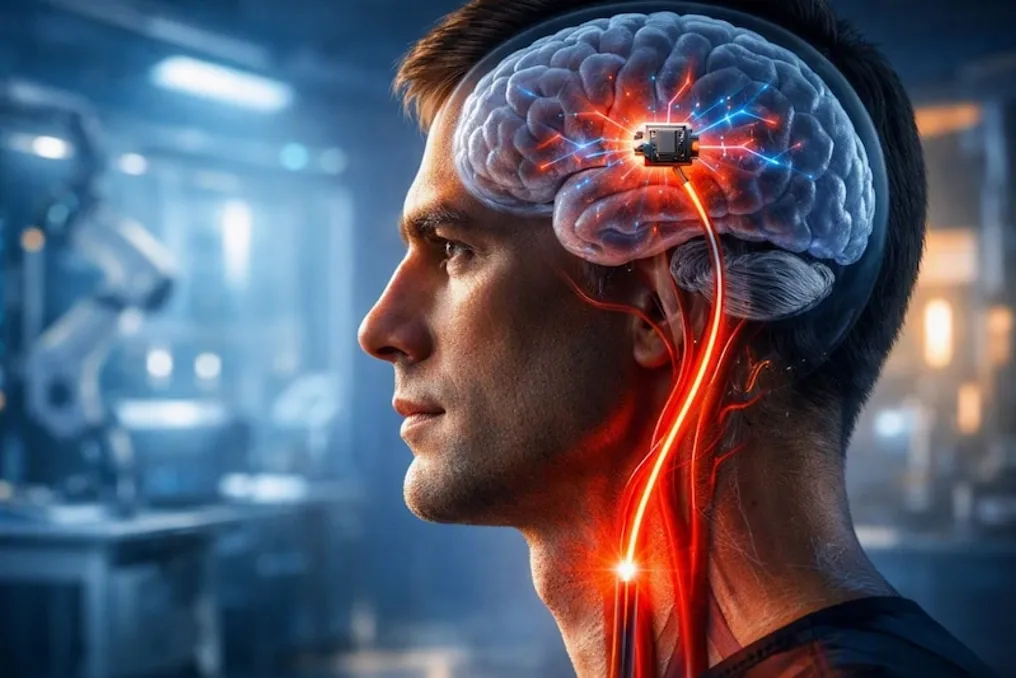
A revolutionary breakthrough has been achieved in the field of medical science and neurotechnology that could permanently change the lives of millions of people suffering from paralysis. Previously, paralyzed patients could communicate by typing messages on a digital screen or making limited sounds, but now they will be able not only to speak but also to make gestures.
Scientists from the Chang Laboratory at the University of California, San Francisco (UCSF) have created a neural implant capable of simultaneously decoding speech and movement signals originating from the patient's brain. This research, published in the New Scientist Journal, has caused significant resonance in the world of neurology.
The researchers note that a large part of daily communication depends on physical gestures; for example, nodding one's head for the word 'possible' has a different meaning than tilting the head. The scientists implanted an iPhone-sized microimplant into the 'sensorimotor cortex' of two paralyzed patients, which is responsible for speech and movement.
After this, the patients were asked to repeat 10 selected phrases (such as 'hello' or 'nice to meet you') and 10 different gestures (such as a handshake or a clap). Based on the signals received from their brains, a special AI-based machine learning model was developed. This technology instantly decodes the patient's thoughts and transforms them into a digital 'avatar' on the screen, which speaks the same words and performs the same movements as the patient intended.
The experiment was conducted on two patients named 'Bravo-1r' (paralyzed after a stroke) and 'Bravo-6' (suffering from motor neuron disease). Both patients had completely lost the ability for physical activity and speech. In the case of the first patient (Bravo-1r), the AI model was able to decode his gestures with 88% accuracy, and voice signals with 84% accuracy. For the second patient, the accuracy was 66% and 70% respectively.
Neurospecialists from the University of Lausanne in Switzerland called this an extremely convincing and reliable scientific achievement. Samantha Brosler, the UCSF researcher who led the study, reported that the technology is currently being refined to recognize a greater number of words and more precise gestures. The ultimate goal in the future is to enable patients to communicate directly using synthesized voice and their own muscles and joints (if safe), without the need for any 'avatar' or 'screen.'