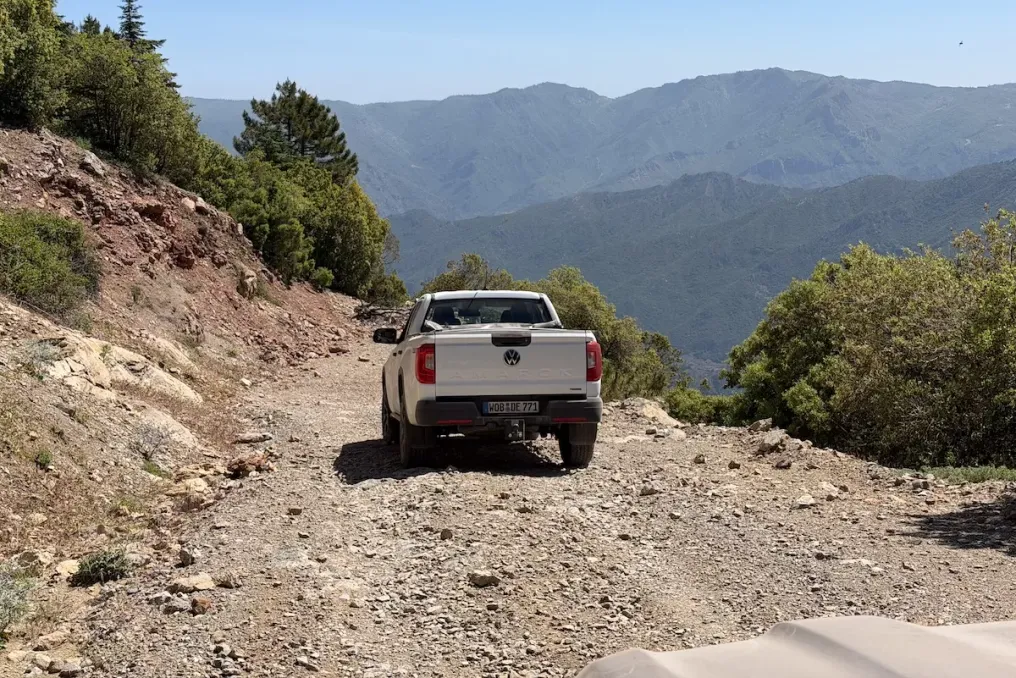
The Volkswagen Amarok PanAmericana demonstrated its capabilities by traversing the Rif mountain range in Morocco. The route began on paved roads from Tangier and concluded in a coniferous forest at an altitude of approximately 2000 meters above the city of Chefchaouen, known as the Blue Pearl.
On the Plaza España plateau, located nearly 2000 meters above sea level, participants stopped for lunch. This location is situated within the winding, coniferous network of the Rif mountains in northern Morocco. They sat on Berber carpets, enjoying kefta (meat skewers), roasted peppers, and hobz bread, while studying local botany.
A local chef explained that this is Moroccan fir (Abies marocana). He noted that another species of this genus exists in the Sierra de Grazalema natural park in Spain, called Spanish fir (A. pinsapo), but Abies marocana is an endemic species to this area and grows only above 1500 meters above sea level.
The ability to reach this high-altitude forest was made possible by the low torque and all-wheel-drive systems of the flagship Volkswagen Amarok PanAmericana. Volkswagen Group aims to remind the global market of the high level of engineering prowess inherent in the dual-cab pickup in the modern era. The modern Amarok from Volkswagen, which shares a platform with the Ford Ranger, sets the standard for combining luxury, comfort, and functionality in this segment.
The differences between these vehicles lie in the subsequent modifications made by Volkswagen: proprietary body detailing, cabin, steering wheel, and suspension tuning. The route, which combined the asphalt of Tangier with gravel mountain roads, allowed this modification to be seen against an impressive landscape.
In less than 24 hours, the group traveled from Tangier Ibn Battouta International Airport, mastering driving rules and traffic peculiarities, to Talassemtane National Park in the western Rif mountains, near Chefchaouen. The park, established in 2004 and recognized by UNESCO as part of the Mediterranean Intercontinental Biosphere Reserve, covers approximately 590 km² of rugged terrain, deep gorges, and dense forest. Its main objective is the protection of the Moroccan fir (A. marocana).
Before beginning the surreal ascent into this endangered mountain forest, before turning onto the gravel road that guided the convoy inward and upward, a view opened up of the city of Chefchaouen, the 'Blue Pearl,' whose roofs shone brightly under the harsh daylight. It resembled lapis lazuli in a limestone sea.
Chefchaouen has deservedly earned its nickname: every wall, staircase, and doorway in the old medina is painted in various shades of blue, from pale powder blue to deep cobalt, creating a disorienting effect, as if walking through a sun-faded city. The reasons for this remain a subject of debate: some attribute it to Jewish refugees who arrived in the 1930s, who painted the city blue as a reminder of the sky and a means of protection against mosquitoes. Others point to older Andalusian traditions brought by Muslim and Jewish families fleeing the Reconquista, who settled here after the city's founding in 1471 as a mountain fortress against Portuguese invasions. Regardless of its origin, maintaining cleanliness is a community ritual, as residents repaint their section of the wall annually before the rains.
Thanks to the nature of the trip—an off-road adventure through the Rif mountains that culminated in dinner in the city itself—the participants were able to experience the visual splendor twice: first from the mountains, and then at eye level. From afar, the city looks like a striking blue iris among the lower folds of the mountains; up close, in the valley, its individuality unfolds. The knowing gaze of the locals accompanies you as you navigate the labyrinth of azure alleys, narrow staircases, and knee-high doors. A certain mystery lies within the blue walls.
Observing the mountain range from below was as impressive as viewing it from the peaks of the Rif, watching evening descend upon the rock in a dance of yellow light. The best view was obtained from the terrace of the Triana cafe and restaurant, located on the roof of the upper medina, where they serve tagines, fried fish, and mint tea, characteristic of Moroccan and Andalusian cuisine.
The beauty of the vehicle, especially an elite dual-cab type like the Amarok, lies in the access it provides to the world. One evening, during a two-hour direct flight from Tangier to Chefchaouen, along with assistant Calvin Fisher, the author shared the merits of the Amarok's V6 engine, perfectly paired with a 10-speed automatic transmission, and the silence inside the cabin. The next morning, they engaged the four-wheel drive and only switched it off after experiencing the wonder of ascending one of the world's most fascinating mountain ranges. This could have been done on foot, but it certainly would not have taken just one day!
The fleet for this stage of the tour consisted of the Volkswagen Amarok PanAmericana model, specially designed for off-road use, and each vehicle was prepared for the conditions of Talassemtane National Park. Reinforced suspension and increased ground clearance, along with increased payload capacity, proved useful on the route combining gravel switchbacks with rare open rocky outcrops. A hard canopy covered the cargo bed, keeping gear dry and protected from dust throughout the day, which ranged from dry heat on the N2 highway to occasional rains higher up in the mountains. BF Goodrich All-terrain tires were fitted on all four corners, providing sufficient sidewall to resist sharp limestone rocks (though one suffered damage!). However, this does not change the fact that the Amarok, despite all modifications, remains the same dual-cab pickup that easily handles the two-hour asphalt stretch to Chefchaouen. This range, from speed cruiser to mountain alpinist, is the essence of the PanAmericana specification.