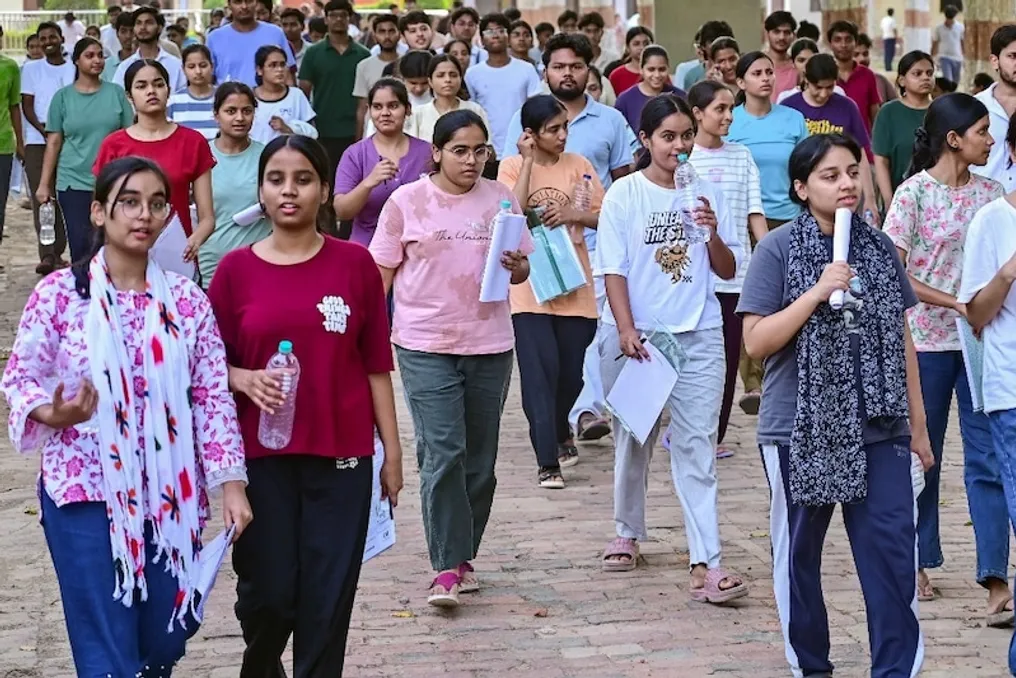
ABVP suggests that Nandan Nilekani Committee conduct NEET in two phases and twice a year
Read more
Aaj Tak
www.aajtak.in

ABVP suggests that Nandan Nilekani Committee conduct NEET in two phases and twice a year

In light of continuous irregularities, paper leaks, and technical issues in the competitive examination system, the Akhil Bharatiya Vidyarthi Parishad (ABVP) has taken a significant step. ABVP has presented a detailed roadmap to Nandan Nilekani, the chairman of the High Powered Task Force constituted by the central government, to make the examination system flawless and transparent.

ABVP's main proposal is to conduct major competitive exams, including NEET, in two phases and explore the possibility of holding the NEET exam twice a year.

This suggestion paper was not prepared solely in closed rooms but based on the opinions of students and experts across the country. The organization organized roundtables in Pune, Nagpur, Bhopal, Delhi, Chandigarh, and South Bihar, where direct dialogue was established with students and education experts. These discussions resulted in dividing the examination reforms into three categories: immediate, medium-term, and long-term changes.

ABVP's 5 Key Recommendations

The first phase should be a screening test, followed by a main examination in the second phase for final selection. Doing this will reduce the pressure and dependence on a single-day exam for students. Additionally, following the model of JEE Main, it should be explored the possibility of conducting NEET twice a year so that students have the opportunity to utilize their best scores.

The organization has demanded that the examination be made maximally Computer Based Test (CBT), strengthen the security of question papers, and establish a uniform national standard for examination centers across the country. It also pointed out the need to create a clear protocol for immediate re-examination in case of any technical or administrative lapse at any center. Furthermore, a 'Central Examination Dashboard' should be developed to ensure complete transparency in the answer key, normalization, and tie-breaking process.

Under long-term reforms, it has been suggested that the education at the school and college level be strengthened so much that students do not have to depend on coaching institutes. In this regard, Dr. Virendra Singh Solanki, National General Secretary of ABVP, commented that the examination system should be one that accurately assesses the student's hard work and ability, rather than subjecting them to uncertainty and stress due to administrative or technical failure.
Similar stories

IIT Madras launches 17 new online courses for 9th-12th grade students
Read more
www.aajtak.in

IIT Madras launches 17 new online courses for 9th-12th grade students

The question of what to study after finishing school and in which field to build a career often causes difficulties for students and their parents. Due to a lack of proper guidance or awareness, children often choose from a limited number of options. To solve this problem and link school education with higher education, the prestigious institute of the country, IIT Madras, has initiated a remarkable program.

The Center for Outreach and Digital Education (CODE) at IIT Madras has expanded the scope of its flagship project, the 'School Connect Program,' by launching 17 new online certification courses for students in grades 9-12.

This program is designed specifically for students in grades 9, 10, 11, and 12. Its main goal is to introduce students to the practical world and modern career opportunities that go beyond the standard curriculum. Thanks to this initiative by IIT Madras, schoolchildren from remote parts of the country will have the opportunity to receive high-quality education at the IIT level.

Students from partner schools can enroll in any of the 17 courses according to their preferences. Available fields include: 'Data Science and AI' (data science and artificial intelligence basics), 'Electronic Systems' (introduction to electronics and equipment), 'Architecture and Design' (basic principles of design and construction), 'Engineering Biological Systems', 'Fun with Math and Computing', 'Introduction to Law' (fundamentals of law), 'Math Unplugged' (studying mathematics through games and puzzles), 'Fundamentals of Aerospace' (space and aviation technologies), 'Introduction to Ecology' (ecology and environment), 'Humanities Unplugged', 'Chemical Engineering', 'Economics, Finance and Money Matters' (finance and economics management), 'Game Tech Explorers' (game technology and human-machine interaction), 'Product Design', 'Molecular Engineering', 'Cyber Security' (lessons in digital world safety), and 'Digital Humanities'.

Students from partner schools register for these courses. In addition to studying, they must complete assignments and take online exams. Students who successfully complete the course and pass the exam will be issued an official 'e-certificate' from IIT Madras.

The IIT Madras network is rapidly expanding: currently, 4920 schools across the country have joined the program, and over 175,270 students have registered to participate.

The application deadline is set for September 30, 2026, and classes are scheduled to begin on October 5, 2026.

The 'School Connect' program gives children the opportunity to understand their true interests—whether it be aerospace, product design, cybersecurity, or finance—many years before entering college, which helps avoid choosing an unsuitable major after graduating from the 12th grade.

Nadda announced withdrawal of cases against protesting students after FIR cancellation
Read more
timesofindia.indiatimes.com

Nadda announced withdrawal of cases against protesting students after FIR cancellation

Federal Minister JP Nadda announced on Tuesday that the government is fulfilling its promises regarding the withdrawal of legal cases initiated against students who participated in protests. He also welcomed the decision to cancel the protest scheduled for September 5th.

Nadda emphasized that in the interest of the future of students, the Indian government guaranteed the withdrawal of all registered cases and promised not to apply any harsh measures to them in the future.

The minister specified that to implement this promise, the Centre consulted with the state governments governed by the Bharatiya Janata Party.

Furthermore, the federal minister expressed approval of the decision announced by the press secretary of the Cockroach Janta Party (CJP) at a press conference concerning the cancellation of the action planned for September 5th.

He added that the development and progress of the youth remain the government's top priority.

CJP Co-chairman Saurav Das had previously stated during hearings in the Supreme Court that in light of the positive guarantees from the Indian government and the judicial significance, as well as considering the court's ruling, CJP deems it appropriate to withdraw the call for a march on September 5th and expects compliance with today's directive.

Popular